Agaricus arvensis Schaeff. - Horse Mushroom
Phylum: Basidiomycota - Class: Agaricomycetes - Order: Agaricales - Family: Agaricaceae
Distribution - Taxonomic History - Etymology - Toxicity - Identification - Culinary Notes - Reference Sources
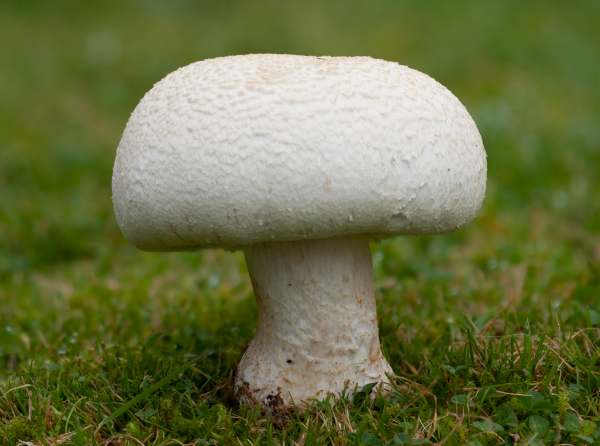
Roadside verges and permanent pasture are places where you will see this large, edible fungus - although if gathering mushrooms to eat it is not a good idea to include roadside specimens. Beware also of a toxic lookalike, the Yellow Stainer, which is also fond of roadside grassy habitats and can cause serious stomach upsets if included in a mushroom meal. Agaricus arvensis, the Horse Mushroom, first appears in summer, and these large fungi usually continue fruiting until the end of autumn.
Distribution
Fairly frequent in Britain and Ireland as well as in most countries of mainland Europe and parts of Asia and North America, the Horse Mushroom has also been reported from Australia (where it is sometimes referred to as the Almond Mushroom) as well as New Zealand.
Taxonomic history
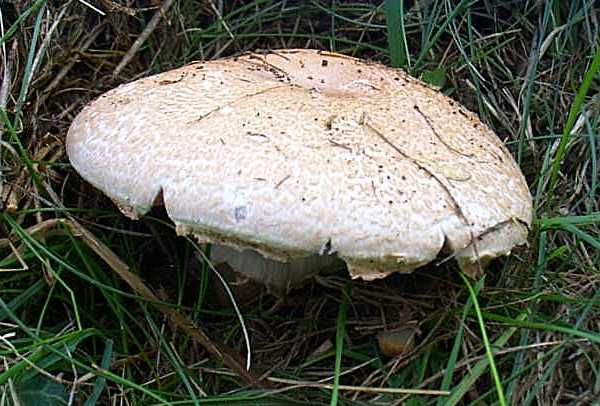
First described from Bavaria in 1762 by Jacob Christian Schaeffer, who gave it the name Agaricus arvensis (although like many mushrooms it later spent some time in the genus Psalliota before reverting to its original Agaricus home), the Horse Mushroom is a cosmopolitan mushroom.
Synonyns of Agaricus arvensis include Agaricus arvensis Schaeff., Psalliota arvensis (Schaeff.) Gillet, and Agaricus fissuratus F.H. Møller. (The latter is treated by some authorities as a separate species; it has a cap that crazes when old and its spores are on average somewhat smaller than is typical of Agaricus arvensis.)
Etymology
The specific epithet arvensis means 'of the field' or 'of meadows' - a reference to the habitat in which the Horse Mushroom is most commonly found. Less obviously, the common name may not be the more obvious to horses and its apparent appetite for horse manure (and hence the common occurrence of this mushroom near stables or fields in which horses graze) but, some people have suggested, an allusion to the large size that these mushrooms can attain.
In New Zealand this species is commonly known as the Snowball Mushroom.
Toxicity
There are reports that this edible and greatly prized mushroom tends to accumulate heavy metals such as copper and cadmium, and so if eaten it is best considered an occasional treat rather than a food-for-free bonanza in those years when grassland mushrooms are plentiful.
Identification guide
 |
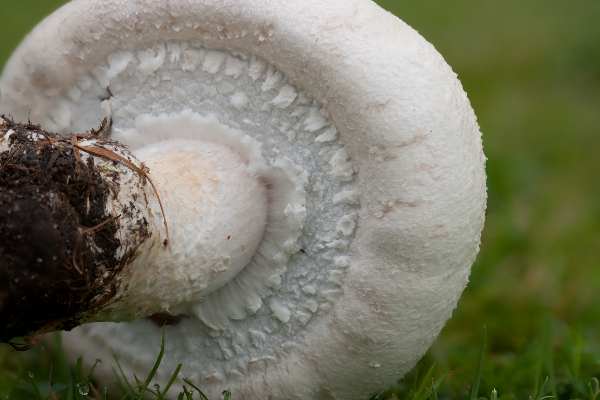
CapThe cap of Agaricus arvensis matures at 8 to 20cm (exceptionally to more than 30cm) diameter. White but yellowing gradually with age, smooth or finely scaly, the cap is initially spherical and expands until it is flat or nearly so. The thick flesh is white and firm. The cap turns yellowish where bruised, and old caps often take on a yellow-brown tinge. |
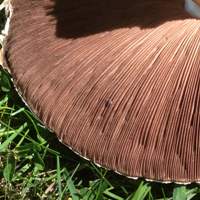 |
GillsAt first pale pink, darkening and then becoming brown, the gills of the Horse Mushroom are free and crowded. |
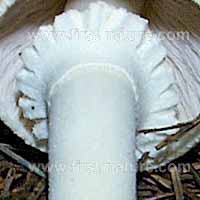 |
StemUp to 10cm tall, the parallel stem usually a small bulb at its base and a robust, double ring with a cog-wheel form on the underside. The solid stem is smooth above the ring but sometimes finely scaly below. Its diameter ranges from 2 to 3cm. When cut at the stem base, Agaricus arvensis does not rapidly turn bright yellow - a useful visual distinction between this edible mushroom and the poisonous Yellow Stainer, Agaricus xanthodermus, whose stem base turns chrome yellow as soon as its cut flesh is exposed to air. |
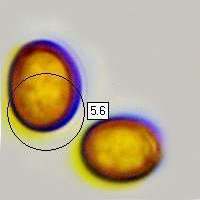 |
SporesEllipsoidal, smooth, 6-9 x 4-6µm. Spores of Agaricus arvensis Horse Mushroom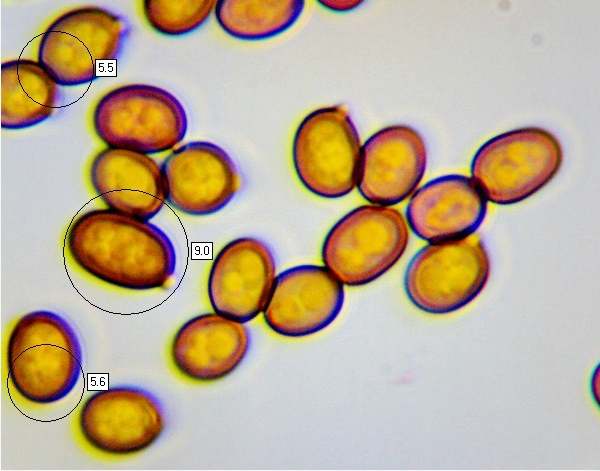 Spore printDark purple-brown. |
Odour/taste |
Taste not distinctive. Strong odour of aniseed. (The rather similar Yellow Stainer has an unpleasant phenolic or inky odour - a useful way of distinguishing between the edible Horse Mushroom, which also bruises slightly yellow, and that toxic toadstool Agaricus xanthodermus.) |
Habitat & Ecological role |
Agaricus arvensis appears in manured meadows and beside bridle paths and other places where there is plenty of decaying organic matter, upon which it feeds saprophytically. The Horse Mushroom is one of the largest and most distinctive fungi in its genus, often forms fairy rings many metres in diameter in permanent pastures. |
Season |
August to November, typically a week or two later than the Field Mushroom, Agaricus campestris, with which the Horse Mushroom is sometimes confused. |
Similar species |
The poisonous Yellow Stainer, Agaricus xanthodermus, quickly turns bright chrome yellow when cut or bruised, and it smells of iodine or ink rather than of aniseed. Agaricus urinascens var. urinascens (syn. Agaricus macrosporus) is very similar in appearance but does not turn bright chrome yellow when cut or bruised.; it grows in open grassland and in woodland clearings. The specific epithet of its older synonym refers to the large (for an Agaricus species) size of the spores this mushroom - typically 11 x 6µm - which also distinguishes it from the Yellow Stainer. |
Culinary Notes
The Horse Mushroom is a good edible species and can be used in any recipe calling for large (Portobello) cultivated mushrooms. It is great in rissotto dishes and omelettes, and it certainly has enough flavour to make tasty soups or sauces to be served with meat dishes.
The most important thing is to make absolutely sure that what you have found really is a Horse Mushroom and not a toxic toadstool such as a Yellow Stainer (Agaricus xanthodermus) or, heaven forbid, a Destroying Angel (Amanita virosa). The stem-base colour change resolves the former, and checking that the gills are pink or brown rather than white averts the latter potentially-fatal error. The cautious old mushroom gatherer's maxim is so important: 'Never munch on a hunch'. (There are not many incautious old mushroom gatherers!)
The Horse Mushroom at the closed-cup stage seen above and the specimen seen at the top of this page were photographed by Dave Kelly, with whose kind permission these picture are shown.
Reference Sources
Fascinated by Fungi, 2nd Edition, Pat O'Reilly 2016, reprinted by Coch-y-bonddu Books in 2022.
BMS List of English Names for Fungi
The genus Agaricus in Britain, 3rd Edition, self-published, Geoffrey Kibby 2011
Funga Nordica: 2nd edition 2012. Edited by Knudsen, H. & Vesterholt, J. ISBN 9788798396130
Dictionary of the Fungi; Paul M. Kirk, Paul F. Cannon, David W. Minter and J. A. Stalpers; CABI, 2008
Taxonomic history and synonym information on these pages is drawn from many sources but in particular from the British Mycological Society's GB Checklist of Fungi.
Acknowledgements
This page includes pictures kindly contributed by David Kelly.
Fascinated by Fungi. Back by popular demand, Pat O'Reilly's best-selling 450-page hardback book is available now. The latest second edition was republished with a sparkling new cover design in September 2022 by Coch-y-Bonddu Books. Full details and copies are available from the publisher's online bookshop...