
Agaricus bitorquis (Quél.) Sacc. - Pavement Mushroom
Phylum: Basidiomycota - Class: Agaricomycetes - Order: Agaricales - Family: Agaricaceae
Distribution - Taxonomic History - Etymology - Identification - Culinary Notes - Reference Sources
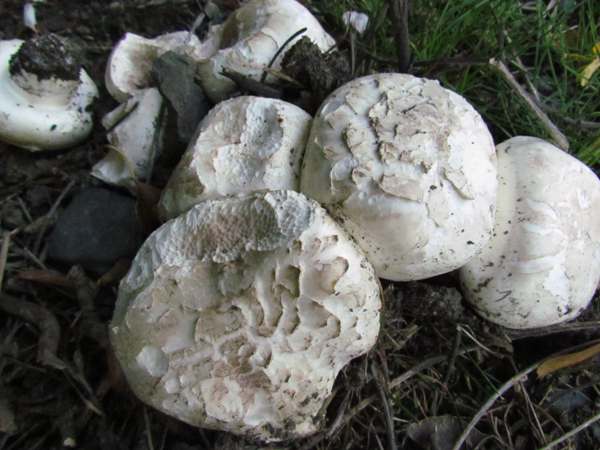
Agaricus bitorquis, commonly known as the Pavement Mushroom because it often appears on the edges of pavements and sometimes even erupts through asphalt or pushes open the gaps between paving slabs, is an edible mushroom.
Distribution
Pavement Mushrooms are uncommon to rare in most parts of Britain and Ireland, but where they do occur these mushrooms are more often seen in small groups rather than as singletons.
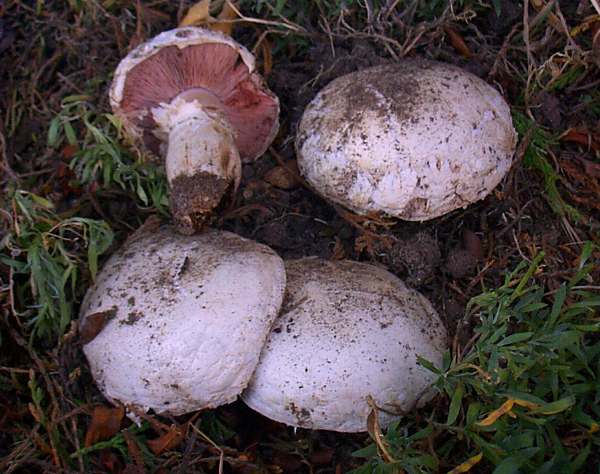
Agaricus bitorquis occurs also on mainland Europe and in parts of North America.
Taxonomic history
The specific name bitorquis was given to this mushroom by Lucien Quélet - often written as Quelet without the accent - in 1883 (published 1884), who called it Psalliota bitorquis. Italian mycologist Pier Andrea Saccardo (1845 - 1920) moved the Pavement Mushroom to its present genus Agaricus in 1887.
Synonyms of Agaricus bitorquis include Chitonia pecquinii Boud., Agaricus campestris var. edulis Vittad., Agaricus rodmanii Peck, Psalliota bitorquis Quél., Psalliota peronata Richon & Roze, Psalliota rodmanii (Peck) Kauffman, Psalliota edulis (Vittad.) Jul. Schäff. & F.H. Møller, Psalliota edulis var. valida F.H. Møller, and Agaricus bitorquis var. validus (F.H. Møller) Bon & Cappelli.
Etymology
The Latin word bitorquis means 'with two collars' - a reference to the double ring that results when the partial veil covering the young gills tears from the cap rim, leaving thin white annuli where the veil was attached at two regions of the stem, one high up and the other lower down.
Identification guide
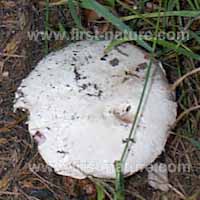 |
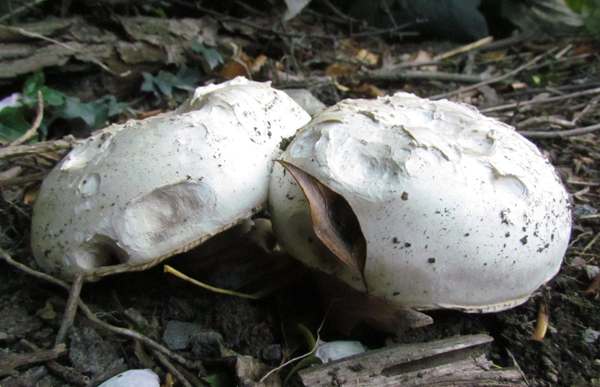
CapInitially convex and then becoming flattened, the surface of the cap of Agaricus bitorquis is white and finely flaky or scaly; the thick cap flesh is white, turning slightly pink on exposure to air. More often than not the cap surface is discoloured by earth, and in some instances these mushroom actually mature underground or with only a small part of the cap rim visible from above ground. At maturity, the cap diameter is between 5 and 10cm. |
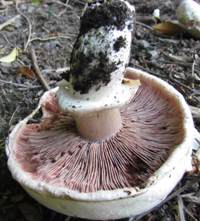 |
GillsThe free gills are narrow and densely spaced; pale pink when young, becoming, reddish-brown as the spores mature. StemCylindrical or narrowing slightly towards the apex and towards the slightly rooting base, stems are usually 4-6cm long and 2-4cm in diameter; a membranous double ring persists. |
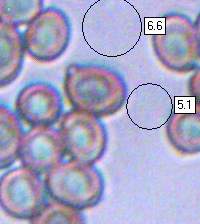 |
BasidiaMostly four-spored but some two-spored basidia may also be found. SporesSubglobose, 5-7 x 4-5.5µm. Spore printDeep chocolate brown. |
Odour/taste |
Not distinctive. |
Habitat & Ecological role |
Saprobic, on dry soil beside footpaths; occasionally it is to be seen pushing up through tarmac or in the gaps between paving slabs. |
Season |
Late spring to autumn. |
Similar species |
Agaricus bernardii is similar but can be distinguished from the Pavement Mushroom by its salty odour and the fact that its flesh reddens when cut. Agaricus campestris, the Field Mushroom, is somewhat similar in appearance but has a more substantial single ring; it is usually taller for the same cap diameter. |
Culinary Notes
There is nothing about the appearance or location of these often worm-ridden fungi that cries out 'eat me', and although often reported to be edible they are surely best left to drop their spores and then rot away.
Reference Sources
Fascinated by Fungi, 2nd Edition, Pat O'Reilly 2016, reprinted by Coch-y-bonddu Books in 2022.
BMS List of English Names for Fungi
The genus Agaricus in Britain, 3rd Edition, self-published, Geoffrey Kibby 2011
Funga Nordica: 2nd edition 2012. Edited by Knudsen, H. & Vesterholt, J. ISBN 9788798396130
Dictionary of the Fungi; Paul M. Kirk, Paul F. Cannon, David W. Minter and J. A. Stalpers; CABI, 2008
Taxonomic history and synonym information on these pages is drawn from many sources but in particular from the British Mycological Society's GB Checklist of Fungi.
Fascinated by Fungi. Back by popular demand, Pat O'Reilly's best-selling 450-page hardback book is available now. The latest second edition was republished with a sparkling new cover design in September 2022 by Coch-y-Bonddu Books. Full details and copies are available from the publisher's online bookshop...