
Agaricus impudicus (Rea) Pilát
Phylum: Basidiomycota - Class: Agaricomycetes - Order: Agaricales - Family: Agaricaceae
Distribution - Taxonomic History - Etymology - Identification - Culinary Notes - Reference Sources
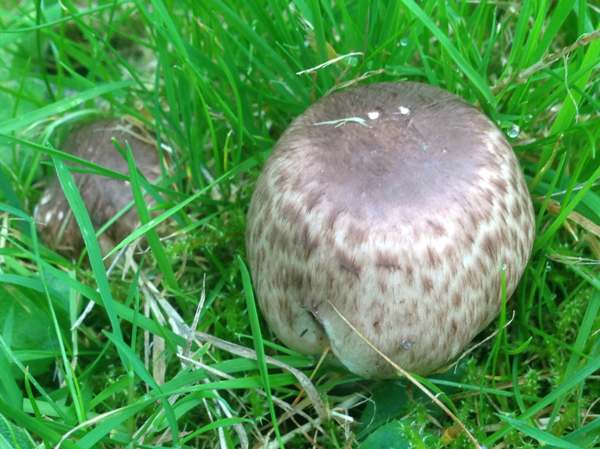
Agaricus impudicus is one of the many edible wood mushrooms, but it is far from remarkable for its flavour and so not much sought for by fungi foragers. This attractive species is widespread, but it is only an occasional find in many parts of Britain and Ireland.
Although they occur most often in groups beneath conifers, you may occasionally find these stately mushrooms also in deciduous woods and in mixed woodland.
Distribution
A fairly common woodland mushroom in Britain and Ireland, Agaricus impudicus occurs also in mainland Europe. The specimens shown on this page were photographed in England and Wales, UK.
Taxonomic history
First described in 1932 by the British mycologist Carleton Rea (1861 - 1946), one of the founders of the British Mycological Society, who gave this species the binomial scientific name Psalliota impudica, this saprobic woodland mushroom was transferred to the genus Agaricus in 1951 by Czech mycologist Albert Pilát (1903 - 1974), whereupon it acquired its currently-accepted scientific name Agaricus impudicus.
Synonyms of Agaricus impudicus include Psalliota impudica Rea, Psalliota variegata F.H. Møller, Agaricus variegatus (F.H. Møller) Pilát, Agaricus variegans F.H. Møller, Psalliota variegata var. koelerionis Bon, and Agaricus koelerionensis (Bon) Bon.
Etymology
The specific epithet impudicus is Latin for 'shameless' or 'immodest'.
Identification guide
 |
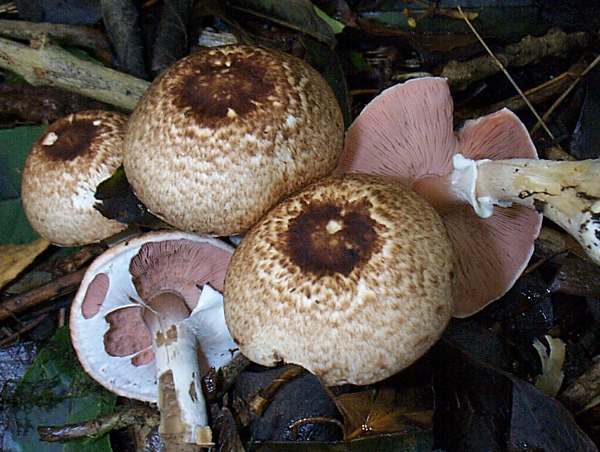
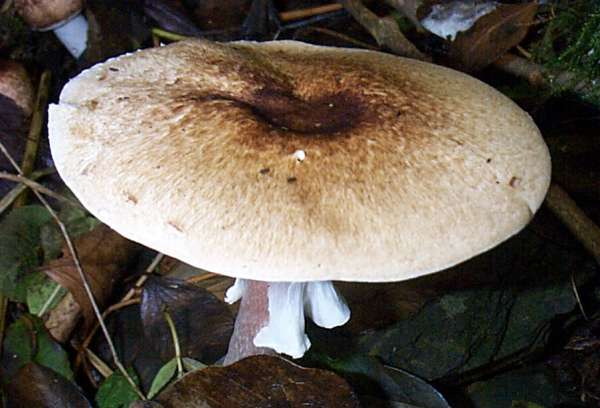
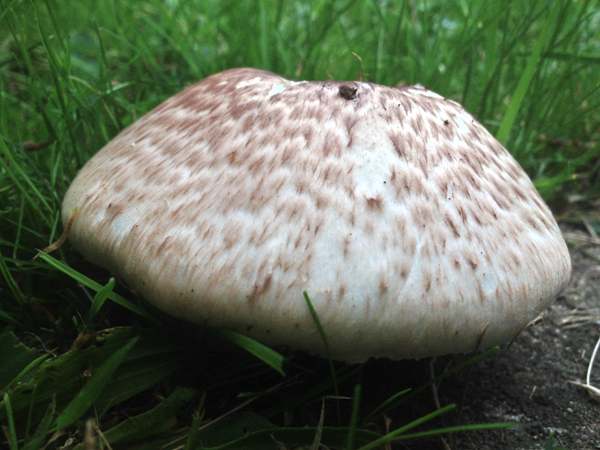
Cap5 to 10cm across; initially convex, often becoming flat topped as it expands; large scales usually in various shades of dark brown on a pale brown background; whitish flesh either slowly turning very slightly red or unchanging when cut. |
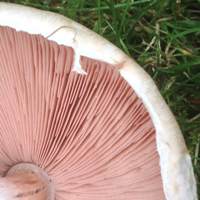 |
GillsFree; crowded; greyish pink, turning brown with age. Stem6 to 10cm long and 0.8 to 1.2 cm dia., with a slightly bulbous base; white pendulous ring; surface smooth and white, turning brown with age. |
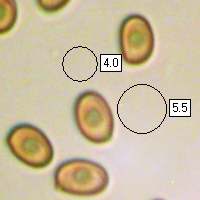 |
SporesEllipsoidal to ovoid, smooth, 4-6.7 x 3.7-4.5µm. Show larger imageSpores of Agaricus impudicus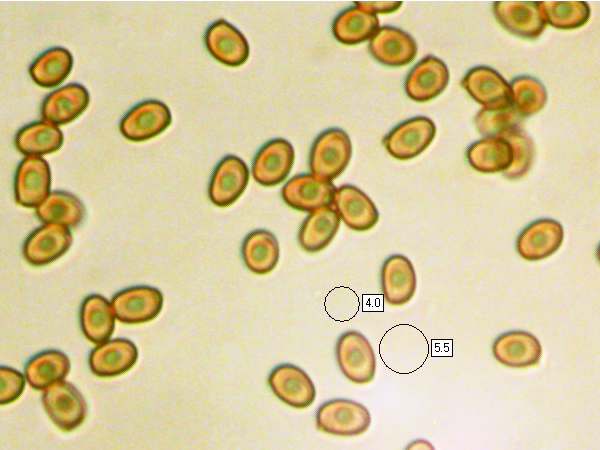 Spore printChocolate brown. |
Odour/taste |
Odour strong, unpleasant, reminiscent of radish; taste earthy-mushroomy, unpleasant. |
Habitat & Ecological role |
Saprobic, usually in groups in conifer forests and mixed woodland. |
Season |
August to November in Britain and Ireland. |
Similar species |
Agaricus haemorrhoidarius is very similar, with grey-brown scales and a stouter stem; it occurs under broad-leaved trees, notably oak and beech. Agaricus augustus, The Prince, is larger and smells of bitter almonds. |
Culinary Notes
In Italy, where Agaricus impudicus is a very common mushroom of pine forests, this is considered a good edible species.
Reference Sources
Fascinated by Fungi, 2nd Edition, Pat O'Reilly 2016, reprinted by Coch-y-bonddu Books in 2022.
Kibby, G. (2011) The genus Agaricus in Britain, 3rd Edition, published by Geoffrey Kibby
BMS List of English Names for Fungi
Funga Nordica: 2nd edition 2012. Edited by Knudsen, H. & Vesterholt, J. ISBN 9788798396130
Dictionary of the Fungi; Paul M. Kirk, Paul F. Cannon, David W. Minter and J. A. Stalpers; CABI, 2008
Taxonomic history and synonym information on these pages is drawn from many sources but in particular from the British Mycological Society's GB Checklist of Fungi.
Acknowledgement
This page includes pictures kindly contributed by Simon Harding.
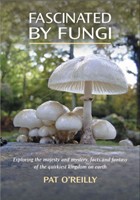
Fascinated by Fungi. Back by popular demand, Pat O'Reilly's best-selling 450-page hardback book is available now. The latest second edition was republished with a sparkling new cover design in September 2022 by Coch-y-Bonddu Books. Full details and copies are available from the publisher's online bookshop...