
Amanita citrina var. citrina (Schaeff.) Pers. - False Deathcap
Phylum: Basidiomycota - Class: Agaricomycetes - Order: Agaricales - Family: Amanitaceae
Distribution - Taxonomic History - Etymology - Identification - Culinary Notes - Reference Sources
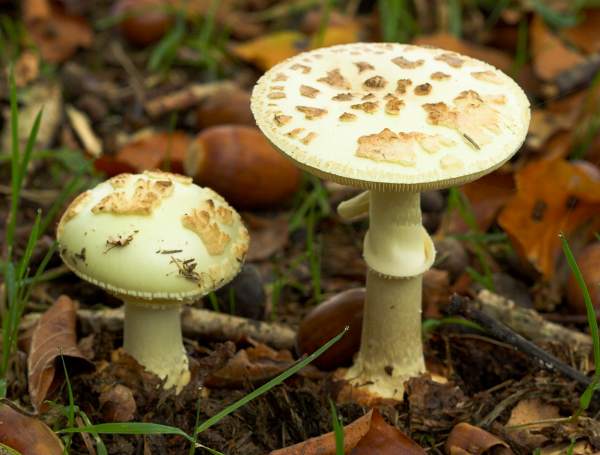
Amanita citrina, often referred to as the False Deathcap (sometimes written False Death Cap), is an inedible fungus, although not reported to be seriously toxic. In any case great care is necessary because it is easily confused with deadly poisonous Amanita species such as the Destroying Angel.
Distribution
Found throughout most of Britain and Ireland, Amanita citrina is very common in some places.
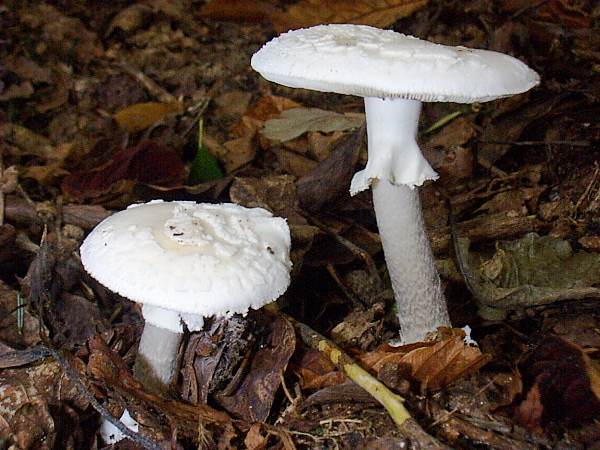
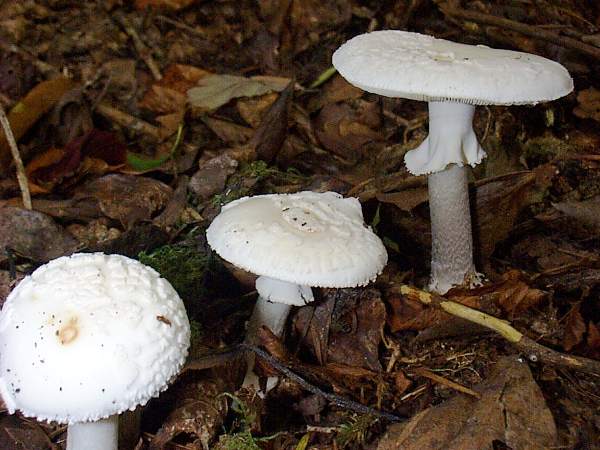
Above: Amanita citrina var. alba
This species is also seen frequently across most of mainland Europe and is reported from parts of North America, where it is also quite common.
Taxonomic history
Jacob Christian Schaeffer described this mycorrhizal woodland mushroom in 1762 and named it Agaricus citrinus. (Most of the gilled mushrooms were included initially in the genus Agaricus, the contents of which has since been largely dispersed into many other newer genera.) Christiaan Hendrik Persoon renamed this species Amanita citrina in 1797. Synonyms of Amanita citrina include Agaricus citrinus Schaeff., Agaricus mappa Batsch, and Amanita mappa (Batsch) Bertill.
Etymology
The specific epithet citrina is a reference to the lemon-yellow (citrine) tinge of the caps.
For a detailed description of the Amanita genus and identification of common species see our Simple Amanita Key...
Identification guide
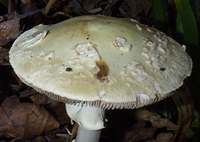 |
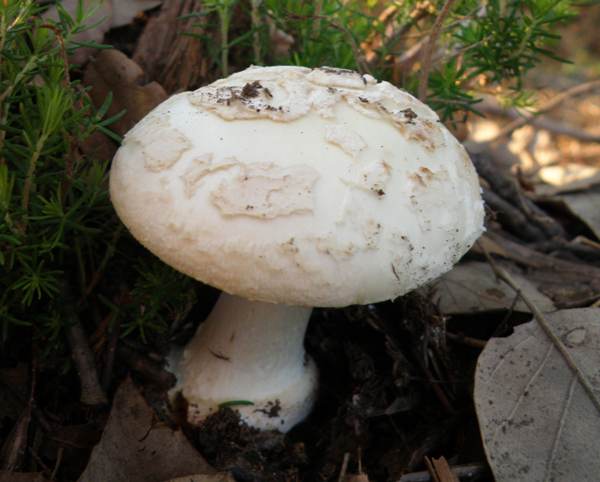
Cap of Amanita citrina var. citrina5 - 10cm diameter; usually lemon-yellow with large veil fragments that are brilliant white, as shown in the picture on the left. Initially rounded, the cap usually flattens at maturity. |
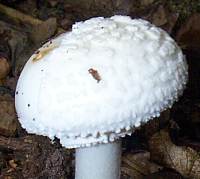 |
Cap of Amanita citrina var. albaAn all-white variant is also quite common - Amanita citrina var. alba (Gillet) Rea. The var. alba False Deathcap generally has a larger cap (up to 12cm diameter compared with 5 to 10cm for the more common lemon variety, and its stem is also white rather than lemon-yellow. Some authorities consider this to be a separate species rather than just a variety. |
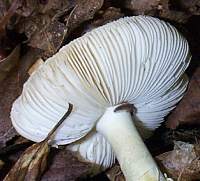 |
GillsThe gills of Amanita citrina are white, free and crowded. |
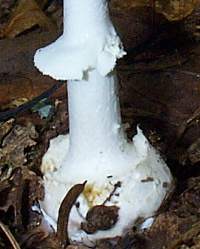
StemWhite; typically 5 - 8cm long and rising from a very large, white volva that encloses an abrupt basal bulb. There is a gutter-like ridge at the top of the volva, which adheres to the stem base rather than forming a loose bag around the base. The large stem-ring of the False Deathcap hangs down slightly; it usually remains intact through to maturity. |
|
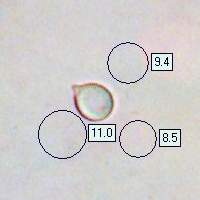
SporesSpherical (or very nearly so), smooth, 6.5 - 10µm; amyloid. Spores of Amanita citrina, False Deathcap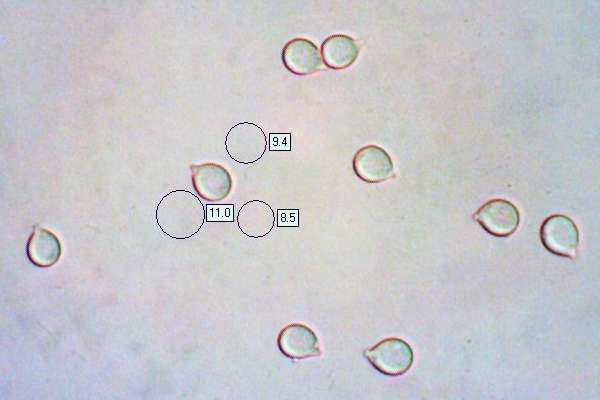 Spore printWhite. |
|
Odour/taste |
The flesh of young specimens of this mushroom smells rather like a cut raw potato (or, ssome say, like a cut radish); older fruitbodies, in my experience, often have very little in the way of a discernable odour. |
Habitat & Ecological role |
Ectomycorrhizal with hardwood and softwood trees but particularly often found under beech trees, Amanita citrina is very common in mixed woodland on alkaline or neutral soil. These attractive mushrooms seem to be much less common in areas where the soil is strongly acidic. |
Season |
August to November in Britain and Ireland. |
Similar species |
Amanita virosa, the Destroying Angel, rarely retains veil fragments on its cap through to maturity, the cap remains somewhat domed, its stem-ring is usually high up and not very substantial, and it does not have a sharp smell. Amanita phalloides, the Deathcap, rarely retains veil fragments on its cap, and it develops a sickly-sweet odour as it matures. |
Culinary Notes
Amanita citrina is now known to contain the toxin alpha-amanitin; however, if eaten in normal amounts it is considered the concentration is so low that it is unlikely to have any significant effect on a healthy adult. Of far greater risk is the possibility of confusion with one of the deadly Amanita species such as the Deathcap, Amanita phalloides, or the Destroying Angel, Amanita virosa. For this reason our advice is not to eat Amanita citrina, whether it is raw or cooked.
The splendid False Deathcap shown above was photographed in Scotland's Caledonian Forest, where it is sometimes confused with the deadly poisonous Destroying Angel Amanita virosa, which is quite common in central and northern Scotland. (Amanita virosa is only rarely seen further south in Britain, where the False Deathcap Amanita citrina is much more common).
Reference Sources
Fascinated by Fungi, 2nd Edition, Pat O'Reilly 2016, reprinted by Coch-y-bonddu Books in 2022.
Funga Nordica: 2nd edition 2012. Edited by Knudsen, H. & Vesterholt, J. ISBN 9788798396130
BMS List of English Names for Fungi
Geoffrey Kibby, (2012) Genus Amanita in Great Britain, self-published monograph.
Paul M. Kirk, Paul F. Cannon, David W. Minter and J. A. Stalpers (2008). Dictionary of the Fungi; CABI
Taxonomic history and synonym information on these pages is drawn from many sources but in particular from the British Mycological Society's GB Checklist of Fungi.
Acknowledgements
This page includes pictures kindly contributed by David Kelly.
Fascinated by Fungi. Back by popular demand, Pat O'Reilly's best-selling 450-page hardback book is available now. The latest second edition was republished with a sparkling new cover design in September 2022 by Coch-y-Bonddu Books. Full details and copies are available from the publisher's online bookshop...