
Amanita ovoidea (Bull.) Quél. - Bearded Amanita
Phylum: Basidiomycota - Class: Agaricomycetes - Order: Agaricales - Family: Amanitaceae
Distribution - Taxonomic History - Etymology - Identification - Culinary Notes - Reference Sources
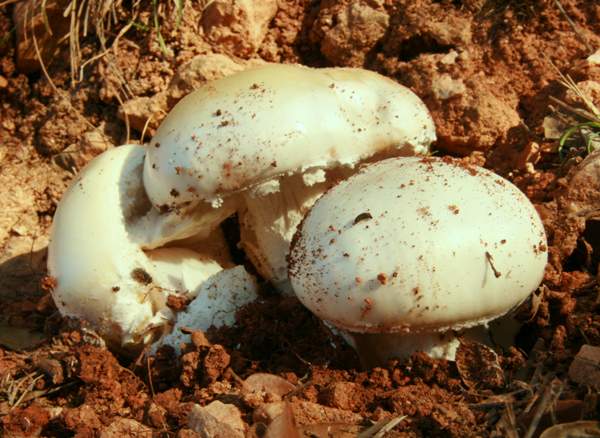
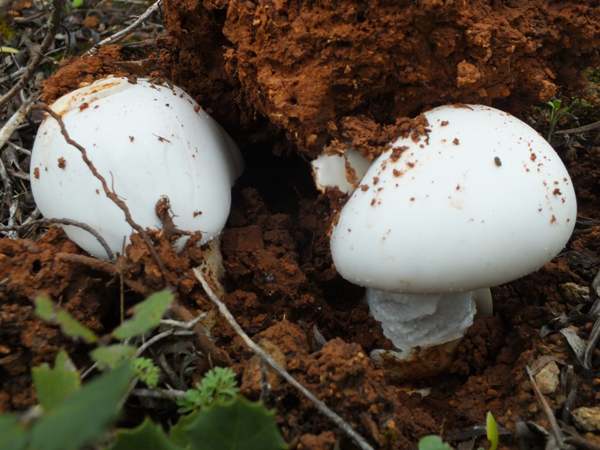
Mainly mushrooms of warm southern European countries, at first glance these chunky Amanita fungi could easily be mistaken for white forms of the Deathcap, but the large veil fragments around the cap rim are a helpful distinguishing feature. Amanita ovoidea is sometimes referred to as the European Egg Amidella.
Reportedly edible, this is a dangerous Amanita because it is so similar in appearance to deadly poisonous species from the same genus; it is also rare in Britain and so should not be picked.
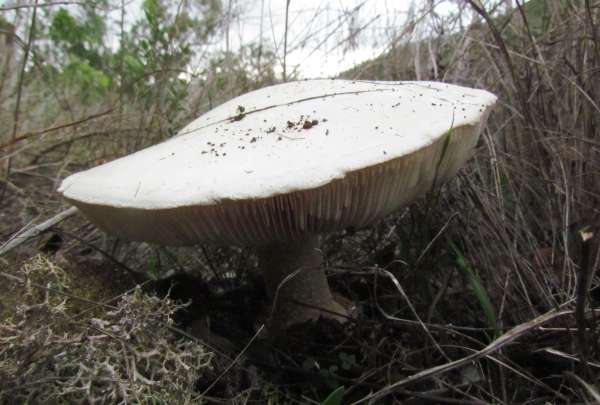
Unlike most other large Amanita species, the Bearded Amanita maintains its 'button mushroom' shape for a long time after it has reached its full size, and usually the caps do not flatten completely out even when fully mature.
For a detailed description of the Amanita genus and identification of common species see our Simple Amanita Key...
Distribution
The Bearded Amanita is an infrequent on mainland Europe, where it is a southern species. This species is extremely rare in Britain, where it has been reported only from Wiltshire and the Isle of Wight; it has not yet been recorded from Ireland.
In common with all European Amanita species, this is a mycorrhizal mushroom and in my experience it is most likely to be found in association with either evergreen or deciduous Quercus (oak) tree species, although I have also found these chunky toadstools beneath olive trees.
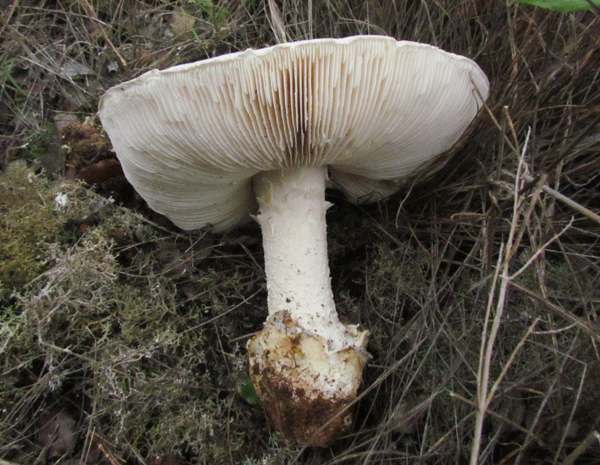
The Bearded Amanita specimens shown on this page were found under Cork Oaks and olive trees in the Algarve region of southern Portugal during November and December.
Taxonomic history
First decribed in 1788 by French botanist-mycologist Jean Baptiste Francois (Pierre) Bulliard and given the name Agaricus ovoideus, in 1872 the Bearded Amanita was transferred to its present genus by Lucien Quélet, who renamed it Amanita ovoidea. Some authorities place Amanita ovoidea in a subsection of the Amanita genus known as Amidella.
Etymology
The specific epithet ovoidea is simply a reference to the egg-shaped form of young fruitbodies. (The surface of a young cap looks very much like the white shell of a chicken's egg!)
Identification guide
 |
CapAmanita ovoidea caps are 8 to 25cm in diameter; the cap remains closed for a long time before becoming hemispherical nad eventually broadly convex at maturity (rarely flattening entirely); white or cream and smooth but with veil fragments hanging from the rim (hence the common name Bearded Amanita) once the veil has fractured. The cap flesh is white. |
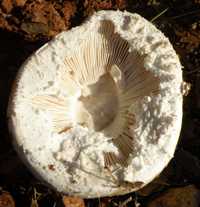 |
GillsWhite, free and crowded, sometimes developing a pinkish tinge when very old. |
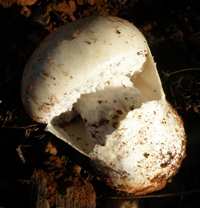 |
Stem8 to 15cm tall and typically 2cm in diameter; pure white and covered in white scales; an insubstantial ring, high up on the stem, is usualy short lived. The fibrous stem flesh of Amanita ovoidea is white and unchangig when cut and exposed to air. VolvaThe large, sack-like volva is creamy white, turning ochraceous with age; it is usually buried deep in the soil. |
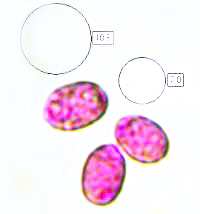 |
SporesBroadly ellipsoid, 10–12 x 6.5–7.5μm; amyloid. Spores of Amanita ovoidea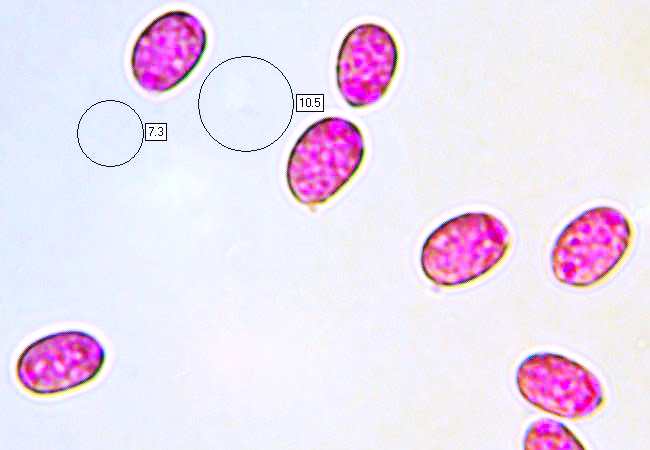 Spore printWhite. |
Odour/taste |
Slightly sweet odour at maturity; easily confused with deadly poisonous Amanita species such as the Destroying Angel and so tasting is definitely not recommended unless you are very experienced (and very hungry!). |
Habitat & Ecological role |
Ectomycorrhizal; found under deciduous trees, notably oaks, on alkaline soil. |
Season |
August to October in Britain but through to December or even into the New Year in some southern European countries. |
Similar species |
Amanita citrina var. alba usually retains velar fragments on the cap; it has the sharp smell of new potatoes rather than a sweet sickly odour. Amanita virosa is taller and slimmer with a less chunky volva; it also lacks the marginal veil fragments and is largely confined to northern regions where Amanita ovoidea is not likely to be found. |
Culinary Notes
In some Mediterranean countries where these large mushrooms are fairly common, Amanita ovoidea is a highly-prized edible mushroom and is often served either whole or sliced with meat dishes, including beef steak. Morels and Chanterelles are, in our opinion, much better suited to that purpose and their survival is unlikely to be threatened by us picking a few as a treat now and then - the best way to treat edible wild mushrooms, surely.
Recently doubts have been cast on the advisability of eating Amanita ovoidea, following a case of poisoning in Italy. We say don't eat these fungi!
Reference Sources
Fascinated by Fungi, 2nd Edition, Pat O'Reilly 2016, reprinted by Coch-y-bonddu Books in 2022.
Funga Nordica: 2nd edition 2012. Edited by Knudsen, H. & Vesterholt, J. ISBN 9788798396130
BMS List of English Names for Fungi
Geoffrey Kibby, (2012) Genus Amanita in Great Britain, self-published monograph.
Paul M. Kirk, Paul F. Cannon, David W. Minter and J. A. Stalpers (2008). Dictionary of the Fungi; CABI
Taxonomic history and synonym information on these pages is drawn from many sources but in particular from the British Mycological Society's GB Checklist of Fungi.

Fascinated by Fungi. Back by popular demand, Pat O'Reilly's best-selling 450-page hardback book is available now. The latest second edition was republished with a sparkling new cover design in September 2022 by Coch-y-Bonddu Books. Full details and copies are available from the publisher's online bookshop...