
Amanita virosa (Fr.) Bertill. - Destroying Angel
Phylum: Basidiomycota - Class: Agaricomycetes - Order: Agaricales - Family: Amanitaceae
Distribution - Taxonomic History - Etymology - Toxicity - Poisoning - Identification - Reference Sources
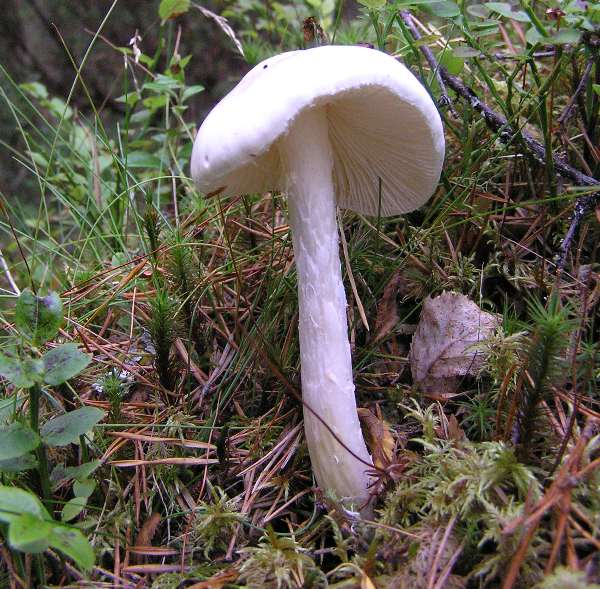
Commonly referred to as the Destroying Angel, Amanita virosa is a deadly poisonous fungus.
Distribution
The Destroying Angel is found infrequently in the lowlands but is more plentiful in mountainous areas in Britain and Ireland. It is not uncommon in low lying areas in northern Scotland and is a very common find in Scandinavian conifer forests (of whichb there are many!).
In northern Europe Destroying Angels usually appear in July, August and September. A similar species, Amanita verna, commonly known as Fool’s Mushroom, appears in springtime. These two pure white amanitas are almost impossible to distinguish from macroscopic characteristics alone, but if you are into chemical testing then it is worth noting that Amanita verna does not react to potassium hydroxide (KOH) whereas the flesh of Amanita virosa instantly turns yellow.
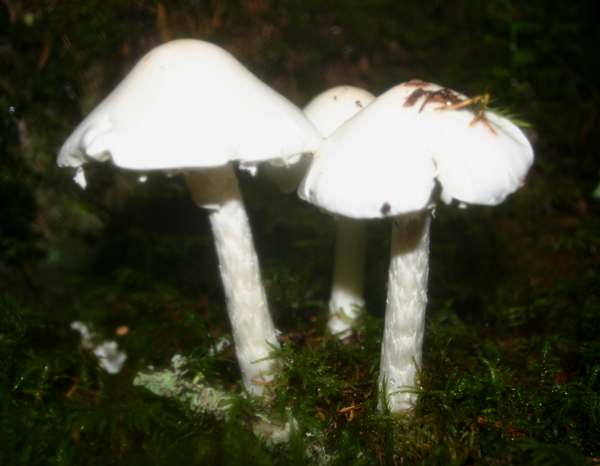
For most people the different fruiting times of Amanita virosa and Amanita verna are fairly conclusive. In any case separating the two is not everyone's objective: Destroying Angels are not fungi that anyone would want to collect as food!
For a detailed description of the Amanita genus and identification of species see our Simple Amanita Key...
Taxonomic history
Originally described from Sweden by Elias Magnus Fries, and named Agaricus virosus (most gilled fungi were initially placed in a giant Agaricus genus, now redistributed to many other genera), the presently accepted scientific name Amanita virosa dates from an 1836 publication by French statistician Louis-Adolphe Bertillon (1821 - 1883) in Dechambre, Dict. Encyclop. Sci. Médic. 3: 497.
Etymology
The common name Destroying Angel is applied also in North America to two other fairly common members of the genus Amanita. They are Amanita bisporigera and Amanita ocreata, which are most commonly found in in eastern North America and western North America respectively. (In France, Amanita verna is a fairly frequent find, and it too goes by the common names of Spring Amanita or, again, Destroying Angel.)
Toxicity
It's worth restating that all of these pure white Amanita fungi contain the same deadly toxins as are found in Amanita virosa, the Destroying Angel, and Amanita phalloides, the Deathcap (or Death Cup, as it is more generally known in North America). Unlike Amanita phalloides, however, not only is Amanita virosa pure white, like the supermarket button mushroom, but it also looks gorgeous and it does not have the repulsive smell that, to anyone with a nose, should betray the evil within a mature Deathcap.
Symptoms of poisoning by Amanita virosa
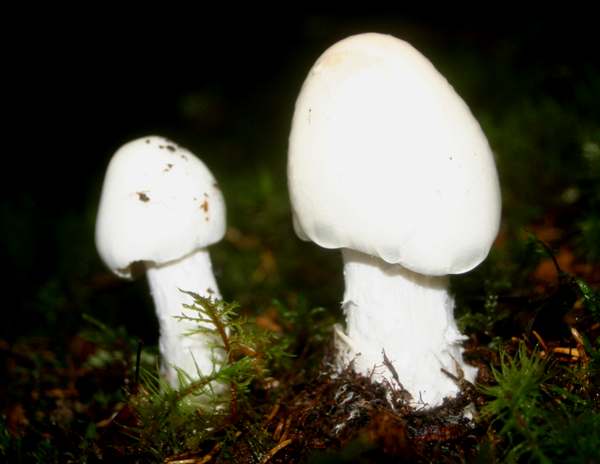
Destroying Angels contain a complex group of poisonous substances called amatoxins. Contained not only in certain amanitas but also in some fungi from the genera Galerina, Lepiota and Conocybe, amatoxins initially cause gastrointestinal disorders with symptoms such as diarrhea, nausea and stomach pains occurring within five to twelve hours. Cruelly, the symptoms usually fade away for several hours or even a day or two, tricking the victim into thinking that they are recovering. When in due course the symptoms return with a vengeance, it may well be too late: kidney and liver damage is already underway. Without treatment, coma and eventual death are almost inevitable.
Often, people hospitalised late into a poisoning episode can be saved only by major surgery and a liver transplant, and even then recovery is a precarious, painful and protracted process.
Avoiding the risk of poisoning
Anyone gathering mushrooms to cook and eat needs to be able to identify this poisonous amanita fungus and to distinguish between a young Destroying Angel and an edible Agaricus mushroom such as the Wood Mushroom, Agaricus sylvicola, which occurs in the same habitat as Amanita virosa, or the Field Mushroom, Agaricus campestris, which is often found in fields bordered by deciduous trees with which Amanita virosa can be associated. Destroying Angels at the button stage could also be mistaken for edible puffballs such as Lycoperdon perlatum, the Common Puffball, or Lycoperdon pyriforme, the Stump Puffball; however, if the fruitbody is cut in half longitudinally the volva of Amanita virosa, the Destroying Angel, would immediately become apparent.
One piece of advice that I received many years ago has helped me to enjoy eating wild mushrooms while avoiding the risks of poisoning by deadly Amanita toadstools: before even bothering to learn about the key identification features of the world's best edible fungi - and there are plenty of them - take the trouble and make the time to learn to identify, without any shadow of doubt, the two most deadly fungi on earth: Amanita virosa and its close allies that are all commonly referred to as the Destroying Angels, and Amanita phalloides, variously known as the Death Cap, Deathcap or Death Cup. In the meantime, 'never eat a Amanita' seems to be a pretty good maxim, and especially when applied to white members of the Amanita genus.
Identification guide
 |
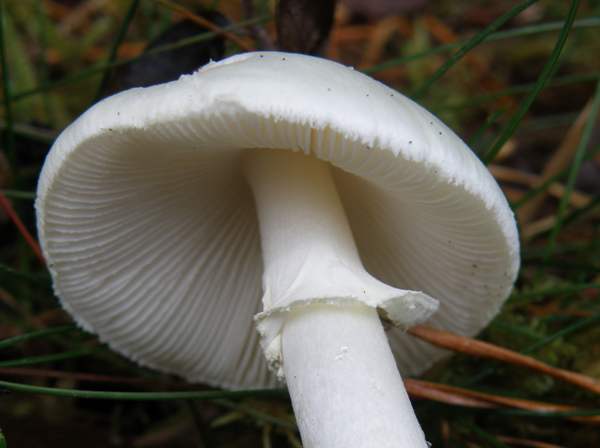
CapCaps of the Destroying Angel are 5 to 10cm in diameter, pure white, and without any marginal striations. The cap is initially egg-shaped and then campanulate (bell shaped) or occasionally almost flat but with a broad umbo, and is often tilted on the stipe. Although some young caps carry white remains of the universal veil, they soon wash off in wet weather and are rarely seen on mature caps. |
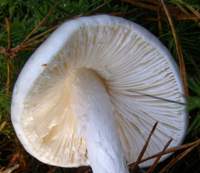 |
GillsAmanita virosa gills are white, free and crowded. |
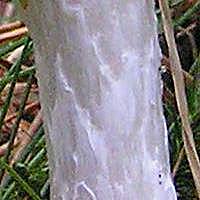 |
StemStems of Destroying Angels are 9 to 15cm tall, 0.6 to 2cm in diameter, and often slightly curved; pure white and fibrous with an ungrooved, fragile ring high up on the stipe. The large, sack-like volva is usually buried deep in the soil. |
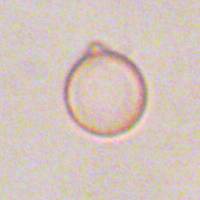 |
SporesSpherical or subglobose, 7-8μm in diameter. Spore printWhite. |
Odour/taste |
Mature specimens have a faint sickly and unpleasant odour (easily missed, especially in the outdoors on breezy days). Because this mushroom is deadly poisonous it must not be tasted. |
Habitat & Ecological role |
Often found at the edge of deciduous or mixed woodland, Amanita virosa is more common at higher altitude. |
Season |
August to November in Britain. |
Similar species |
Amanita citrina var. alba usually retains velar fragments on the cap; it has the sharp smell of new potatoes rather than a sweet sickly odour. Young caps of Amanita virosa could be collected by accident when gathering edible Agaricus species such as Agaricus sylvicola, the Wood Mushroom; gills of Amanita virosa are pure white, whereas the Agaricus species have gills that are initially pink and later turn brown. |
Reference Sources
Fascinated by Fungi, 2nd Edition, Pat O'Reilly 2016, reprinted by Coch-y-bonddu Books in 2022.
Funga Nordica: 2nd edition 2012. Edited by Knudsen, H. & Vesterholt, J. ISBN 9788798396130
BMS List of English Names for Fungi
Geoffrey Kibby, (2012) Genus Amanita in Great Britain, self-published monograph.
Paul M. Kirk, Paul F. Cannon, David W. Minter and J. A. Stalpers (2008). Dictionary of the Fungi; CABI
Taxonomic history and synonym information on these pages is drawn from many sources but in particular from the British Mycological Society's GB Checklist of Fungi.
Fascinated by Fungi. Back by popular demand, Pat O'Reilly's best-selling 450-page hardback book is available now. The latest second edition was republished with a sparkling new cover design in September 2022 by Coch-y-Bonddu Books. Full details and copies are available from the publisher's online bookshop...