Armillaria gallica Marxm. & Romagn. - Bulbous Honey Fungus
Phylum: Basidiomycota - Class: Agaricomycetes - Order: Agaricales - Family: Physalacriaceae
Distribution - Taxonomic History - Etymology - Identification - Toxicity - Reference Sources
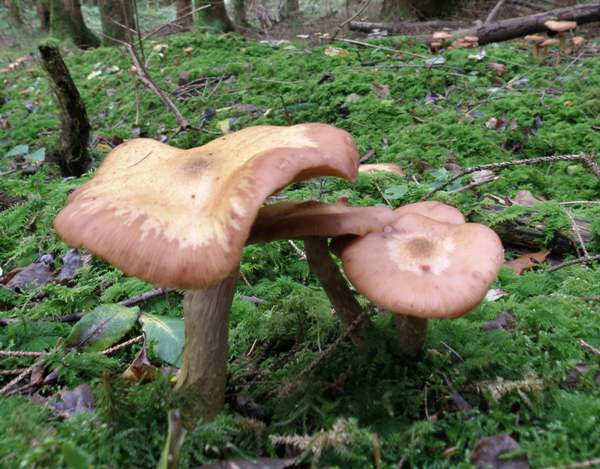
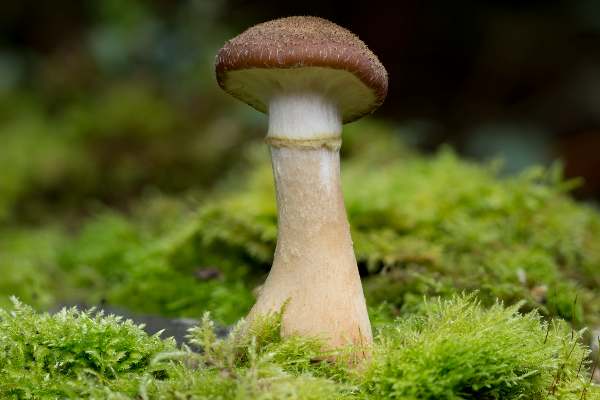
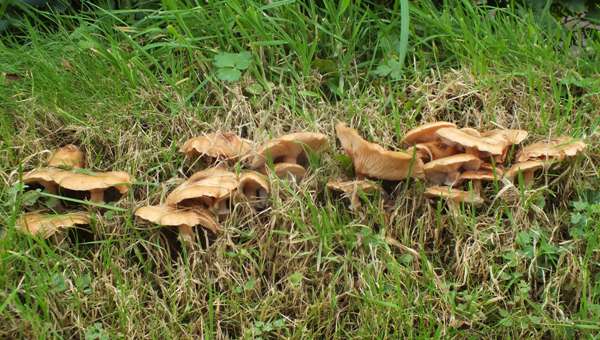
There are many forms of Honey Fungus, and in the past they all shared the scientific name Armillaria mellea. Nowadays it is generally accepted that there are several distinct species, one of which, Armillaria gallica, is distinguished by having a bulbous or swollen stem base.
Armillaria gallica is on average a little smaller and usually darker than Armillaria mellea, and its pallid stem ring is insubstantial and usually not evident on fully mature specimens..
Distribution
This species is an uncommon find in Britain and Ireland; it occurs also in most parts of central and southern mainland Europe and in North Africa as well as parts of Asia and North America (where it is often referred to as the Bulbous Honey Mushroom).
Taxonomic history
This species, formerly recorded in many field guides as a form of Armillaria mellea, was described in 1987 by Helga Marxmüller and Henri Romagnesi (1912 - 1999), who gave it the currently-accepted binomial scientific name Armillaria gallica.
Synonyms of Armillaria gallica include Armillaria bulbosa (Barla) Kile & Watling, Armillaria inflata Velen., Armillariella bulbosa (Barla) Romagn., and Armillaria lutea Gillet.
Etymology
The specific epithet gallica comes from the Latin noun Gallia which means that it is French; France is indeed the geographical location (known as the type locality) where the type specimen of Armillaria gallica came from.
Toxicity
Although all Armillaria species were for many years generally considered edible when thoroughly cooked, members of the honey fungus group (including Armillaria mellea, the type species of this genus) that occur on hardwoods are considered by some to be suspect, as cases of poisoning have been linked to eating these fungi; this is most probably due to a small but significant proportion of people being adversely affected rather than a universal human reaction to these fungi. We therefore recommend that Armillaria gallica is not collected for the pot.
Identification guide
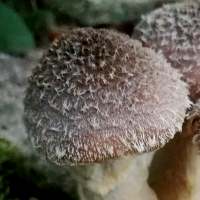 |
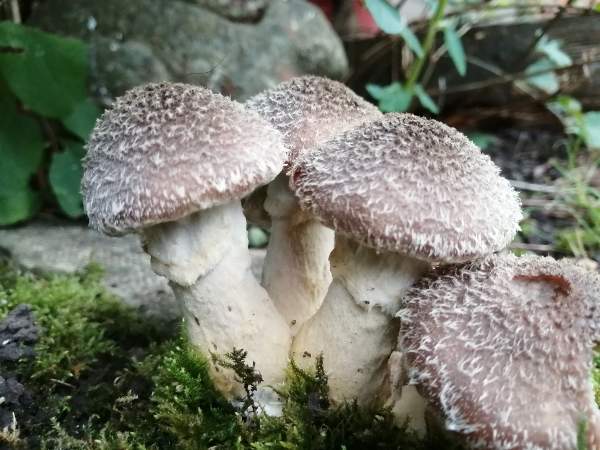
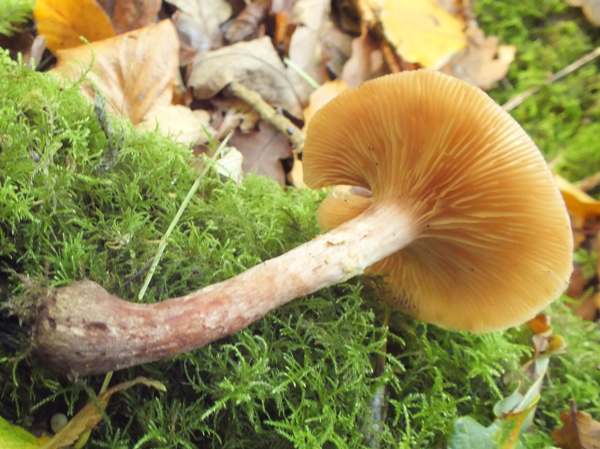
Cap4 to 10cm in diameter; colour ranging from ochre-brown to red-brown, usually somewhat darker near the centre. The cap flesh is white and firm. Initially convex with inrolled margins, the caps flatten and become slightly depressed with slightly wavy margins. Fine brown scales with darker tips cover the cap surfaces. |
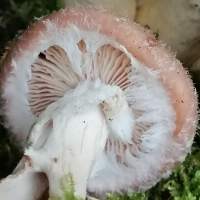 |
GillsThe adnate or weakly decurrent gills are crowded and initially almost white and covered by a fleeting cottony partial veil, the gills becoming increasingly yellowish-brown at maturity. |
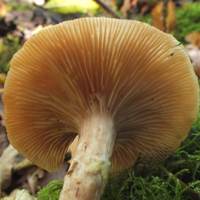 |
StemWhite at the apex; colour as cap below the ring zone, darkening as the fruitbody matures; 5 to 10mm in diameter and 5 to 12cm tall; bulbous towards the base where stems usually emerge from the substrate in clusters. The stem flesh is whitish, and there is a short-lived cobweb-like ring (reminiscent of the cortina characteristic of the genus Cortinarius) that collapses to leave a yellowish ring zone on the stem. |
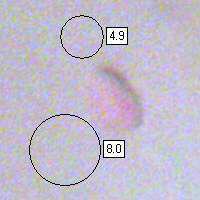 |
SporesEllipsoidal, smooth, 7-8.5 x 5-6µm; amyloid. Spores of Armillaria gallica, Bulbous Honey Fungus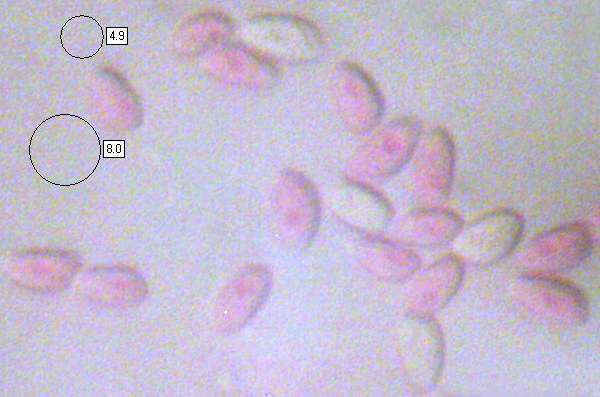 Spore printWhite or very pale cream. |
Odour/taste |
Sweet odour but sometimes with a bitter taste. |
Habitat & Ecological role |
Saprobic on woodland litter, dead stumps and buried rotting wood of broad-leaf trees; very occasionally found under conifers. |
Season |
June to November in Britain and Ireland. |
Similar species |
Armillaria mellea, commonly referred to as Honey Fungus, is larger and paler but it has a persistent stem ring. Pholiota squarrosa is generally similar in colour and covered in scales; it retains an in-rolled margin, the gills turn uniformly rusty-brown, and it has a radish-like smell and taste. |
Reference Sources
Fascinated by Fungi, 2nd Edition, Pat O'Reilly 2016, reprinted by Coch-y-bonddu Books in 2022.
Pegler DN. (2000). 'Taxonomy, nomenclature and description of Armillaria'. In Fox RTV. Armillaria Root Rot: Biology and Control of Honey Fungus. Intercept Ltd. pp. 81–93. ISBN 1-898298-64-5.
British Mycological Society, English Names for Fungi.
Dictionary of the Fungi; Paul M. Kirk, Paul F. Cannon, David W. Minter and J. A. Stalpers; CABI, 2008
Taxonomic history and synonym information on these pages is drawn from many sources but in particular from the British Mycological Society's GB Checklist of Fungi.
Acknowledgements
This page includes pictures kindly contributed by David Kelly and Jane Steere.
Fascinated by Fungi. Back by popular demand, Pat O'Reilly's best-selling 450-page hardback book is available now. The latest second edition was republished with a sparkling new cover design in September 2022 by Coch-y-Bonddu Books. Full details and copies are available from the publisher's online bookshop...