Ascocoryne sarcoides (Jacq.) J.W. Groves & D.E. Wilson - Purple Jellydisc
Phylum: Ascomycota - Class: Leotiomycetes - Order: Leotiales - Family: Gelatinodiscaceae
Distribution - Taxonomic History - Etymology - Identification - Culinary Notes - Reference Sources
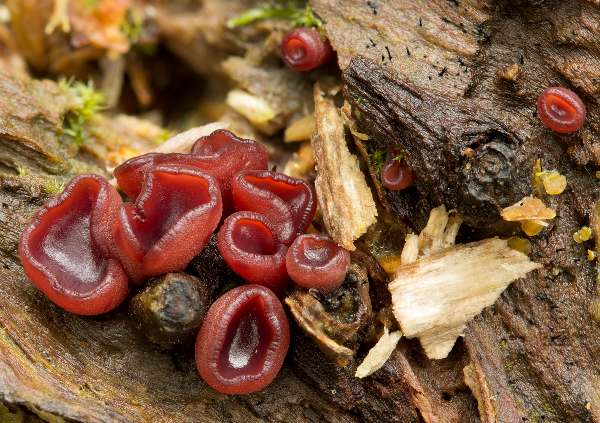
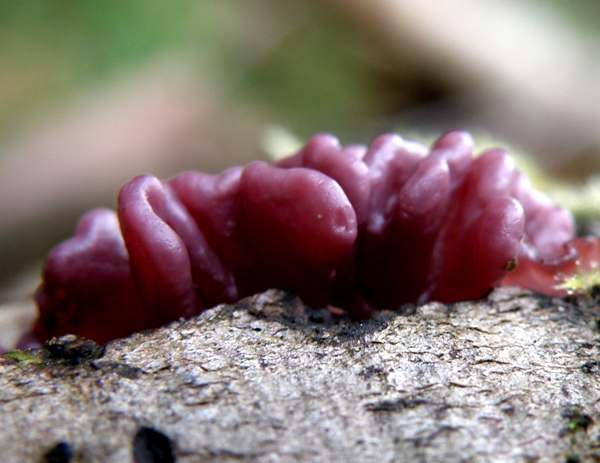
Above: telemorphic stage in which ascospores are produced
Found mainly on the trunks and branches of dead Beech trees, this colourful wood-rotting fungus can form large and conspicuous clusters.
Because of its jelly-like nature, Ascocoryne sarcoides is often confused with some of the heterobasidiomycete species (the true 'jelly fungi') in the genus Tremella. For example Tremella foliacea is sometimes brain-like in structure, rather than leaf-like as its scientific name suggests; it is usually reddish brown.
Distribution
Very common and widespread throughout Britain and Ireland, Ascocoryne sarcoides is also found throughout Europe wherever the are broadleaf woodlands or parklands where fallen timber is allowed to rot away naturally.
This ascomycete occurs in many other parts of the world including North America.
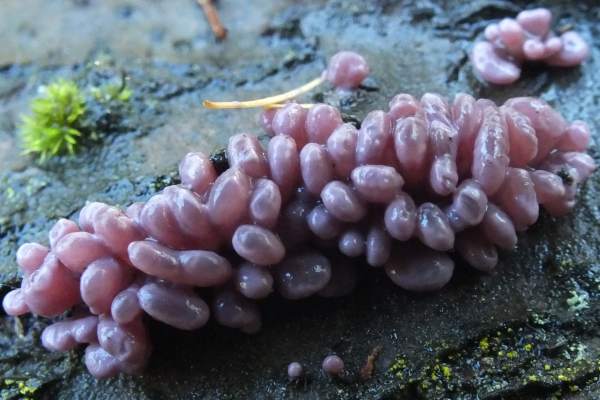
Above: anamorphic stage in which asexual (cloned) conidia are produced
Taxonomic history
This species was first described in 1781 by the Dutch naturalist Nikolaus Joseph von Jacquin (1727 - 1817) who named it Lichen sarcoides. The currently accepted scientific name Ascocoryne sarcoides dates from 1967, when Canadian mycologist James Walton Groves (1906 - 1970) and D E Wilson proposed the new genus Ascocoryne with the perfect (sexual) form of the Purple Jellydisc as the type species.
Synonyms of Ascocoryne sarcoides include Bulgaria sarcoides (Jacq.) Fr., Helvella sarcoides (Jacq.) Dicks., Lichen sarcoides Jacq., Tremella sarcoides (Jacq.) With., Acrospermum dubium Pers., Tremella dubia (Pers.) Pers., Tremella sarcoides (Jacq.) Pers., Coryne dubia (Pers.) Gray, Coryne sarcoides (Jacq.) Tul. & C. Tul., Ombrophila sarcoides (Jacq.) W. Phillips, Scleroderris majuscula Cooke & Massee, and Pirobasidium sarcoides (Jacq.) Höhn.
Etymology
Ascocoryne, the genus name, is made up of Asco- the prefix indicating that this fungus belongs to the phylum Ascomycota (fungi whose sexual spores are produced inside asci), and coryne which comes from from the Greek corönë meaning 'knotted rod'. The specific epithet sarcoides means fleshy or flesh-like.
Identification guide
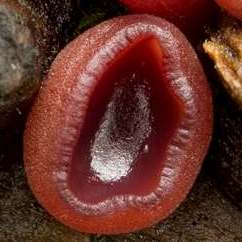 |
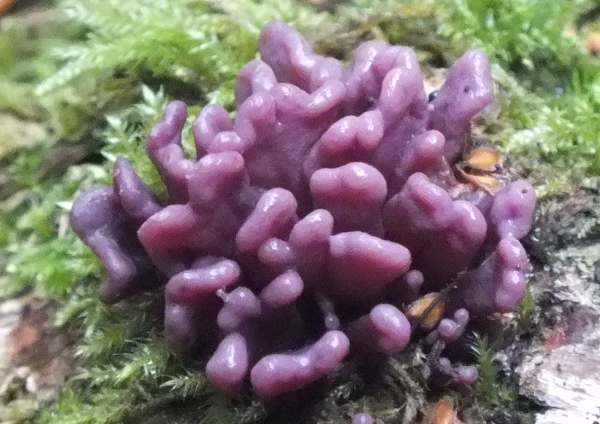
FruitbodyVarious shades of pinkish purple; spherical at first, either sessile or with a very short stem, later becoming centrally depressed and then irregularly cushion shaped; forming brain-like compound groups; gelatinous; individual fruitbodies 0.5 to 1.5cm across; clusters often 5 to 10cm across. This jelly-like fungus goes through both asexual (conidial) and sexual spore-producing stages. The individual 'blobs' are larger and more cup like at the telemorphic stage, but without microscopic study I still find it almost impossible to predict whether the tiny conidiospores or the much larger ascospores are being produced. |
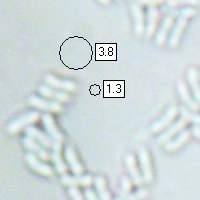 |
Conidia3-4 x 1-2µm, smooth, slightly allantoid, hyaline. Show larger imageConidia (asexual spores) of Ascocoryne sarcoides, Purple Jellydisc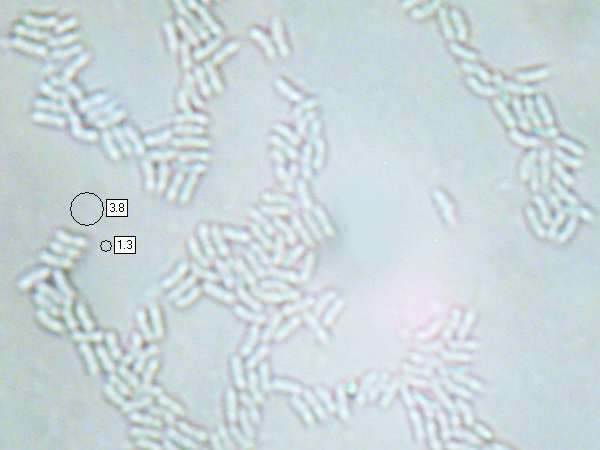 |
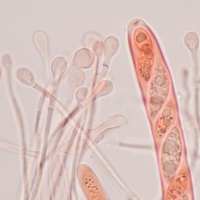 |
Asci160 x 10µm, with eight spores in each ascus. ParaphysesNarrow, clavate. Show larger imageAsci and paraphyses of Ascocoryne sarcoides, Purple Jellydisc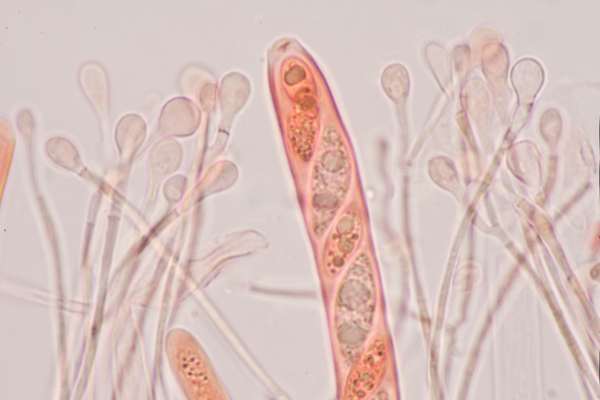 |
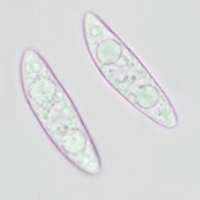 |
SporesEllipsoidal, smooth, with one septum at maturity; 10-19 x 3-5µm; hyaline; each spore contains one or two oil drops. Show larger imageSpores of Ascocoryne sarcoides, Purple Jellydisc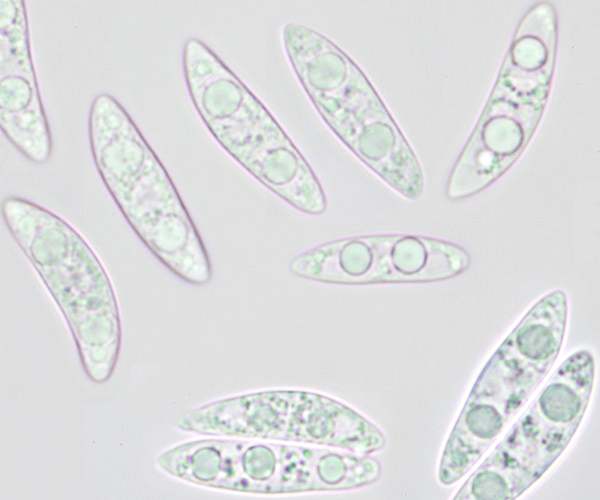 Spore printWhite. |
Odour/taste |
Not distinctive. |
Habitat & Ecological role |
Saprobic, on rotting trunks and stumps of broadleaf trees, particularly Beech. |
Season |
Fruiting in late summer, autumn and early winter. |
Similar species |
Ascocoryne cylichnium is similar but its fruitbodies remain cup shaped rather than merging into a brain-like form; it can be identified with certainly only by microscopic study of the spores, which are much larger than those of Ascocoryne sarcoides. |
Culinary Notes
Despite the word jelly in its common name, this insubstantial fungus is generally regarded as inedible.
Reference Sources
Fascinated by Fungi, 2nd Edition, Pat O'Reilly 2016, reprinted by Coch-y-bonddu Books in 2022.
Groves J W, Wilson D E (1967). The nomenclatural status of Coryne. Taxon 16 (1): 35–41
Dennis, R.W.G. (1981). British Ascomycetes; Lubrecht & Cramer; ISBN: 3768205525.
Dictionary of the Fungi; Paul M. Kirk, Paul F. Cannon, David W. Minter and J. A. Stalpers; CABI, 2008
Taxonomic history and synonym information on these pages is drawn from many sources but in particular from the British Mycological Society's GB Checklist of Fungi.
Acknowledgements
This page includes pictures kindly contributed by Simon Harding, David Kelly and Richard Shotbolt.
Fascinated by Fungi. Back by popular demand, Pat O'Reilly's best-selling 450-page hardback book is available now. The latest second edition was republished with a sparkling new cover design in September 2022 by Coch-y-Bonddu Books. Full details and copies are available from the publisher's online bookshop...