
Chlorophyllum rhacodes (Vittad.) Vellinga - Shaggy Parasol
Phylum: Basidiomycota - Class: Agaricomycetes - Order: Agaricales - Family: Agaricaceae
Distribution - Taxonomic History - Etymology - Toxicity -Identification - Reference Sources
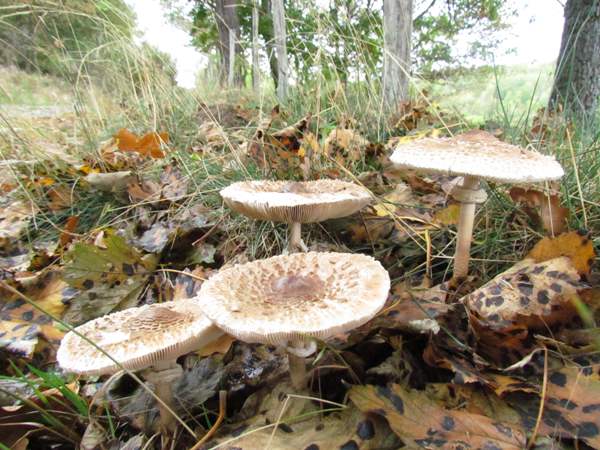
Chlorophyllum (formerly Macrolepiota) rhacodes, the Shaggy Parasol, is a fairly common mushroom found mainly in or beside woods and hedges. It is smaller than the Parasol Mushroom, Macrolepiota procera, and its stem lacks the snakeskin-like patterning associated with the Parasol. (See the Identification Guide, below.)
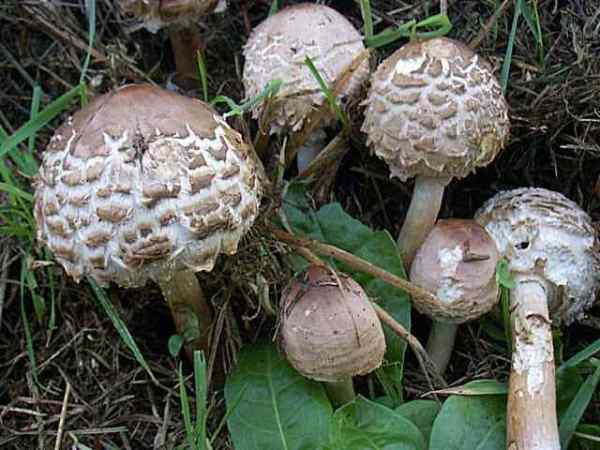
Distribution
Frequent in Britain and Ireland, Shaggy Parasols occur throughout Europe and North America.
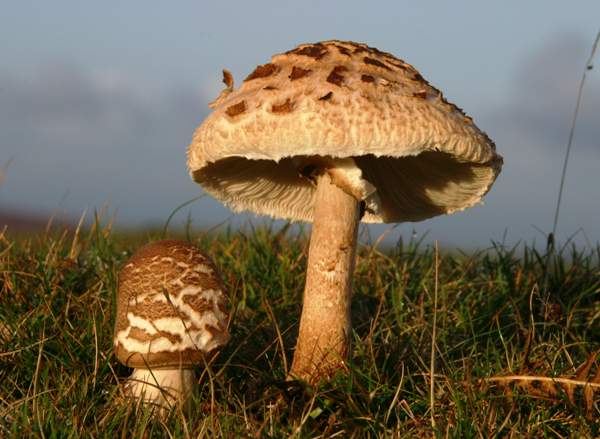
If you find fungi that look rather like Shaggy Parasols in open grassland, don't be too hasty in labelling them as such; there are several other large parasol-like fungi that appear occasionally in meadows, in dune grassland and in parkland.
See also Agaricus augustus, commonly known as The Prince, as this large mushroom could also be mistaken for a Shaggy Parasol unless you look carefully at all of its identifying features.
Taking a spore print (for which a mature fruitbody is necessary) would quickly resolve any such uncertainty, as the Shaggy Parasol produces very pale cream spores while Agaricus species produce dark brown or purplish-brown spores.
Taxonomic history
The taxonomy of this species has changed recently. As a result of molecular studies (DNA analysis), in 2003 the genus Macrolepiota was split up and the Shaggy Parasol was transferred to the genus Chlorophyllum, where it resides with other poisonous parasol-like mushrooms. (Macrolepiota procera, the popular edible Parasol, stayed put!)
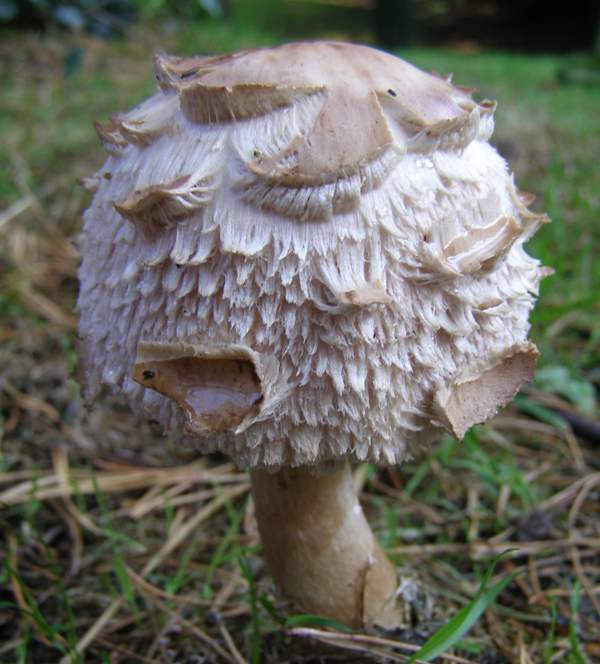
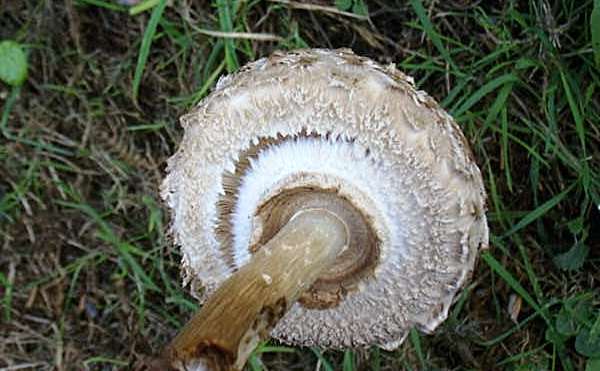
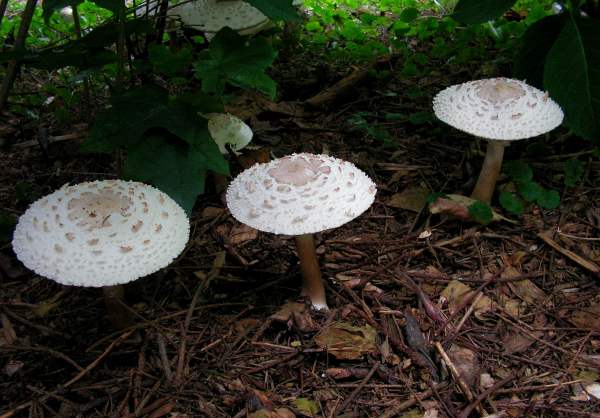
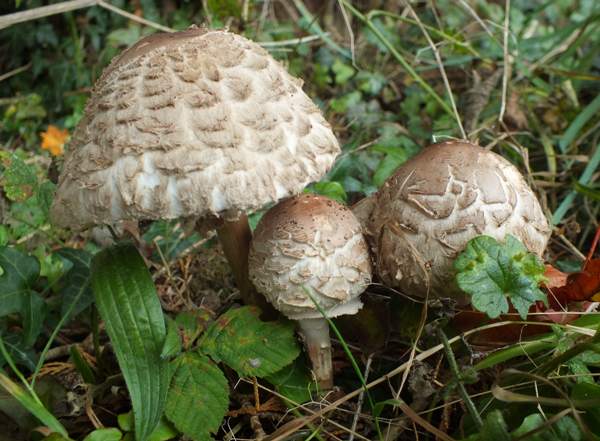
The lovely specimen above demonstrates that the Shaggy Parasol can occasionally be an exquisitely beautiful mushroom. (Picture above © Walker - The Walker Touch)
Described under the name Agaricus rhacodes by Carlo Vittadini (1800 - 1865) in 1835, this large and stocky mushroom has since spent time in the general Lepiota and Macrolepiota until, in 2002, DNA study by Else C Vellinga of the University of California justified its transportation to the genus Chlorophyllum. Common synonyms of Chlorophyllum rhacodes include Agaricus rhacodes Vittad., Lepiota rhacodes (Vittad.) Quél., Lepiota procera var. rhacodes (Vittad.) Massee, Macrolepiota rhacodes (Vittad.) Singer, and Macrolepiota venenata Bon.
Etymology
The generic name Chlorophyllum means 'with green gills' and is a reference to the green-gilled poisonous mushroom Chlorophyllum molybdites, which is common in North America. Other species in this genus have white spores, as indeed does Chlorophyllum rhacodes.
Carlo Vittadini erroneously transcribed the Greek word rhakos, meaning rag - a piece of cloth (this mushroom does often look rather ragged!), to the Latinised form rachos, resulting in the specific epitet rachodes rather than rhacodes. Some reference texts that you may come across may therefore use the scientific name Chlorophyllum rachodes for this species. (Another synonym for this species is Lepiota rhacodes.)
Toxicity
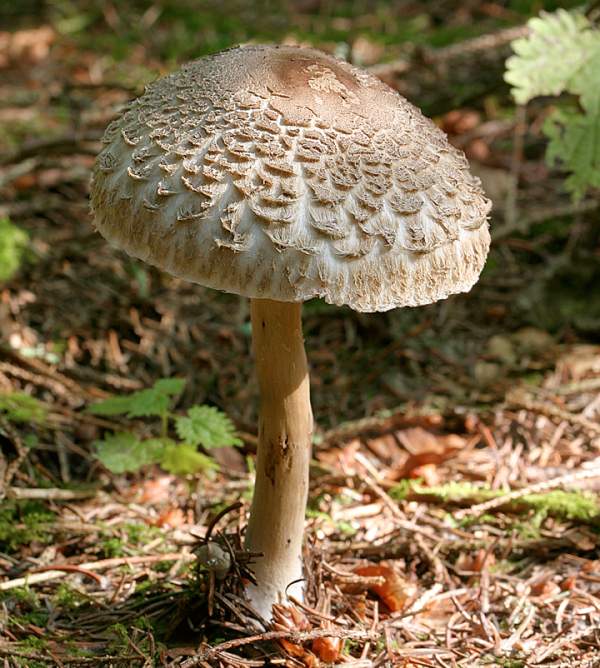
Many books and websites state that this is a good edible mushroom, but the Shaggy Parasol has been known to cause serious illness in some people and so in our opinion picking it to eat, intentionally or otherwise, should be avoided.
Identification guide
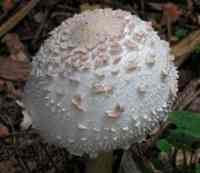 |
CapInitially bun shaped, the cap of Chlorophyllum rhacodes expands and becomes convex. Only rarely do Shaggy Parasols open out completely flat. (Picture: Doug Holland) At maturity, the cap diameter ranges from 5 to 15cm; its flesh reddens when cut. |
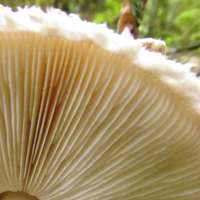 |
GillsThe gills are soft, white, free and crowded. If the gills are bruised or cut, they turn reddish - as also does the cap flesh if it is cut. |
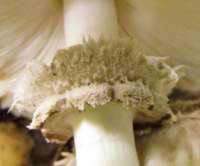 |
StemThe stem of a Shaggy Parasol is white, tinged with red-brown, and it rises eccentrically from a large bulbous base. The stem diameter is between 1.8 and 2.4cm, and the stem flesh turns reddish when cut or bruised. A movable white double ring, the same colour as the stem, sometimes falls to the base as the fruitbody matures. |
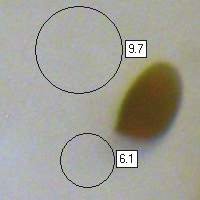 |
SporesBroadly ellipsoidal to globose or pyriform (pear-shaped), smooth, 8.8-12.7 x 5.4-7.9 µm, with a germ pore; hyaline; dextrinoid. Spores of Chlorophyllum rhacodes, Shaggy Parasol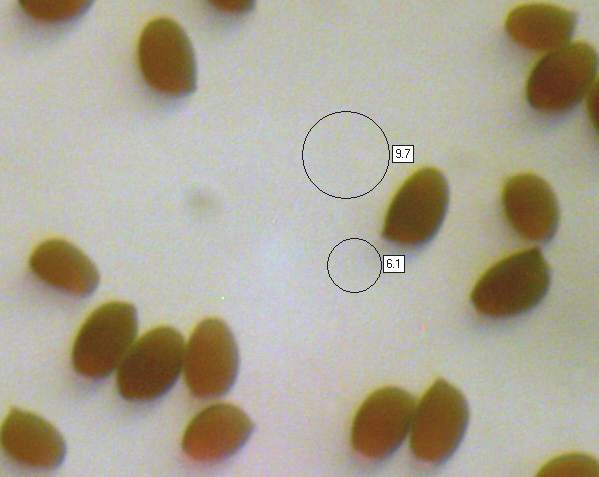 Spore printWhite or pale cream. |
Odour/taste |
Taste not distinctive; odour quite pleasant. |
Habitat & Ecological role |
Chlorophyllum rhacodes is saprobic and occurs in all kinds of woodland and sometimes in humous-rich disturbed soil in gardens. |
Season |
June to October in Britain and Ireland. |
Similar species |
Macrolepiota procera, the Parasol, has smaller scales and a brown and white pattern, often like snakeskin, on the stem. |
Reference Sources
Fascinated by Fungi, 2nd Edition, Pat O'Reilly 2016, reprinted by Coch-y-bonddu Books in 2022.
Elsa C Vellinga, de Kok RPJ, Bruns TD. (2003). Phylogeny and taxonomy of Macrolepiota (Agaricaceae). Mycologia 95 (3): pp 442–56.
Dictionary of the Fungi; Paul M. Kirk, Paul F. Cannon, David W. Minter and J. A. Stalpers; CABI, 2008
Taxonomic history and synonym information on these pages is drawn from many sources but in particular from the British Mycological Society's GB Checklist of Fungi.
Dictionary of the Fungi; Paul M. Kirk, Paul F. Cannon, David W. Minter and J. A. Stalpers; CABI, 2008
Taxonomic history and synonym information on these pages is drawn from many sources but in particular from the British Mycological Society's GB Checklist of Fungi.
Fascinated by Fungi. Back by popular demand, Pat O'Reilly's best-selling 450-page hardback book is available now. The latest second edition was republished with a sparkling new cover design in September 2022 by Coch-y-Bonddu Books. Full details and copies are available from the publisher's online bookshop...