
Clitopilus prunulus (Scop.) P. Kumm. - The Miller
Phylum: Basidiomycota - Class: Agaricomycetes - Order: Agaricales - Family: Entolomataceae
Distribution - Taxonomic History - Etymology - Identification - Culinary Notes - Reference Sources
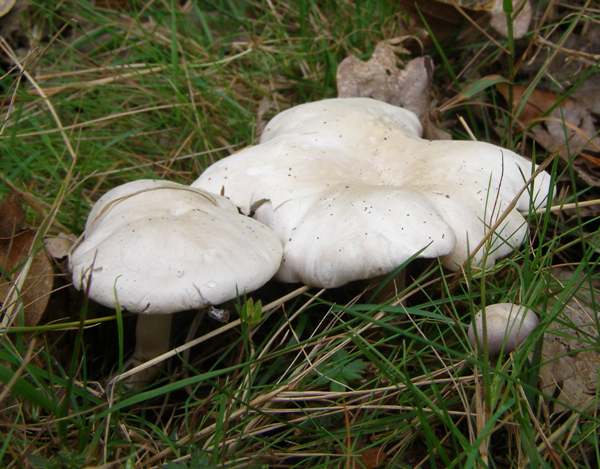
With its smooth matt cap surface and mealy smell it ought to be difficult to confuse this common mushroom of forest tracksides and woodland-edges with any of the white or grey-capped poisonous species, but it does happen and sometimes with serious consequences, because it has toxic lookalikes.
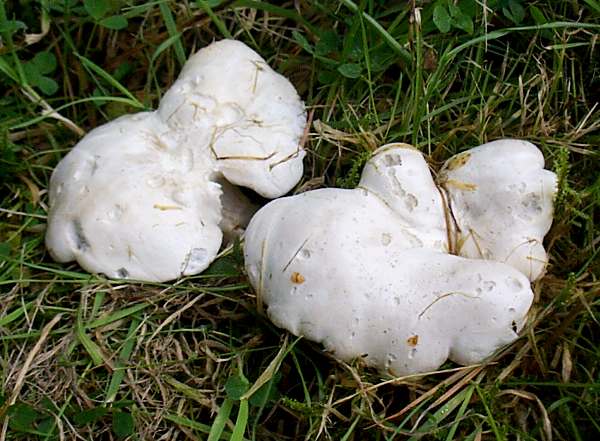
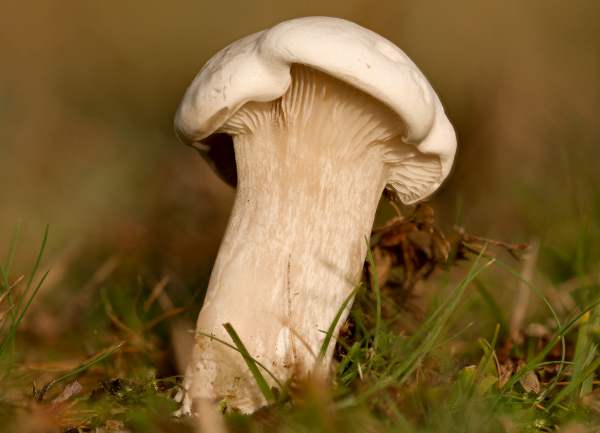
The deeply decurrent gills are a helpful diagnostic feature, clearly differentiating The Miller from most poisonous white-capped fungi.
Distribution
Widespread and fairly common in Britain and Ireland as well as in most countries of mainland Europe and parts of Asia, Clitopilus prunulus is also reported from North America.
Taxonomic history
The Miller was first described scientifically in 1772 by Joannes Antonius Scopoli (1723 - 1788), who named it Agaricus prunulus. (Most gilled fungi were initially placed in a giant Agaricus genus, now redistributed to many other genera.) German mycologist Paul Kummer transferred this species to the new (then) genus Clitopilus in 1871, and it retains that name today.
Clitopilus prunulus has many synonyms including Agaricus prunulus Scop., Agaricus orcellus Bull., Clitopilus orcellus (Bull.) P. Kumm., and Paxillopsis prunulus (Scop.) J. E. Lange.
Etymology
The specific epithet prunulus is nothing to do with prunes. Some authoprities, including AMINT in their field guide Tutto Funghi, have suggested that, despite the absence of a 'i' in its spelling prunulus means pruinose - frosted or covered in a fine white powder - not generally a prominent characteristic of suede-like caps of this mushroom, whose floury common name The Miller refers to odour rather than form. Much more credible is a suggestion that it is a diminutive form of prunus, a plum tree - hence prunulus would suggest a likeness to a small plum tree.
Identification guide
 |
CapWhite or pale grey with cream or pink tints; matt or finely frosted like fine suede or chamois leather; 5 to 12cm across; irregularly convex and developing a central depression; margin undulating and sometimes lobed; retaining an incurved margin; flesh firm and white. |
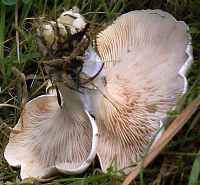 |
GillsWhite at first, becoming pink; deeply decurrent; many of the gills forking. StemWhite or grey often with a cream or pink tinge; 2 to 4cm wide and solid; more or less cylindrical, the stem of Clitopilus prunulus is 1.5 to 4cm tall (relatively short for such a large mushroom) and often the attachment is slightly eccentric. There is no stem ring. |
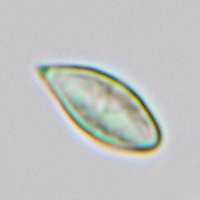 |
SporesEllipsoidal, oblong or amygdaloid; 9-12 x 4-6μm; ornamented with 6 to 8 longitudinal ridges. Show larger imageSpores of Clitopilus prunulus, The Miller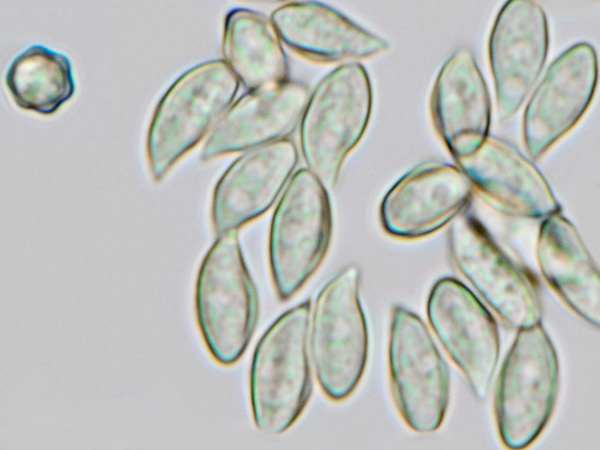 Spore printPink. |
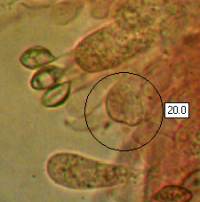 |
Other microscopic charactersThe basidia are four-spored - see picture on the left. |
Odour/taste |
The Miller gets its common name from its mealy odour and taste. |
Habitat & Ecological role |
Look for Clitopilus prunulus in grassy clearings in deciduous woods; beneath hedges on roadside verges; occasionally under broadleaf trees in parkland. |
Season |
June to late November in Britain and Ireland. |
Similar species |
This mushroom could be confused with St George's Mushroom, Calocybe gambosa, which usually fruits from springtime until early summer. Many white-capped fungi in the family Tricholomataceae occur in similar habitats - Clitocybe nebularis, is one such example - but gill colour and odour help differentiate The Miller from the many other pale funnel-shaped fungi. |
Culinary Notes
Although edible, The Miller is not among the most highly rated of mushrooms, and so for safety reasons is probably best avoided except by very experienced foragers.
Reference Sources
Fascinated by Fungi, 2nd Edition, Pat O'Reilly 2016, reprinted by Coch-y-bonddu Books in 2022.
Dictionary of the Fungi; Paul M. Kirk, Paul F. Cannon, David W. Minter and J. A. Stalpers; CABI, 2008
Taxonomic history and synonym information on these pages is drawn from many sources but in particular from the British Mycological Society's GB Checklist of Fungi.
Fascinated by Fungi. Back by popular demand, Pat O'Reilly's best-selling 450-page hardback book is available now. The latest second edition was republished with a sparkling new cover design in September 2022 by Coch-y-Bonddu Books. Full details and copies are available from the publisher's online bookshop...