
Coltricia perennis (L.) Murrill - Tiger's Eye
Phylum: Basidiomycota - Class: Agaricomycetes - Order: Polyporales - Family: Polyporaceae
Distribution - Taxonomic History - Etymology - Identification - Culinary Notes - Reference Sources
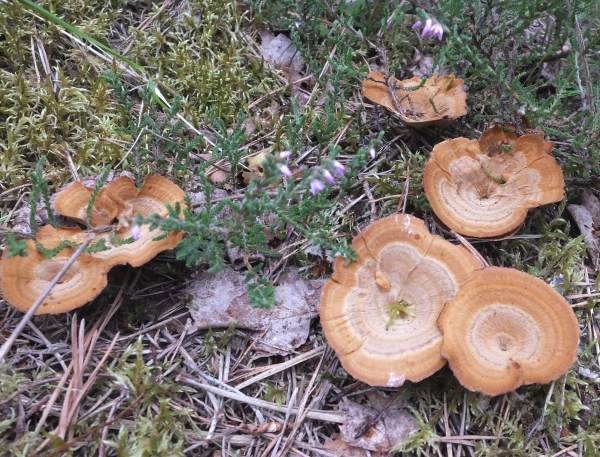
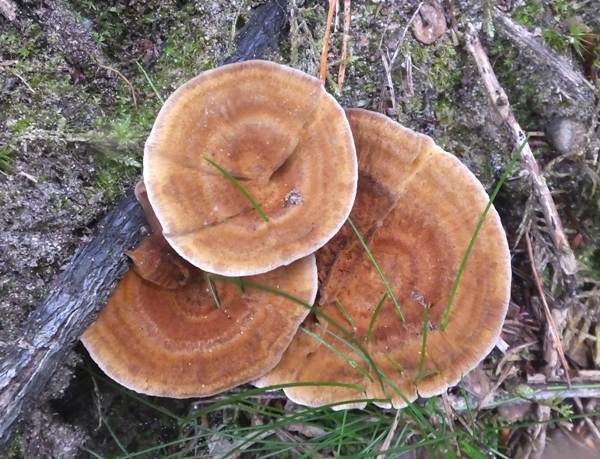
Although most polypores grow as either crusts or brackets, there are a few that form cup-like fruitbodies. One of these is Tiger’s Eye, a very attractive cup-and-stem fungus that grows in humus-rich sandy soil on woodland edges and on acidic heathland.
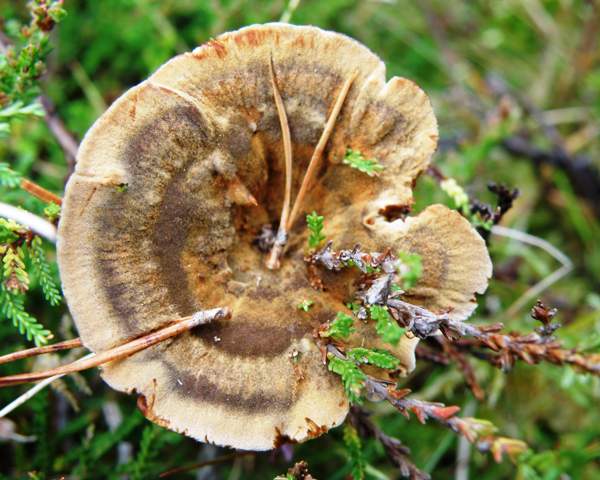
Young specimens have downy infertile (upper) cap surfaces but the down is only transient; older caps usually have radial furrows and irregular, wrinkled margins.
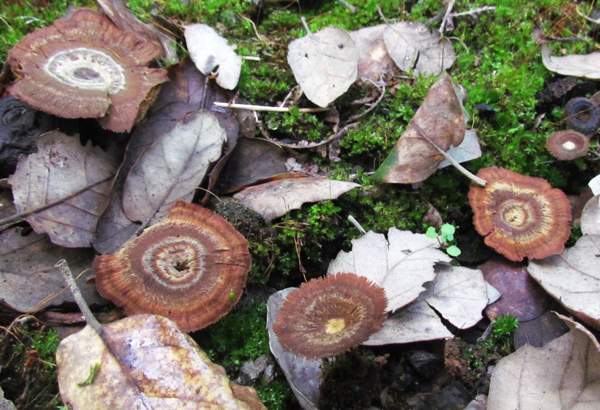
The specimen shown above was found on the edge of a sandy path beneath Scots Pines in the Caledonian Forest, central Scotland, while the picture shown below was taken at a fire site in a mixed pine and oak forest near Monchique, in southern Portugal.
Distribution
Uncommon and localised in areas of pine woods and plantations and on heathland in Britain and Ireland, Tiger's Eye occurs also in most parts of mainland Europe from Scandinavia down to the Mediterranean region. Coltricia perennis is also commonly seen in conifer woodlands (especially pinewood plantations) in many parts of North America.
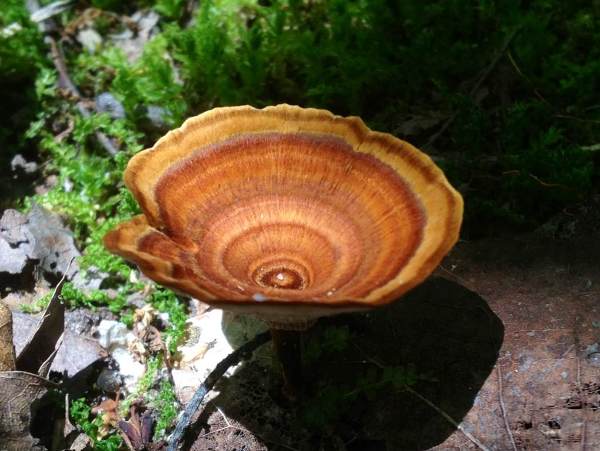
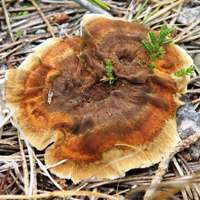
The beautifully zoned specimen below is shown by kind permission of Dustin Ware and Sarah Neumann, who took this photograph near Alpena, Michigan USA.
Taxonomic history
Tiger's Eye was described in 1753 by Carl Linnaeus, who gave it the name Boletus perennis (at a time when any fungus with pores was placed initially into the genus Boletus). It was American mycologist William Alphonso Murrill (1869 - 1957) who, in 1903, transferred this species to the genus Coltricia, thus establishing its currently-accepted scientific name Coltricia perennis.
Synonyms of Coltricia perennis include Boletus perennis L., Coltricia connata Gray, Polyporus perennis (L.) Fr., and Polystictus perennis (L.) P. Karst.
Etymology
The origin of the generic name Coltricia is Latin and means a couch or a seat. (In the USA the common name for this mushroom is Fairy's Stool.) The specific epithet perennis is straightforward and means, just as it sounds, perennial.
Identification Guide
 |
CapShallow, thin-fleshed cup, 3 to 10cm diameter often developing a wavy, irregular margin at maturity; upper surface velvety, becoming smooth, concentrically zoned in shades of ochre, mid brown and red-brown, margin often paler than centre; lower (fertile) surface covered with greyish brown pores. When two or more fruitbodies develop very close together, the stems tend to fuse and a single cap with two or more 'eyes' forms, as illustrated on the left. (This compound fruitbody was one of several seen on an old fire site in the Caledonian Forest, central Scotland.) |
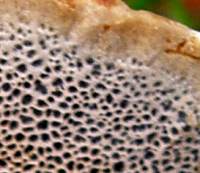 |
Tubes and poresTubes adnate or decurrent, 3 to 4 per mm. Pores grey-brown, rounded or slightly angular. StemDark brown, velvety, central, 2-5cm long, cylindrical or slightly laterally compressed; base sometimes slightly swollen. |
SporesBroadly ellipsoidal, smooth, 6-7.5 x 4-4.5µm; inamyloid. Spore printGolden brown. |
|
Odour/taste |
Not distinctive. |
Habitat & Ecological role |
On sandy soil on coniferous woodland, especially edges and clearings, often on fire sites; also on heathland. |
Season |
Perennial, sporulating in the autumn. |
Similar species |
Trametes versicolor, Turkeytail, sometimes zoned produces rosettes but they grown from wood, are generally lobed and produce white spores. |
Culinary Notes
Tiger's Eye is a tough and insubstantial fungus. The fact that it is such a long-lasting polypore is evidence that other creatures also find it hard to chew and swallow. Needless to say we have no recipe information for this species.
Reference Sources
Fascinated by Fungi, 2nd Edition, Pat O'Reilly 2016, reprinted by Coch-y-bonddu Books in 2022.
Dictionary of the Fungi; Paul M. Kirk, Paul F. Cannon, David W. Minter and J. A. Stalpers; CABI, 2008
Taxonomic history and synonym information on these pages is drawn from many sources but in particular from the British Mycological Society's GB Checklist of Fungi.
Fascinated by Fungi. Back by popular demand, Pat O'Reilly's best-selling 450-page hardback book is available now. The latest second edition was republished with a sparkling new cover design in September 2022 by Coch-y-Bonddu Books. Full details and copies are available from the publisher's online bookshop...