Cortinarius caerulescens (Schaeff.) Fr. - Mealy Bigfoot Webcap
Phylum: Basidiomycota - Class: Agaricomycetes - Order: Agaricales - Family: Cortinariaceae
Distribution - Taxonomic History - Etymology - Toxicity - Identification - Reference Sources
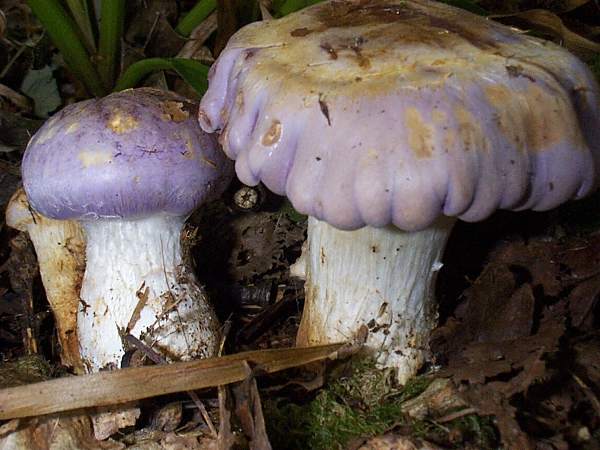
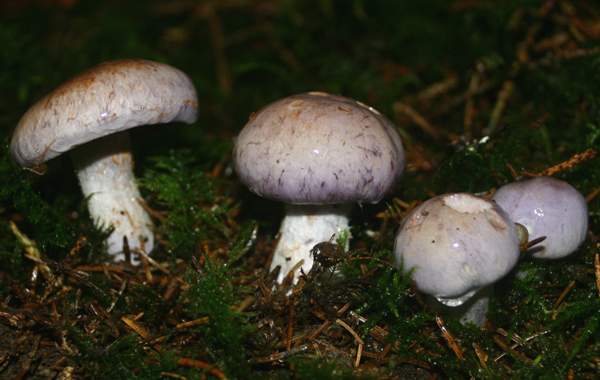
Cortinarius caerulescens is found in late summer and autumn growing in deciduous woodland, mainly under mature beech and oak trees. This large attractive mushroom is quite rare in Britain.
When the caps are young, the striking bluish-mauve caps are very distinctive, but like most colourful members of its genus, the cap of the Mealy Bigfoot Webcap turns brown from the centre as it matures. The intriguingly lobed specimen shown here is typical of mature caps that have expanded during a dry spell.
Distribution
An uncommon but fairly widespread species in Britain and Ireland, the Mealy Bigfoot Webcap is found also in many parts of mainland Europe.
Taxonomic history
When in 1762 Jacob Christian Schaeffer described this woodland mushroom he gave it the binomial name Agaricus caerulescens. (In the early days of fungal taxonomy, most gilled fungi were initially dumped into a gigantic Agaricus genus, the contents of which have since largely been redistributed across newer genera.)
It was the great Swedish mycologist Elias Magnus Fries who, in 1838, transferred this species to the genus Cortinarius, whereupon its scientific name became Cortinarius caerulescens. This webcap is a member of the Cortinarius subgenus Phlegmaceum.
Synonyms of Cortinarius caerulescens include Agaricus caerulescens Schaeff., Agaricus cyanus ß caerulescens (Schaeff.) Pers., Cortinarius cyanus ß caerulescens (Schaeff.) Gray,and Cortinarius caesiocyaneus Britzelm.
Etymology
The generic name Cortinarius is a reference to the partial veil or cortina (meaning a curtain) that covers the gills when caps are immature. In the genus Cortinarius most species produce partial veils in the form of a fine web of radial fibres connecting the stem to the rim of the cap rather than a solid membrane.
Counter intuitively, the specific epithet caerulescens could be translated as 'becoming blue', whereas the cap surface of the Mealy Bigfoot Webcap starts off blue and becomes brown as the fruitbody ages; however, another meaning of the suffix -escens is 'almost'. Almost blue is therefore the more appropriate interpretation in this instance.
Toxicity
This mushroom is reported by some authorities to be 'edible but worthless', whereas in other field guides it is recorded as 'suspect'. In my opinion, therefore, the Mealy Bigfoot Webcap should not be gathered for eating.
Identification guide
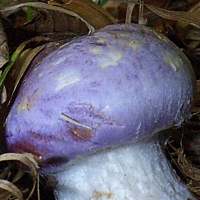 |
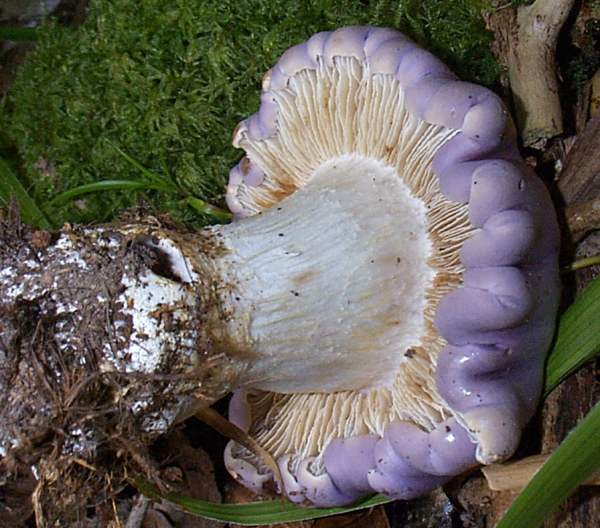
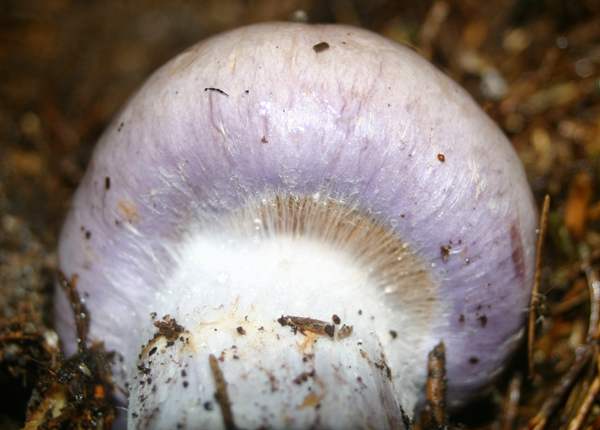
CapYoung caps are convex, later flattening as they expand but invariably retaining an in-rolled margin even when fully developed. The cap diameter varies from 6 to 20cm at maturity. At first a beautiful blue-mauve and particularly fibrillose at the margin, the cap turns ochre-brown, or sometimes rufous-brown, from the centre and becomes more smooth and shiny with age. In dry weather the margin wrinkles, whereas in wetter conditions it tends to remain more regularly circular. |
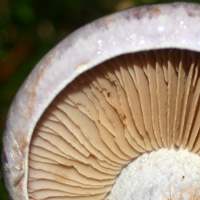 |
GillsThe adnate to notched gills are toothed and are close and initially white or pale grey and covered by a fleeting bluish cortina. As the spores mature, the gills turn rusty brown, but they usually retain a pale edge until the fruitbody begins decaying. |
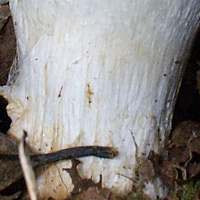 |
StemThe stipe is white at first and clavate (club-shaped), broadest at the base, becoming more parallel-sided as the cap expands. It is covered with long flaky scales below a fleeting ring formed as the cortina parts. Once the cap is fully developed, the stem discolours in patches as rust-coloured spores fall from the gills. |
SporesAmygdaloid, verrucose, 8.5-10 x 5-5.5μm; dextrinoid. Spore printRusty brown. |
|
Odour/taste |
Odour slightly earthy; taste mild. |
Habitat & Ecological role |
In deciduous woodland in chalk and limestone areas, infrequent in warm and sheltered locations and rare elsewhere. |
Season |
September and October in Britain and Ireland |
Similar species |
Cortinarius violaceus, the Violet Webcap, has a darker violet cap, gills and stem, and its flesh is deep violet throughout. |
Reference Sources
Fascinated by Fungi, 2nd Edition, Pat O'Reilly 2016, reprinted by Coch-y-bonddu Books in 2022.
Funga Nordica, Henning Knudsen and Jan Vesterholt, 2008.
Fungi of Switzerland Agarics, part 3: Cortinariaceae, Breitenbach, J., Kränzlin, F.
Dictionary of the Fungi; Paul M. Kirk, Paul F. Cannon, David W. Minter and J. A. Stalpers; CABI, 2008
Taxonomic history and synonym information on these pages is drawn from many sources but in particular from the British Mycological Society's GB Checklist of Fungi.
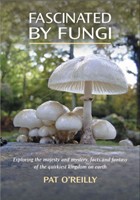
Fascinated by Fungi. Back by popular demand, Pat O'Reilly's best-selling 450-page hardback book is available now. The latest second edition was republished with a sparkling new cover design in September 2022 by Coch-y-Bonddu Books. Full details and copies are available from the publisher's online bookshop...