Cortinarius collinitus (Sowerby) Gray - Blue-girdled Webcap
Phylum: Basidiomycota - Class: Agaricomycetes - Order: Agaricales - Family: Cortinariaceae
Distribution - Taxonomic History - Etymology - Toxicity - Identification - Reference Sources
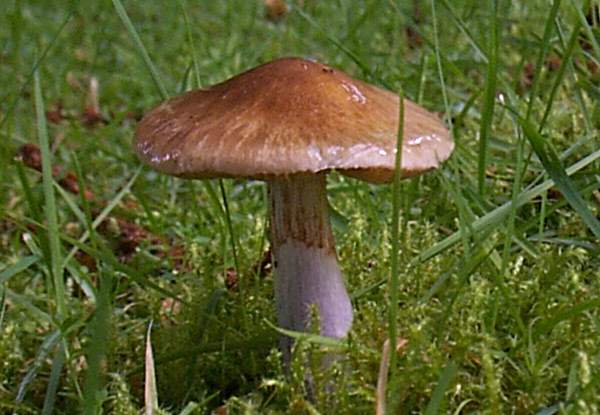
Cortinarius collinitus is found in late summer in coniferous forests and, very occasionally, in broad-leaf woodland. This is an inedible fungus and should never be collected because it can be confused with some of the other webcaps that are deadly poisonous.
Identification of webcaps is very difficult, and unfortunately there are many brownish species with macroscopic characteristics similar to this rather nondescript member of the clan.
Distribution
A uncommon species in Britain and Ireland, the Blue-girdled Webcap occurs throughout northern Europe and is also reported to occur in North America (although it is far from clear whether the European and American mushrooms by this name are actually the same species). Look out for this webcap in conifer plantations on acidic soil.
Taxonomic history
When British mycologist James Sowerby (1757 - 1822) described this webcap in 1797 he gave it the binomial scientific name Agaricus collinitus. (Vast numbers of gilled fungi were dumped into the Agaricus genus in the early days of fungal taxonomy; most have since been moved to other genera leaving in the present-day Agaricus genus a much smaller number of gilled mushrooms that are sometimes referred to as the 'true mushrooms'.) It was another British mycologist, Samuel Frederick Gray (1766 - 1828) who, in 1821, transferred this species to the genus Cortinarius, thereby establishing its currently accepted scientific name as Cortinarius collinitus.
Synonyms of Cortinarius collinitus (Sowerby) Gray include Agaricus collinitus Sowerby, and Cortinarius muscigenusPeck.
Etymology
The generic name Cortinarius is a reference to the partial veil or cortina (meaning a curtain) that covers the gills when caps are immature. In the genus Cortinarius most species produce partial veils in the form of a fine web of radial fibres connecting the stem to the rim of the cap rather than a solid membrane.
Entirely justified but derived via a root that is not immediately obvious, the specific epithet collinitus comes from Latin and means 'smeared' or 'greased'.
Toxicity
This mushroom (like most other species in the same genus) is generally regarded as 'suspect' and may contain dangerous toxins; it should not be gathered for eating. Some reddish-brown Cortinarius species with which the Blue-girdled Webcap could be confused contain the toxin orellanine, which if eaten destroys human kidneys and liver.
Identification guide
CapYoung caps are convex, later almost flattening but usually retaining a broad umbo and a slightly in-rolled margin even when fully developed. The caps vary from mid brown to dark brown, generally with a lighter region near the rim and with faint radial streaks. Very slimy in wet weather, the caps eventually dry to a smooth glossy finish. The diameter ranges from 3 to 10cm at maturity. |
|
GillsThe gills are close and initially white or pale violaceous-grey at first, becoming rusty brown as the spores mature. |
|
Stem |
The top of the stipe is white; the central section is irregularly banded with the viscid veil remains and tinged with violet; the lower part is coloured brown. 7 to 20mm in diameter and from 5 to 12cm tall. |
SporesEllipsoidal to lemon-shaped or almond-shaped; thick-walled; rough and verrucose, 13-16 x 7.5-9.5μm; inamyloid. Spore printRusty brown. |
|
Odour/taste |
No significant odour; taste mild but not distinctive. |
Habitat & Ecological role |
In boggy acidic coniferous woodland; rarely under broad-leaf trees. |
Season |
August to October in Britain and Ireland. |
Reference Sources
Fascinated by Fungi, 2nd Edition, Pat O'Reilly 2016, reprinted by Coch-y-bonddu Books in 2022.
Funga Nordica, Henning Knudsen and Jan Vesterholt, 2008.
Fungi of Switzerland Agarics, part 3: Cortinariaceae, Breitenbach, J., Kränzlin, F.
Dictionary of the Fungi; Paul M. Kirk, Paul F. Cannon, David W. Minter and J. A. Stalpers; CABI, 2008
Taxonomic history and synonym information on these pages is drawn from many sources but in particular from the British Mycological Society's GB Checklist of Fungi.
Fascinated by Fungi. Back by popular demand, Pat O'Reilly's best-selling 450-page hardback book is available now. The latest second edition was republished with a sparkling new cover design in September 2022 by Coch-y-Bonddu Books. Full details and copies are available from the publisher's online bookshop...