
Craterellus cornucopioides (L.) Pers. - Horn of Plenty
Phylum: Basidiomycota - Class: Agaricomycetes - Order: Cantharellales - Family: Cantharellaceae
Distribution - Taxonomic History- Etymology - Identification - Culinary Notes - Reference Sources
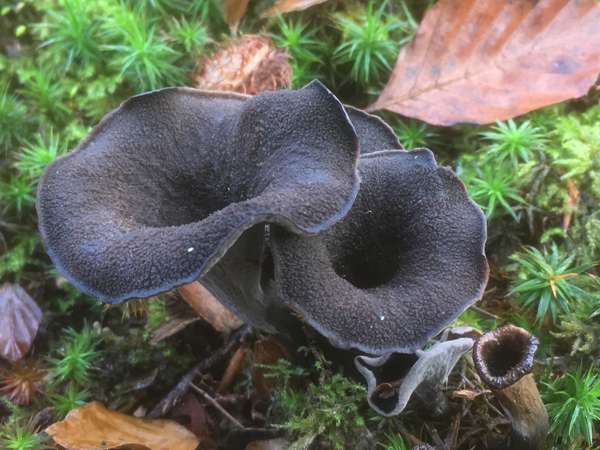
A very deep funnel characterises this sombre, edible fungus, which is variously known as the Trumpet of Death and the Horn of Plenty. The fruitbodies grow on soil under deciduous trees; they are tough-skinned and so they rarely get infested with maggots, and they can be found well into the winter months.
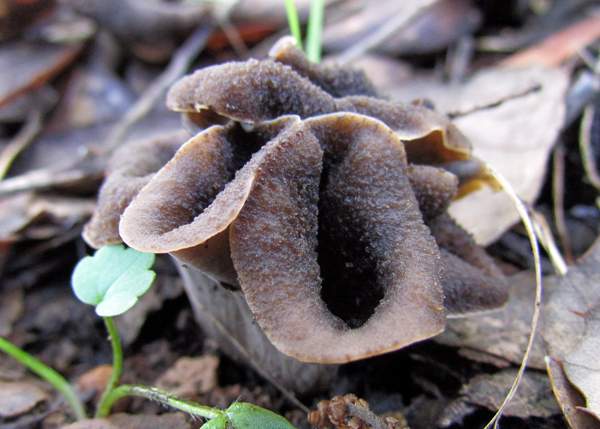
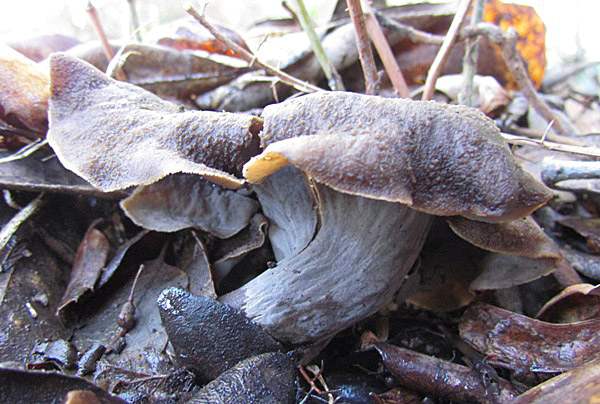
Above: In a shady spot at Haliotis, in the Alentejo region of southern Portugal, I found this cluster and several other small groups of Craterellus cornucopioides. The grey-brown colour of the infertile (inner surface) can darken with age.
Distribution
Localised in Britain and Ireland, the Horn of Plenty is often abundant where it does occur. This edible mushroom, or rather a complex of species until recently included under this name, occurs in North, Central and South America, throughout Europe (from Scandinavia to the Mediterranean) and Asia as well as in Japan. Craterellus cornucopioides (senso stricta) is now (see Matheny et al., 2010) considered to be a purely European species.
Craterellus fallax, a very similar species occurs in many parts of North America.
Taxonomic history
Carl Linnaeus described this species in 1753 and called it Peziza cornucopioides; Christiaan Hendrik Persoon, in his 1825 publication, gave it the name Craterellus cornucopioides. Synonyms include Cantharellus cornucopioides (L.) Fr., and, perhaps much more surprisingly, Pleurotus cornucopioides (L.) Gillet.
Etymology
In Greek mythology one version of the origin of Cornucopia (and there are several others) was that it a magical horn that the young Zeus accidentally broke from the head of the goddess Amalthea, who has suckled the child while he was hidden away from his father Cronos (or Kronos), who made a habit of eating his new-born sons to thwart the prophesy that he would be overthrown by his son. Zeus survived and overthrew Cronos. The horn of Amalthea, the Cornucopia, inherited the goddess's divine power of providing unending supplies of nourishing food. Craterellus cornucopioides, commonly called the Horn of Plenty, does on occasion provide a bountiful source of food, but on its own it certainly does not constitute a balanced diet and its availability is limited to just a few weeks of the year.
Identification guide
 |
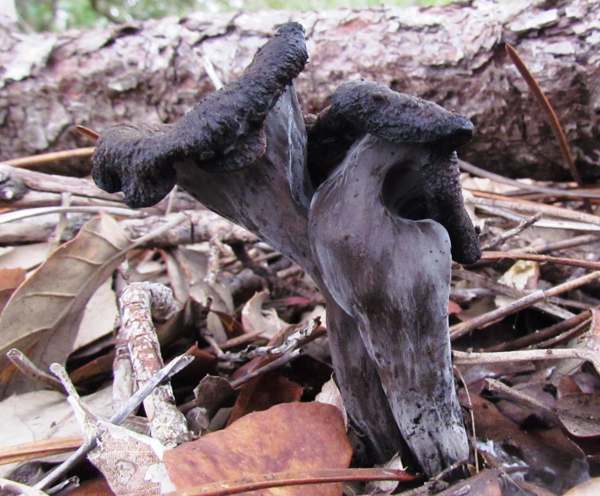
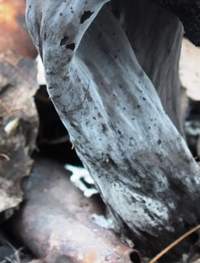
CapThe funnel-shaped cap has an inrolled margin; its diameter ranges from 4 to 8 cm, and the colour of the upper (infertile) surface varies from grey-brown to dark grey or black; with wrinkled marginal striations. The outer (fertile or hymenial) surface is grey, pruinose and longitudinally finely wrinkled. |
 |
StemThe grey pruinose, longitudinally finely wrinkled stem is hollow right down to the base, towards which it tapers slightly. |
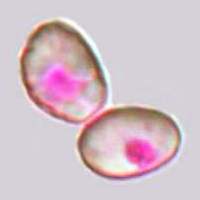 |
SporesBroadly ellipsoidal, smooth, 11.5-16 x 7-10μm; hyaline. Spores of Craterellus cornucopioides, Horn of Plenty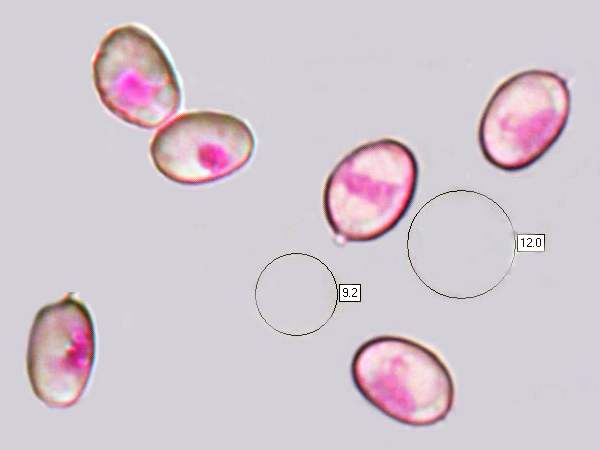 Spore printWhite Other microscopic charactersThe basidia are slenderly clavate (club shaped) and each has two sterigmata. In contrast, the Chanterelle Cantharellus cibarius, and the Trumpet Chanterelle Cantharellus tubaeformis produce four spores per basidium, while the basidia of Craterellus cinereus (rather similar in appearance to the Horn of Plenty but with a much more deeply wrinkled hymenial surface) are distinguished by being five spored. |
Odour/taste |
Not distinctive. |
Habitat & Ecological role |
This hard-to-spot species is most frequently found in deciduous forests under Beech trees, but it also occurs with oaks. |
Season |
June to November - even into December in mild autumns in southern Britain. In Mediterranean countries and the Iberian Peninsula this fine edible mushroom can be found well into the New Year. |
Similar species |
Cantharellus cibarius is a bright yellow or yellow-orange fungus of similar form and size. Cantharellus tubaeformis has a brownish cap and a yellow stem. |
Culinary Notes
Craterellus cornucopioides tastes a lot better than it looks. These mushrooms can be dried (over a radiator or in a warm oven with the door open) and then stored in airtight jars for future use. We also make them into a sauce and then freeze meal-sized portions in (labeled!) polythene bags or plastic boxes. This way we can have a lovely mushroom sauce with meals through the winter.
Reference Sources
Fascinated by Fungi, 2nd Edition, Pat O'Reilly 2016, reprinted by Coch-y-bonddu Books in 2022.
Matheny et al., (July 2010). "Craterellus fallax, a Black Trumpet mushroom from eastern North America with a broad host range". Mycorrhiza. 20 (8): pp 569–575.
British Mycological Society, English Names for Fungi
Dictionary of the Fungi; Paul M. Kirk, Paul F. Cannon, David W. Minter and J. A. Stalpers; CABI, 2008
Taxonomic history and synonym information on these pages is drawn from many sources but in particular from the British Mycological Society's GB Checklist of Fungi.
Acknowledgements
This page includes pictures kindly contributed by Simon Harding.

Fascinated by Fungi. Back by popular demand, Pat O'Reilly's best-selling 450-page hardback book is available now. The latest second edition was republished with a sparkling new cover design in September 2022 by Coch-y-Bonddu Books. Full details and copies are available from the publisher's online bookshop...