
Daedalea quercina (L.) Pers. - Oak Mazegill
Phylum: Basidiomycota - Class: Agaricomycetes - Order: Polyporales - Family: Fomitopsidaceae
Distribution - Taxonomic History - Etymology - Identification - Reference Sources
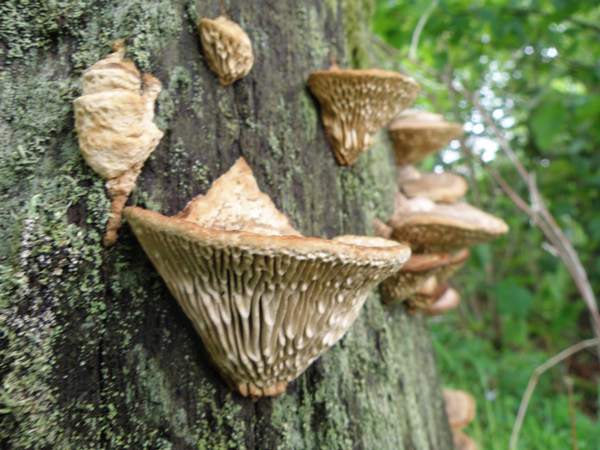
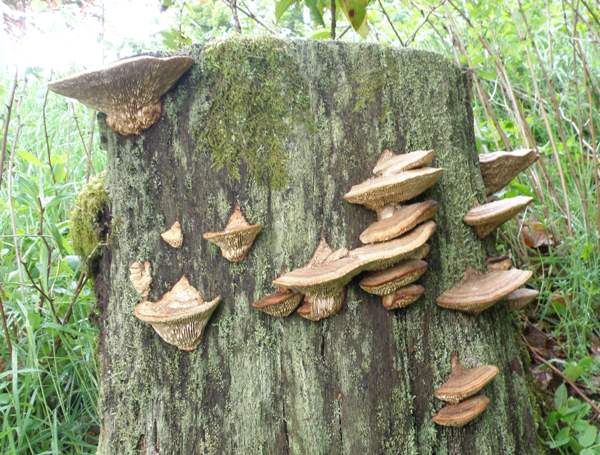
Often solitary, this large imposing bracket fungus sometimes occurs in tiers, particularly on the cut ends of felled oak trunks. It is less often seen on other kinds of hardwood timber.
Daedalea quercina is referred to as a Mazegill fungus, because the very wide gill-like pores are radially-aligned in a pattern that resembles a maze. (This is a much more chunky fungus that the other common species bearing the 'mazegill title: Lenzites betulinus, the Birch Mazegill.)
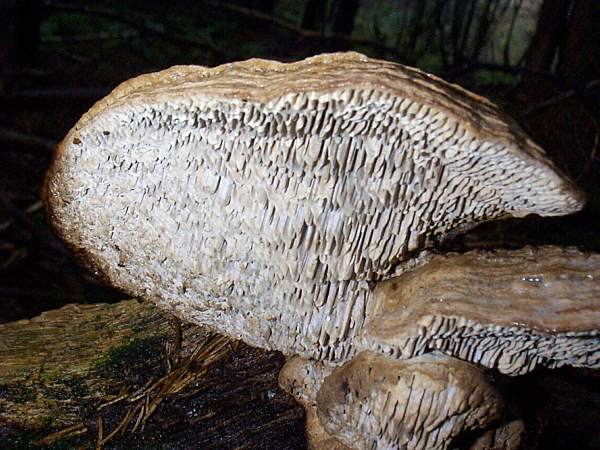
The form of this very common bracket fungus is rather variable. Sometimes - particularly when on fallen trunks and branches - the fruitbodies look very much like shelves with slightly domed tops, as pictured above. More often, and nearly always when growing on standing dead trees or stumps, they take on a semi-conical form as shown in the upper picture. (You might even imagine that there is a lamp inside waiting to be switched on when darkness falls!)
Distribution
Common and widespread in Britain and Ireland and found throughout most of mainland Europe, this saprobic fungus occurs also in North America and in many other temperate regions.
Taxonomic history
In 1753 Carl Linnaeus called the Oak Mazegill Agaricus quercinus; its current name comes from Christiaan Hendrik Persoon's 1801 publication.
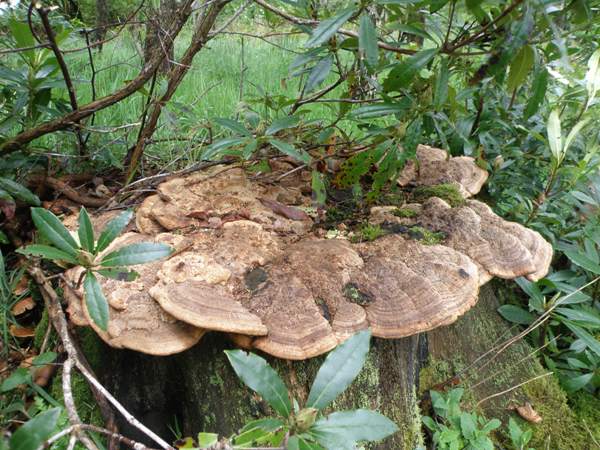
Daedalea quercina is the type species of the genus Daedalea. This small genus, with fewer than ten species (most very rarely seen) recorded in Britain, was established by the pioneering South Africa-born mycologist Christiaan Hendrik Persoon in 1801.
Synonyms of Daedalea quercina include Agaricus quercinus L., Trametes hexagonoides Fr., Trametes quercina (L.) Pilát, Lenzites quercina (L.) P. Karst., and Daedalea quercina f. hexagonoides (Fr.) Bondartsev.
Etymology
It is from its labyrinthine gill-like pores that this distinctive bracket fungus gets its generic scientific name. In Greek mythology, Daedalus constructed a labyrinth at Knossos for King Minos of Crete, and in that labyrinth lived the Minotaur - half-man, half-bull.
Identification guide
 |
CapMost often seen on oak stumps, the caps of this cork-like bracket fungus grow to between 6 and 20cm across and fruitbodies are commonly 2 to 5cm thick but occasionally much thicket at the centre of the attachment region. |
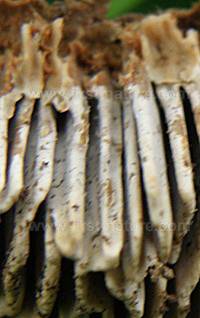 |
TubesThe tubes are in the form of large slots 1 to 3cm deep and 2cm wide; they are interconnected to form a maze-like structure with the slots generally aligned radially. The pale ocraceous walls of the maze vary greatly in thickness from one specimen to another but are typically of width similar to that of the slots. |
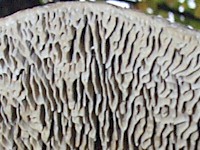 |
PoresThe pore surface is varius shdes of pale ochre, dependent on the age of the fruitbody - usually darkening with age. |
SporesEllipsoidal, smooth, 5-7 x 2-4 µm. Spore printWhite. |
|
Odour/taste |
Slight acrid odour; no distinctive taste but a very tough texture. |
Habitat & Ecological role |
Daedalea quercina is saprobic and occurs on standing and fallen dead oak wood and, less frequently, Sweet Chestnut. |
Season |
Oak Mazegills can be seen all year round, but they shed spores in late summer and autumn. |
Similar species |
Daedaleopsis confragosa, the Blushing Bracket, has smaller pore openings many of which are in the form of closed slots. Lenzites betulinus is similar, with thinner cream 'gills'; it occurs mainly on birch trees. |
Reference Sources
Fascinated by Fungi, 2nd Edition, Pat O'Reilly 2016, reprinted by Coch-y-bonddu Books in 2022.
BMS List of English Names for Fungi
Dictionary of the Fungi; Paul M. Kirk, Paul F. Cannon, David W. Minter and J. A. Stalpers; CABI, 2008
Taxonomic history and synonym information on these pages is drawn from many sources but in particular from the British Mycological Society's GB Checklist of Fungi.
Fascinated by Fungi. Back by popular demand, Pat O'Reilly's best-selling 450-page hardback book is available now. The latest second edition was republished with a sparkling new cover design in September 2022 by Coch-y-Bonddu Books. Full details and copies are available from the publisher's online bookshop...