
Flammulina velutipes (Curtis) Singer - Velvet Shank
Phylum: Basidiomycota - Class: Agaricomycetes - Order: Agaricales - Family: Physalacriaceae
Distribution - Taxonomic History- Etymology - Identification - Culinary Notes - Reference Sources
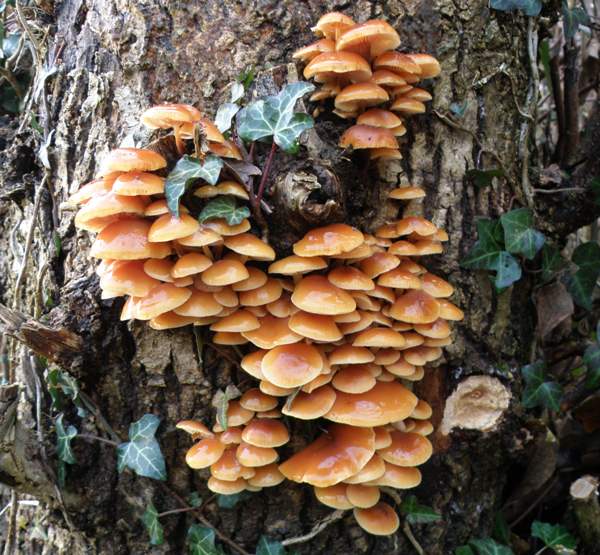
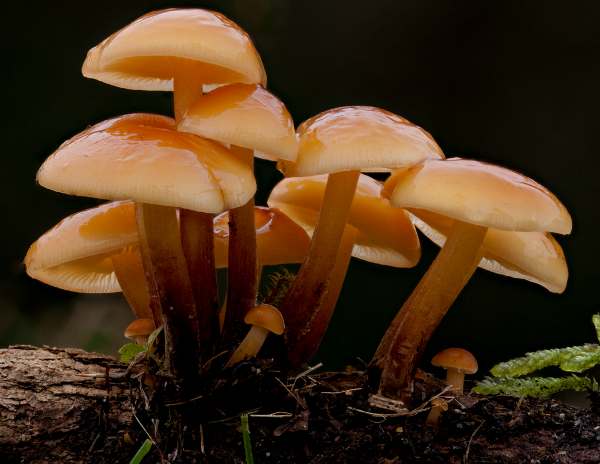
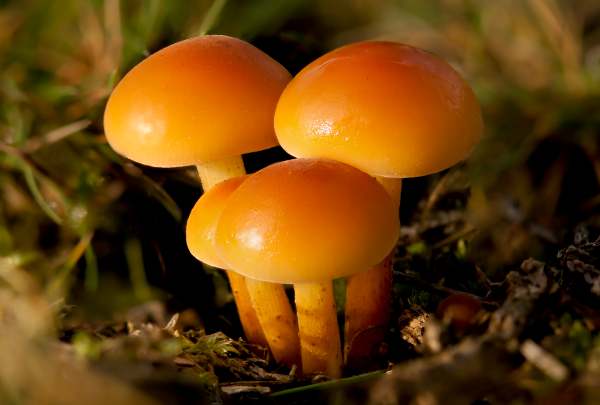
The lovely orange-brown caps of Flammulina velutipes continue fruiting through the winter. Commonly known as Velvet Shank, this is a stump-rotting fungus; it also occurs on standing dead wood.
To see a cluster of these splendid golden-orange caps sprinkled with snow on a crisp winter's morning makes a walk in the cold air seem very worthwhile indeed. We have seen them in good condition as late as the end of January.
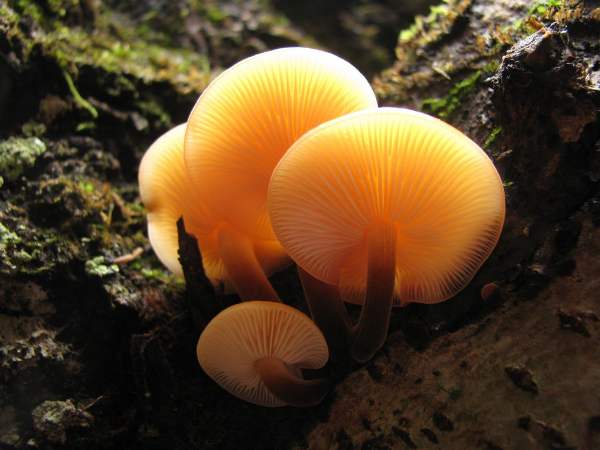
The young fruit bodies shown above were photographed in the USA; they have pale upper stems, while the darker velvety sections are partly buried in the rotten wood on which the fugi are growing. This is often the case when Velvet Shank grows on fallen timber.
On standing dead trees the clusters are usually tiered and, as a result, the caps are fairly regular, but on fallen wood sometimes tufts of Velvet Shank are so dense that the caps push against one another and become distorted and occasionally almost square.
Flammulina velutipes is particularly common on dead elm trees (of which there was no shortage during the 1970s and 1980s as Dutch Elm Disease ravaged the elm woods of Britain and Europe), but currently it is more often seen on Ash, Beech and oaks as well as occasionally on wood from other kinds of broadleaf trees.
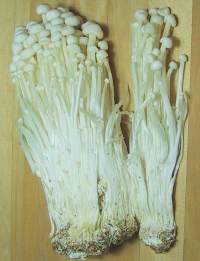
Caps from these fungi are edible and are grown commercially in Japan, where they are variously known as Enoki, Enokitake or Enoko-take.
The Enokitake mushrooms pictured above were purchased in a supermarket in 2004. (Picture attribution: Chris 73 / Wikimedia Commons)
In the wild Flammulina velutipes grows in an unconstrained environment and in whatever daylight there is in winter. As a result the caps are colourful and quite large in comparison with the stem length and diameter, and the stems are generally quite tough so that many people cook only the caps.
In cultivation the mushrooms are grown in dark, cold places so that they develop slowly and are very pale - often almost pure white. The stems are forced to stretch by placing a tightly-fitting collar around clusters of mushroom ; as a consequence the stems are long, delicate and tender. The caps of cultivated Enokitake mushrooms are much smaller than those of wild Velvet Shank fungi. Unlike the wild form, the caps of cultivated varieties of this species are convex when the fruitbodies are fully mature and ready for harvesting.
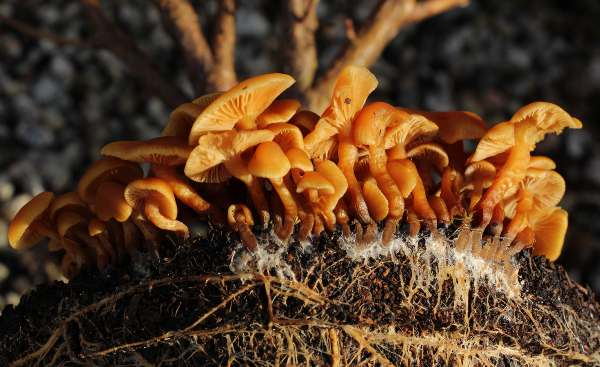
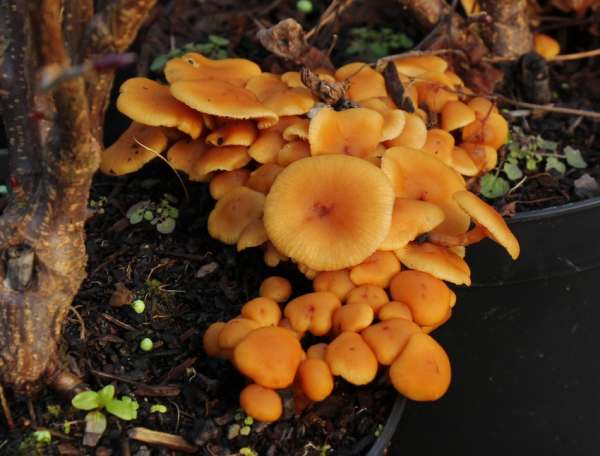
The Velvet Shank mushrooms shown imnmediately above and in the picture below were found growing in plant pots in a nursery in Cornwall, England in January 2014. The pots contain a mixture of peat and woodchip, and it is on the woodchip that the mushrooms are feeding.
Distribution
From autumn through winter and into early spring, Flammulina velutipes is fairly common throughout Britain and Ireland; it also occurs in most parts of Mainland Europe, North Africa and Asia as well as in North America. Molecular research suggests the possibility that two or more species may be covered under the name Flammulina velutipes, in which case the distribution of individual species may not coincide with the whole of the range quoted here.
Taxonomic history
This species was described by Moses Ashley Curtis (1808 - 1872), who called it Agaricus velutipes - in the early days of fungus taxonomy most gilled mushrooms were placed in a huge Agaricus genus, most of whose contents have since been redistributed to many other genera. Flammulina velutipes was moved to its present genus in 1947 by the German-born mycologist Rolf Singer. Deprecated synonyms include Agaricus velutipes Curtis, Gymnopus velutipes (Curtis) Gray, and Collybia velutipes Rea.
Etymology
The generic name Flammulina is a reference to the orange caps, which shine like 'little flames' in the winter sunshine. This mushroom's specific epithet is very understandable, because velutipes means 'with velvet legs', and that's exactly what the stems of these winter fungi look and feel like.
Identification Guide
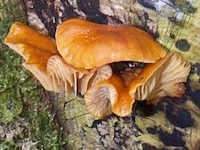 |
Cap2 to 10cm across and often distorted because of neighbouring caps in the cluster, the bright orange caps of Flammulina velutipes are generally somewhat darker towards the centre. Slimy in wet weather, the caps dry to a smooth sheen. |
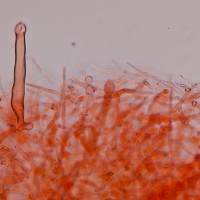 |
PileipellisThe pileipellis (cap surface) is an ixotrichodermium of filamentous, often branched hyphal tips and occasional narrowly ventricose or hair-like pileicystidia (two of which, both noticeably capitate, are visible in the enlarged version of the image shown here). Pileipellis of Flammulina velutipes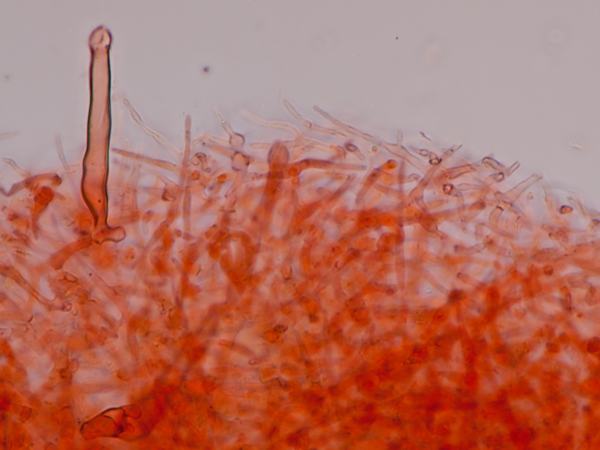 |
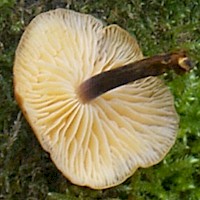 |
GillsAdnate and broad, the gills of Velvet Shank fungi are white at first becoming pale yellow as the fruitbody matures. (The gills of cultivated fiorms of this mushroom usually remain white.) StemThe stem is tough and covered in a fine velvety down. Usually pale near the cap, the stems often turn brown towards the base. |
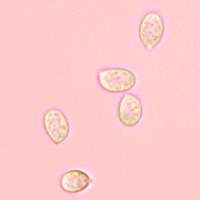 |
SporesEllipsoidal, smooth, 6.5-10 x 3-4µm; inamyloid. Spore printWhite. Spores of Flammulina velutipes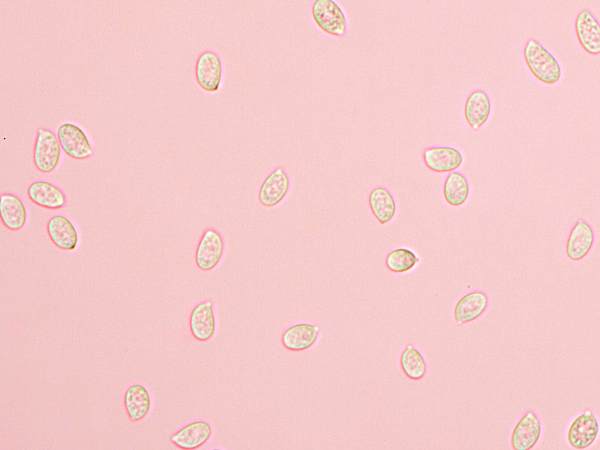 |
Odour/taste |
Not distinctive. |
Habitat & Ecological role |
Velvet Shank fungi are saprobic on stumps and trunks of dead hardwood trees, especially Beech, and occasionally on diseased living trees. |
Similar species |
Kuehneromyces mutabilis, the Sheathed Woodtuft or Brown Stew Fungus, has a similar cap but darker gills and brown spores. |
Culinary Notes
Flammulina velutipes provides the mushroom forager with something to look out for at a time of year (mainly December and January in Britain and Ireland) when the cold weather deters nearly all other edible fungi from fruiting. Although the stems are tough and best discarded, the caps of wild Velvet Shank mushrooms are quite highly prized and can be used to make mushroom soup as well as being very good in rissotto dishes. They must always be cooked, as applies to nearly all wild mushrooms. Extracts from this mushroom show exceptionally high anti-cancer activity, and an epidemiology survey of Flammulina velutipes (Enokitake) farmers in Japan found that the mushroom farmers had lower rates of cancer deaths than people who were not involved in mushroom farming.
Reference Sources
Fascinated by Fungi, 2nd Edition, Pat O'Reilly 2016, reprinted by Coch-y-bonddu Books in 2022.
Dictionary of the Fungi; Paul M. Kirk, Paul F. Cannon, David W. Minter and J. A. Stalpers; CABI, 2008
Taxonomic history and synonym information on these pages is drawn from many sources but in particular from the British Mycological Society's GB Checklist of Fungi.
Treatment of cancer with mushroom products; Monro J A., Arch. Environ. Health. 2003 Aug; 58(8); pp533-537.
Acknowledgements
This page includes pictures kindly contributed by David Kelly, Nigel Kent and Jim Stephens.
Fascinated by Fungi. Back by popular demand, Pat O'Reilly's best-selling 450-page hardback book is available now. The latest second edition was republished with a sparkling new cover design in September 2022 by Coch-y-Bonddu Books. Full details and copies are available from the publisher's online bookshop...