
Gomphidius glutinosus (Schaeff.) Fr. - Slimy Spike
Phylum: Basidiomycota - Class: Agaricomycetes - Order: Boletales - Family: Gomphidiaceae
Distribution - Taxonomic History - Etymology - Identification - Culinary Notes - Reference Sources
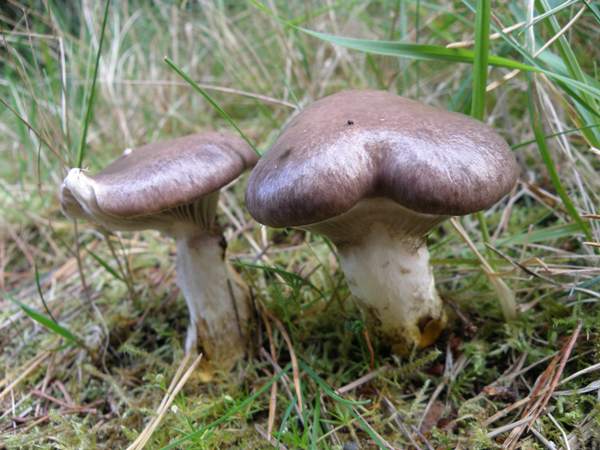
Gomphidius glutinosus, a gilled fungus of the order Boletales, is found beneath spruce trees (genus Picea). The cap of this pale spike is much more slimy than other members of its genus, and in wet weather the whole of the mushroom is slimy, the cap eventually drying with a polished sheen. This gilled bolete, with a greyish-fawn to purplish-brown cap, is similar in dimensions and form to the Copper Spike, Chroogomphus rutilus, but grows under pines; its spore print is also dark brown to nearly black with a purple tinge.
Distribution
Rare in southern Britain and Ireland, the Slimy Spike is more common in northern Scotland and in Scandinavia.
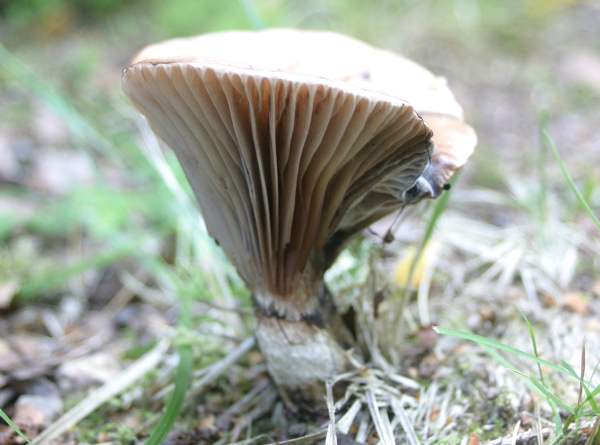
The specimens shown above and on the left were seen growing on the edge of a mixed spruce and pine forest in northern Scotland.
Taxonomic history
The Slimy Spike was first described scientifically in 1762 by Jacob Christian Schaeffer, who gave it the binomial name Agaricus glutinosus. (Most gilled fungi were in those days placed initially in the Agaricus genus, since pared down by redistribution of most of its contents to other, newer genera.) The currently accepted scientific name of this species dates from 1838 when the great Swedish mycologist Elias Magnus Fries transferred it to the genus Gomphidius.
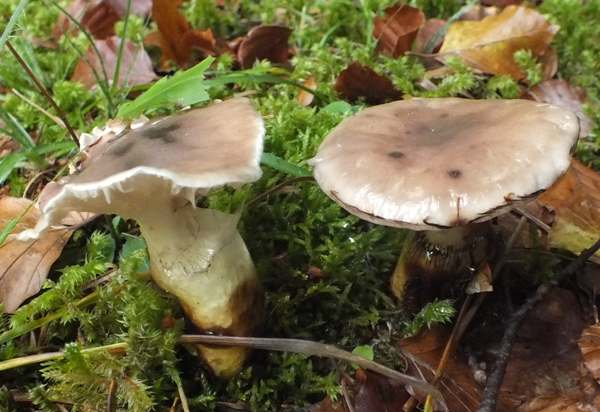
Perhaps because it is both spectacular and variable, there are many synonyms of Gomphidius glutinosus including Agaricus glutinosus Schaeff., Agaricus velatus With., Agaricus viscidus var. atropunctus Pers., Cortinarius viscidus ß atropunctus (Pers.) Gray, and Gomphus glutinosus (Schaeff.) P. Kumm.
Within the Boletales, the 'spikes' are more closely related to Suillus than to Boletus, which may partly explain their mycorrhizal preference for pines and other coniferous trees. The Slimy Spike has been found under pines where the only other boletes fruiting at the time were Suillus grevillei.
Etymology
Gomphidius comes from the Greek 'gomphos', a large conical (wedge-like) nail or bolt with a large head, made of either metal or wood and used mainly in ship-building. The conical shape of the fruitbodies means that they look somewhat like those ancient bolts.
The specific epithet glutinosus hardly needs explaining, but for completeness it comes from Latin and means glutinous.
Identification guide
 |
Cap5 to 12cm in diameter (exceptionally 15cm) the slimy greyish-violet caps are initially convex, becoming flat and often developing a a somewhat spiky central umbo. |
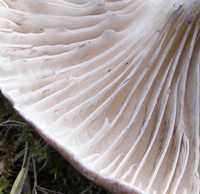 |
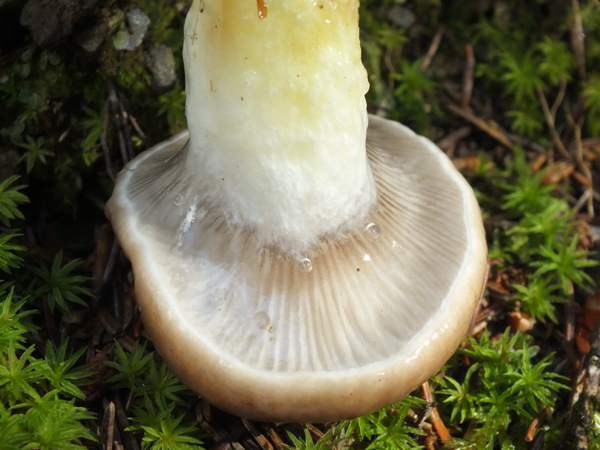
GillsAlthough from its spore characteristics this species is seen to be more closely related to the boletes than to the agaric fungi, it produces its spores via gills rather than pores. The distant, deeply decurrent gills are initially almost white, buff or dull grey, developing a purple-grey tinge at maturity but not reddening (like Chroogomphus rutilus) and note developing rusty spots and then blackening (as Gomphidius maculatus does). |
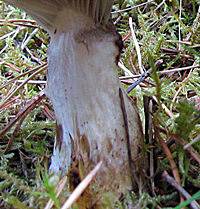 |
Stem1 to 2cm in diameter and usually 3 to 10cm tall, the stems are white at the apex and greyish-brown below, often flushed chrome yellow near the base; covered in slimy gluten. When young a glutinous veil connects the stem and the cap margin; when this veil breaks it leaves a visible neck just below the apex of the stem and a faint ring zone that soon blackens. |
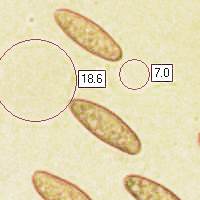 |
SporesSubfusiform, smooth, 17-20 x 5.5-7μm. Spores of Gomphidius glutinosus, Slimy Spike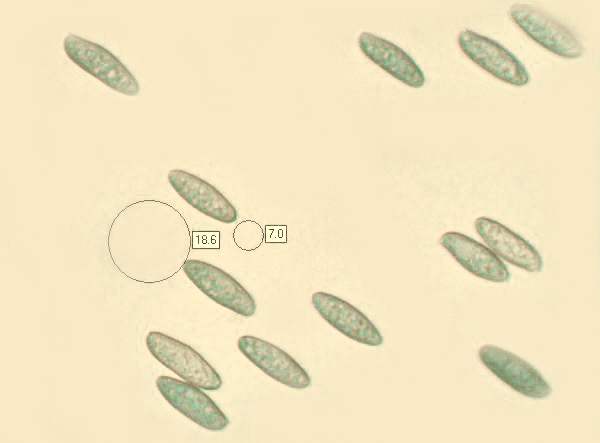 Spore printDark sepia-brown. |
Odour/taste |
Not distinctive. |
Habitat & Ecological role |
In grass or needle litter beneath spruce trees. |
Season |
August to November in Britain and Ireland. |
Similar species |
Chroogomphus rutilus is a much more common find, occurring under pines; its cap is copper coloured. |
Culinary Notes
This largish fleshy mushroom is generally reported to be edible but not recommended. We know of no recipes devised for this particular species, and its rarity is further justification for not gathering the Slimy Spike mushroom for the pot.
Reference Sources
Fascinated by Fungi, 2nd Edition, Pat O'Reilly 2016, reprinted by Coch-y-bonddu Books in 2022.
Dictionary of the Fungi; Paul M. Kirk, Paul F. Cannon, David W. Minter and J. A. Stalpers; CABI, 2008
Taxonomic history and synonym information on these pages is drawn from many sources but in particular from the British Mycological Society's GB Checklist of Fungi.
Fascinated by Fungi. Back by popular demand, Pat O'Reilly's best-selling 450-page hardback book is available now. The latest second edition was republished with a sparkling new cover design in September 2022 by Coch-y-Bonddu Books. Full details and copies are available from the publisher's online bookshop...