Gymnopilus sapineus (Fr.) Maire - Scaly Rustgill
Phylum: Basidiomycota - Class: Agaricomycetes - Order: Agaricales - Family: Strophariaceae
Distribution - Taxonomic History - Etymology - Toxicity - Identification - Reference Sources
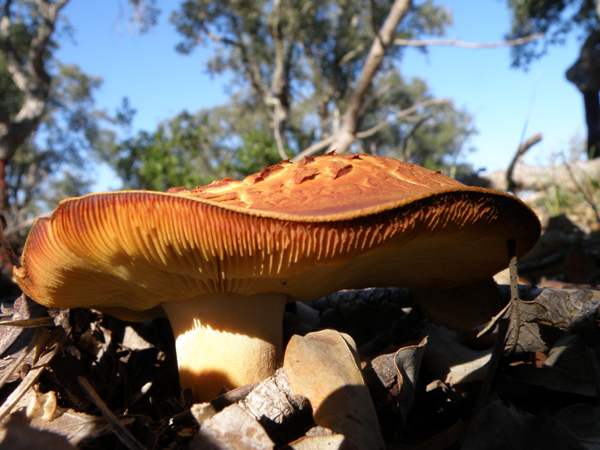
Growing on dead conifer wood, most particularly of pine trees, buried in the litter of the forest floor, this beautiful mushroom is fairly common but easily confused with other members of its genus, nearly all of which have orange caps.
The easiest of the rustgills to identify is Gymnopilus junonius, the Spectacular Rustgill, which often grows on the trunks of ailing trees; it is the only large orange Gymnopilus with a persistent stem ring.
Distribution
The Scaly Rustgill is an infrequent find in Britain and Ireland, but this species is much more common in southern Europe. The Scaly Rustgill is also recorded in many parts of North America.
Taxonomic history
Described in 1821 by Elias Magnus Fries, who named it Agaricus sapineus, the Scaly Rustgill was transferred to the genus Gymnopilus in 1933 by French mycologist René Charles Joseph Ernest Maire (1878 - 1949), thus establishing its currently-accepted scientific name Gymnopilus sapineus.
Synonyms of Gymnopilus sapineus include Agaricus sapineus Fr., Flammula sapinea (Fr.) P. Kumm., and Fulvidula sapinea (Fr.) Romagn.
Etymology
Gymnopilus was proposed as a new genus name in 1879 by the Finnish mycologist Petter Adolf Karsten (1834 - 1917). The origin of this generic name is the prefix Gymn- meaning naked, and the suffix -pilus which means cap - hence naked or bald caps would normally be an expected feature of the mushrooms in this genus.
The specific epithet sapineus means 'of fir or pine' (trees) - a reference to the habitat in which this species occurs.
Toxicity
The Scaly Rustgill is inedible and may even be poisonous; certainly some Gymnopilus fungi have been found to contain seriously poisonous chemicals. Smooth-capped forms of this mushroom can be separated reliably from the Common Rustgill Gymnopilus penetrans only by examination of microscopic characters.
Identification guide
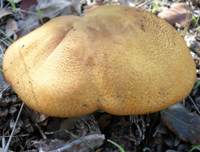 |
Cap4 to 9cm across; becoming almost flat but retaining a broad central umbo; felted when young, usually (but not always) breaking up into scales and sometimes cracking; orange-brown with reddish-brown scales. |
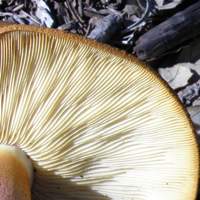 |
GillsAdnate; crowded; initially yellow, soon turning orange and later reddish-brown. |
Stem |
4 to 7cm long and 0.6 to 1.5cm in dia., cylindrical or (more often) tapering towards the base; smooth, occasionally with fine longitudinal fibres; yellowish flushed with cap colour, bruising brown; no stem ring. |
SporesEllipsoidal to almond-shaped, warty, 7-9 x 4-5µm. Spore printRusty brown. |
|
Odour/taste |
Odour slight and mushroomy; taste sometimes but not always bitter. |
Habitat & Ecological role |
Saprobic, on stumps and on buried wood in the forest floor of coniferous woodland. |
Season |
June to November in Britain and Ireland; through to the New Year in Mediterranean countries. |
Occurrence |
Infrequent in Britain and Ireland but common in southern Europe. |
Similar species |
Gymnopilus junonius is larger and retains a stem ring; it occurs in woodland habitat, but unlike Gymnopilus sapineus it is seen more often on hardwood stumps and ailing trees, and only occasionally on conifers. Scaly specimens of Gymnopilus penetrans can look very similar but they differ in the microscopic features of, for example, the cap surface and gill-edge cystidia - attempting to separate the two is not for the fainthearted. Phaeolepiota aurea is a rare mushroom with a granulase cap and lower stem; its spores are light yellow-brown. |
Reference Sources
Pat O'Reilly (2016). 2nd edition; First Nature.
Lincoff, G. and D. J. Mitchel. (1977). Toxic and Hallucinogenic Mushroom Poisoning. Van Nostrand Reinhold, New York.
Bresinsky A, Besl H. (1990). A Colour Atlas of Poisonous Fungi. Wolfe Publishing. ISBN 0-7234-1576-5.
Dictionary of the Fungi; Paul M. Kirk, Paul F. Cannon, David W. Minter and J. A. Stalpers; CABI, 2008
Taxonomic history and synonym information on these pages is drawn from many sources but in particular from the British Mycological Society's GB Checklist of Fungi.
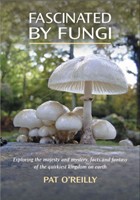
Fascinated by Fungi. Back by popular demand, Pat O'Reilly's best-selling 450-page hardback book is available now. The latest second edition was republished with a sparkling new cover design in September 2022 by Coch-y-Bonddu Books. Full details and copies are available from the publisher's online bookshop...