
Helvella crispa (Scop.) Fr. - White Saddle
Phylum: Ascomycota - Class: Pezizomycetes - Order: Pezizales - Family: Helvellaceae
Distribution - Taxonomic History - Etymology - Identification - Culinary Notes - Reference Sources
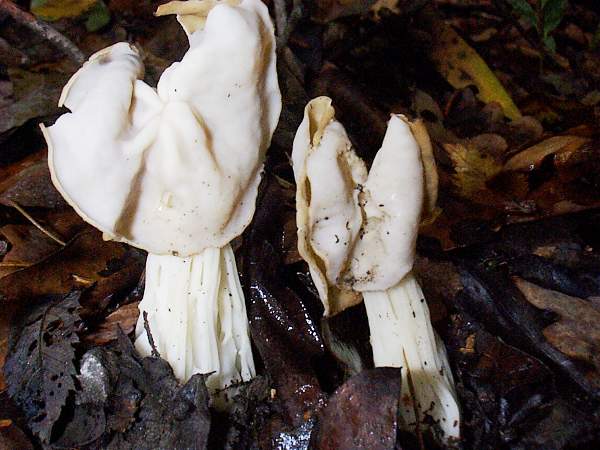
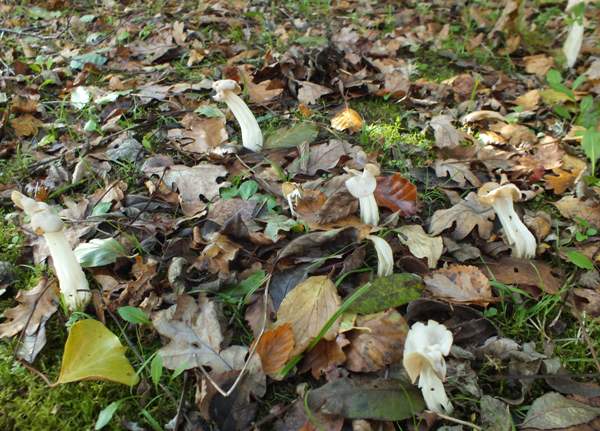
Helvella crispa is one of several 'saddle fungi' that appear in forests, particularly beside footpaths. They are easily overlooked among fallen leaves in dim light, but on bright days these brilliant lighthouse-like fungi are very easy to spot.
Distribution
Common in Britain and Ireland, particularly in Beech woodlands, Helvella crispa occurs throughout mainland Europe and is also recorded from many parts of North America.
Taxonomic history
In 1772 when Giovanni Antonio Scopoli described this woodland mushroom he gave it the binomial scientific name Phallus crispa. This suggests that Scopoli considered it to be a close relative of the stinkhorns such as Phallus impudicus. It's not, of course, because stinkhorns are basidiomycetes and the White Saddle is an ascomycete fungus. It was the great Swedish mycologist Elias Magnus Fries who in 1822 transferred this species to the genus Helvella, renaming it Helvella crispa.
Synonyms of Helvella crispa include Helvella mitra Bolton, and Phallus crispus Scop.
Etymology
Helvella is an ancient term for an aromatic herb. The specific epithet crispa comes from Latin and means curled or wrinkled - a reference to the contorted cap or saddle of this woodland fungus.
Mushrooms in this genus are sometimes referred to as Elfin Saddles, and you may wonder why not Fairy, Pixie or Goblin Saddles, for instance. American mycologist Michael Kuo offers a plausible answer when he reminds us that the original name that Elias Magnus Fries provided for the genus was Elvella rather than Helvella - so perhaps elves really do ride on these woodland fungi in the dead of night.
Identification guide
 |
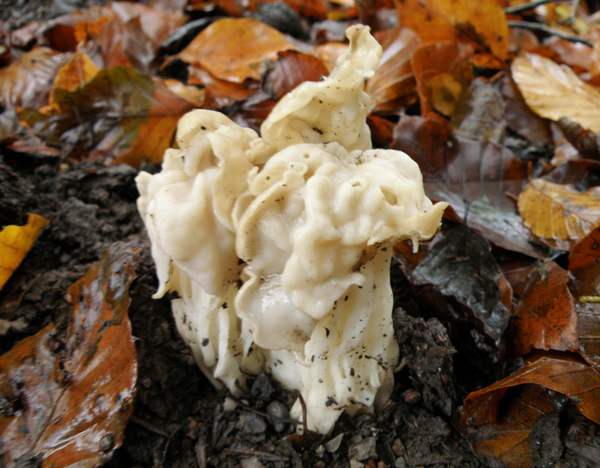
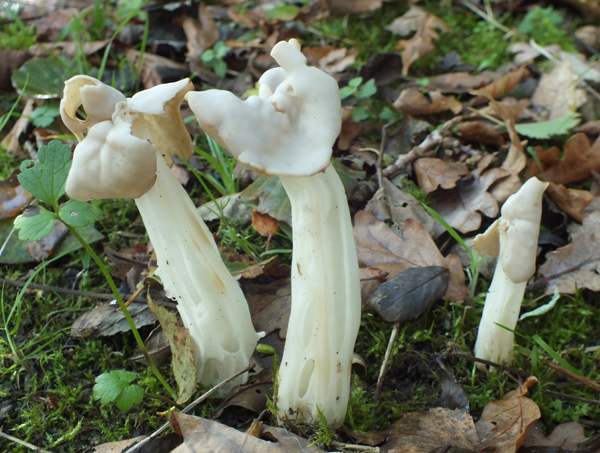
FruitbodyThe saddle-shaped cap may have two or three major undulations and many minor curled contortions. The upper surface is smooth and cream or occasionally pinkish or pale ochre; the underside is pale ochre and slightly downy. The upward tapering stem is white and ornately furrowed or fluted; it is hollow and has thin, elastic flesh. This species is very variable in size. The cap is typically 3 to 8cm across and 1 to 4cm tall; the stem is 2 to 4cm in diameter and 4 to 8cm long. |
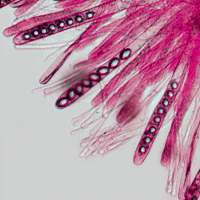 |
AsciTypically 300 x 18μm. Each ascus contains eight spores. Asci and paraphyses of Helvella crispa, White Saddle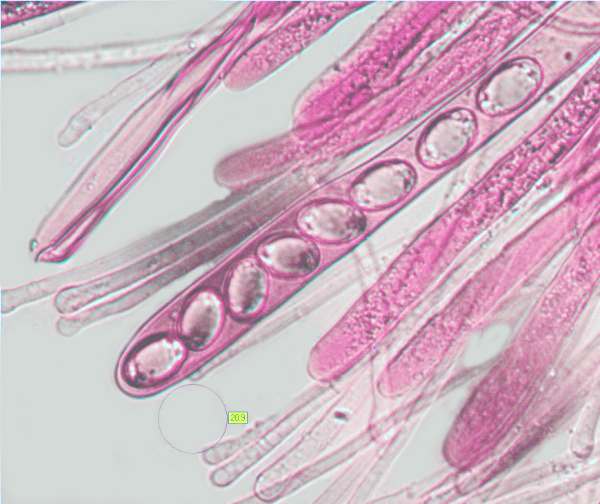 |
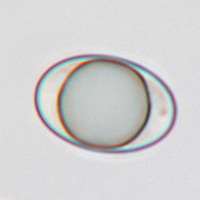 |
SporesEllipsoidal, 18-20 x 10-13µm; hyaline. Spores of Helvella crispa, White Saddle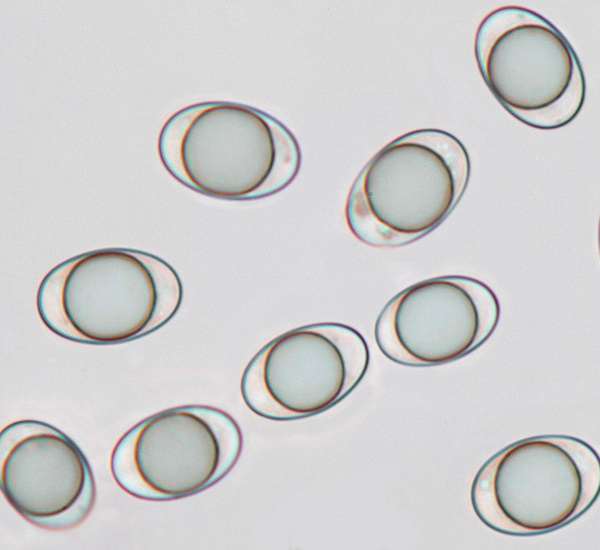 Spore printWhite. |
Odour/taste |
Faint odour; no distinctive taste. |
Habitat & Ecological role |
Believed to be mycorrhizal, under broadleaf trees, particularly beech and oak, and very often beside well-trodden paths. |
Season |
Summer and autumn. |
Similar species |
Helvella elastica has a tough, smooth stem without channels. Helvella lacunosa has a grey-brown or black cap. |
Culinary Notes
Field guides that cover edibility as a topic generally state that Helvella crispa is 'edible but of poor quality'; however, it is well documented that White Saddles can cause stomach upsets unless very thoroughly cooked, at which point they tend to lack both texture and taste.
There is also concern that Helvella fungi may contain carcinogens. What's the point of taking risks for such a dubious gain?
Acknowledgements
This page includes photographs that are shown with the kind permission of James Cook and David Kelly.
Reference Sources
Fascinated by Fungi, 2nd Edition, Pat O'Reilly 2016, reprinted by Coch-y-bonddu Books in 2022.
Dennis, R.W.G. (1981). British Ascomycetes; Lubrecht & Cramer; ISBN: 3768205525.
Breitenbach, J. & Kränzlin, F. (1984). Fungi of Switzerland. Volume 1: Ascomycetes. Verlag Mykologia: Luzern, Switzerland.
Medardi, G. (2006). Ascomiceti d'Italia. Centro Studi Micologici: Trento.
British Mycological Society (2013). English Names for Fungi
Dictionary of the Fungi; Paul M. Kirk, Paul F. Cannon, David W. Minter and J. A. Stalpers; CABI, 2008
Taxonomic history and synonym information on these pages is drawn from many sources but in particular from the British Mycological Society's GB Checklist of Fungi.
Fascinated by Fungi. Back by popular demand, Pat O'Reilly's best-selling 450-page hardback book is available now. The latest second edition was republished with a sparkling new cover design in September 2022 by Coch-y-Bonddu Books. Full details and copies are available from the publisher's online bookshop...