
Hydnum rufescens Pers. - Terracotta Hedgehog
Phylum: Basidiomycota - Class: Agaricomycetes (insertae sedis) - Order: Cantharellales - Family: Hydnaceae
Distribution - Taxonomic History - Etymology - Identification - Culinary Notes - Reference Sources
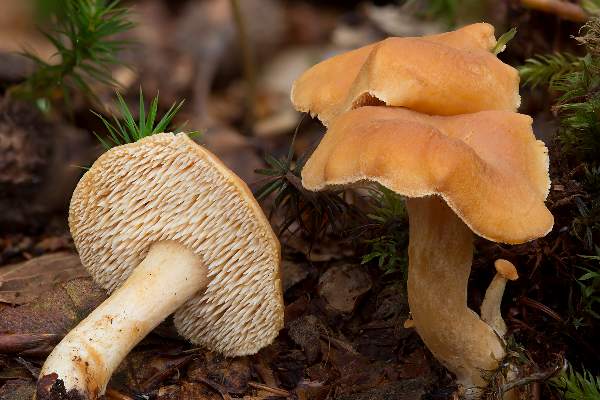
This mushroom grows in all kinds of woodland. Its cap colour that is perfectly described by the common name Terracotta Hedgehog. Other names given to this mushroom include Terracotta Wood Urchin and Rufous Hedgehog.
Distribution
Fairly common in Britain and Ireland, Hydnum rufescens is found throughout mainland Europe. This species has also been reported from the eastern side of North America.
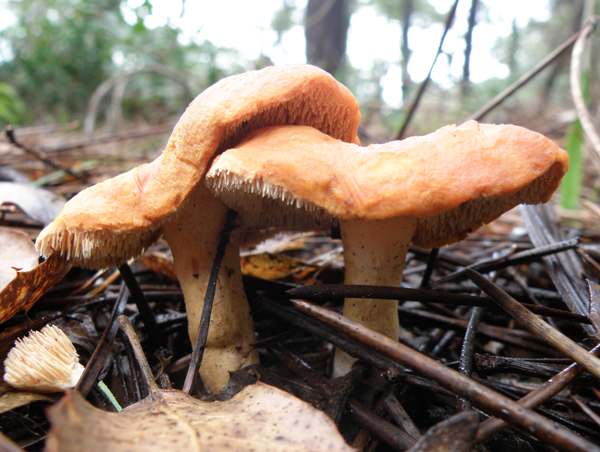
Both the Terracotta Hedgehog and its close relative the Wood Hedgehog Hydnum repandum tend to be gregarious, forming small clumps and occasionally fairy circles.
Taxonomic history
In 1801, when Christiaan Hendrick Persoon described this mushroom, he gave it the binomial name Hydnum rufescens, which still is its generally accepted scientific name.
Synonyms of Hydnum rufescens include Dentinum rufescens (Pers.) Gray, and Hydnum repandum var. rufescens (Pers.) Barla.
Etymology
Hydnum, the genus name, comes from the Greek noun udnon or hudnon, a truffle. The specific epithet rufescens means becoming rufous (reddish-brown).
Identification guide
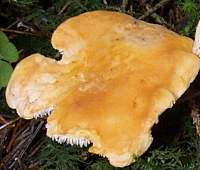 |
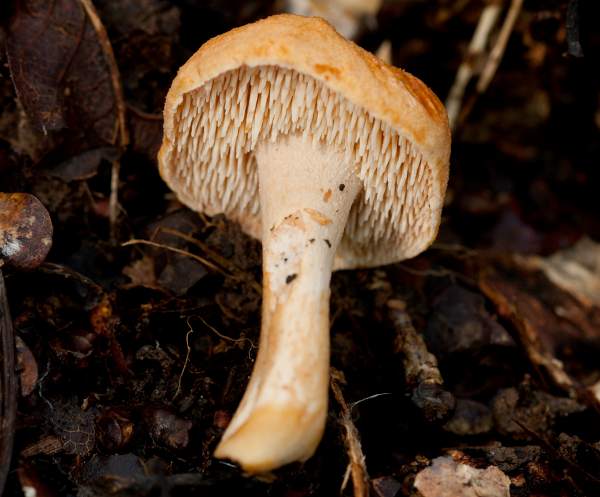
CapThe cap is 2 to 6cm in diameter orange-red or pale tan, smooth and slightly felty to the touch; it is often perched eccentrically upon the stipe. The flesh is pink.
|
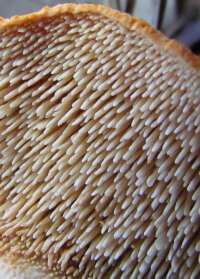 |
SpinesHanging down like stalactites, soft spines cover the fertile surface beneath the cap. Unlike those of its close relative, Hydnum repandum, the pink spines of this species are adnexed or almost free rather than decurrent to the stem. When fully developed, the spines are 2 to 4mm long. StemPinkish white and solid with white flesh, stems of the Terracotta Hedgehog are 2 to 4cm tall and typically 1.5 to 3cm in diameter. |
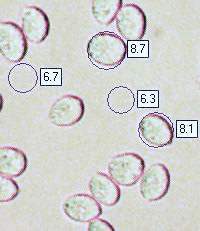 |
SporesEllipsoidal, smooth, 6.5-8 x 5.5-7μm. Spore printWhite. |
Odour/taste |
Odour not distinctive; taste is initially mild but turns bitter in the mouth after a few moments delay. |
Habitat & Ecological role |
Ectomycorrhizal with conifers and probably also with broadleaf trees; often forming rings or arcs among the moss and leaf litter of the forest floor. |
Season |
August to December in Britain and Ireland. |
Similar species |
Hydnum repandum is larger and cream coloured; its spines are decurrent to the stem rather than adnexed. |
Culinary Notes
Hydnum rufescens is a popular edible species, but it should be picked while young and free from worms and grubs. The Terracotta Hedgehog is delicious in all sorts of dishes from soups and risottos to our own favourite invention which we call 'Hedgehogs on Toast'.
Reference Sources
Fascinated by Fungi, 2nd Edition, Pat O'Reilly 2016, reprinted by Coch-y-bonddu Books in 2022.
British Mycological Society English Names for Fungi
Dictionary of the Fungi; Paul M. Kirk, Paul F. Cannon, David W. Minter and J. A. Stalpers; CABI, 2008
Taxonomic history and synonym information on these pages is drawn from many sources but in particular from the British Mycological Society's GB Checklist of Fungi.
Acknowledgements
This page includes pictures kindly contributed by David Kelly.
Fascinated by Fungi. Back by popular demand, Pat O'Reilly's best-selling 450-page hardback book is available now. The latest second edition was republished with a sparkling new cover design in September 2022 by Coch-y-Bonddu Books. Full details and copies are available from the publisher's online bookshop...