
Inocybe sindonia (Fr.) P. Karst. - Beige Fibrecap
Phylum: Basidiomycota - Class: Agaricomycetes - Order: Agaricales - Family: Inocybaceae
Distribution - Taxonomic History - Etymology - Identification - Toxicity - Reference Sources
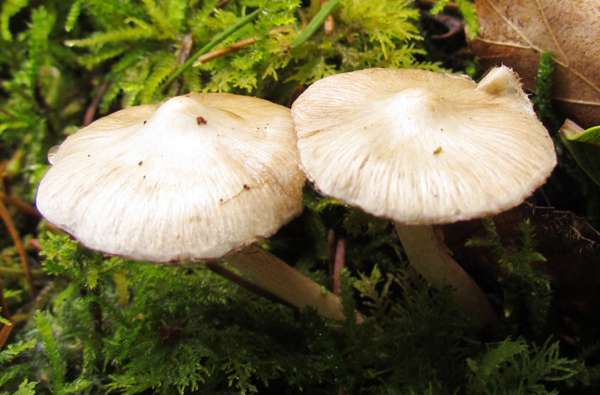
Inocybe sindonia is not a common species in northern Europe, although it is found quite frequently in some parts of southern Europe. This mushroom has recently been given (by the British Mycological Society) the common name Beige Fibrecap.
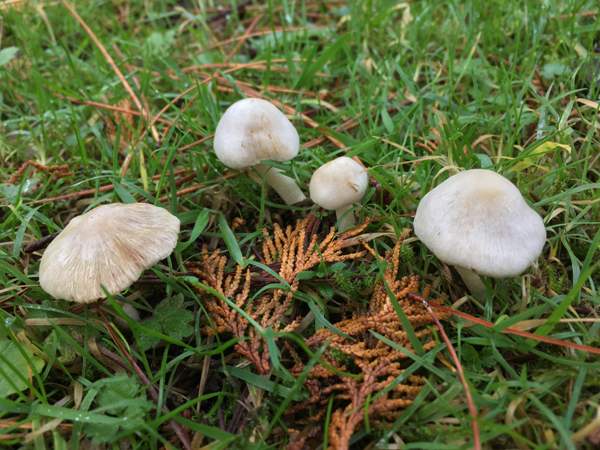
Particularly in areas of heavy clay soil, look out for this smallish but pale and so not hard-to-spot fibrecap in woods; it occurs in broadleaf woodlands and in conifer plantations.
Inocybe is a difficult genus, with numerous 'little brown mushrooms' (LBMs as they are commonly called) that to the naked eye appear to be identical until they are examined under a microscope. Alan Outen and Penny Cullington have produced a very detailed key, without which I would not want even to attempt identification of fibrecap mushrooms. It takes time: this is not a simple process, but it is very straightforward to follow. You need specimens in prime condition complete with any basal bulb, and it is crucial to minimise handling, otherwise this may remove caulocystidia (stem cystidia) or other identifying features. See the references section below.
Distribution
Inocybe sindonia is a fairly common and widespread woodland species throughout Britain and Ireland. These toxic little toadstools are found in most parts of mainland Europe, and they are also recorded as common in eastern North America.
Taxonomic history
In 1838 the famous Swedish mycologist Elias Magnus Fries described this fibrecap, giving it the binomial scientific name Agaricus sindonius. It was Finnish mycologist Petter Adolf Karsten (1834 - 1917) who in 1879 transferred this species to the genus Inocybe, whereupon it acquired its currently-accepted scientific name Inocybe sindonia.
Synonyms of Inocybe sindonia include Agaricus sindonius Fr., Agaricus muticus Fr., Inocybe mutica (Fr.) Sacc., Inocybe commutabilis Furrer-Ziogas, Inocybe kuehneri Stangl & J. Veselský, and Inocybe eutheles.
Etymology
Inocybe, the genus name, means 'fibrous head', while the specific epithet rimosa is derived from the Latin adjective sindonius whose meaning is currently unknown to me. Any help with this would be much appreciated.
Toxicity
Inocybe sindonia is a poisonous and fairly common species that grows in habitats where people expect to find edible mushrooms. That makes it very dangerous . The symptoms of poisoning by this and several similar Inocybe species are those associated with muscarine poisoning. Excessive salivation and sweating set in within half an hour of eating these fungi. Depending on the amount consumed, victims may also suffer abdominal pains, sickness and diarrhoea, together with blurred vision and laboured breathing. Deaths of otherwise healthy people from eating these fungi are not reported. Anyone with a weakened heart or with respiratory problems is much more at risk.
Identification guide
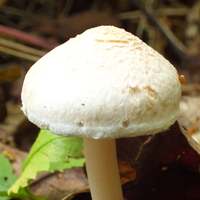 |
Cap2 to 6cm in diameter, obtusely conical-convex, not flattening completely and often retaining a small umbo; finely fibrillose at first, eventually tending to become finely scaly. Beneath the cap surface the flesh is whitish. |
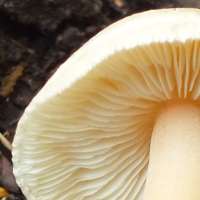 |
GillsThe crowded, adnexed gills start off greyish-yellow and they darken a little with age. Stem2 to 8mm in diameter and 2.5 to 10cm tall, the pale stem is cylindrical, sometimes with a slightly swollen or clavate base; pruinose; whitish, sometimes with a pinkish tinge in the upper part. |
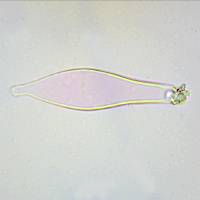 |
PleurocystidiaPleurocystidia (cystidia on the gill faces) are thick walled and abundant; elongated fusoids typically 15 x 60µm with apical encrustations. Show larger imagePleurocystidium of Inocybe sindonia Beige Fibrecap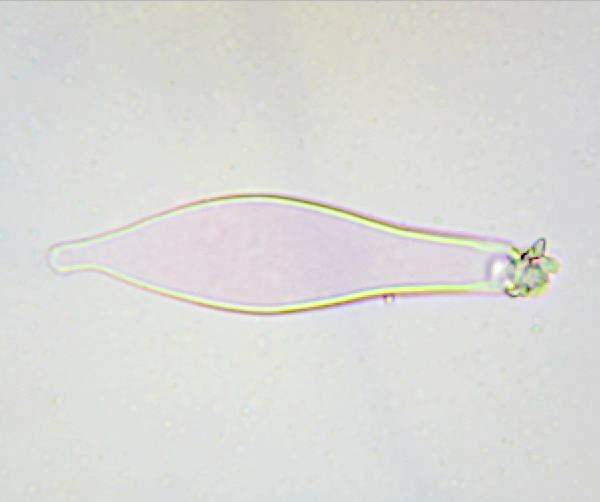 |
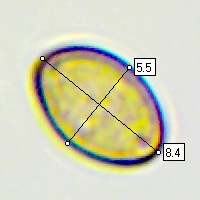 |
SporesEllipsoidal to ovoid, smooth, 7.5-10 x 5-6µm. Show larger imageSpores of Inocybe sindonia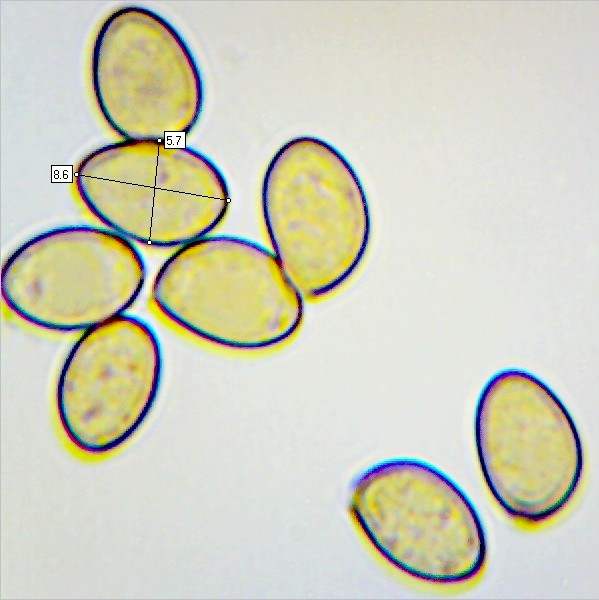 Spore printDull brown. |
Odour/taste |
Not distinctive - but note that this is a poisonous mushroom. |
Habitat & Ecological role |
Beneath deciduous trees and conifers. |
Season |
Late August to November in Britain and Ireland |
Similar species |
The white variety of Inocybe geophylla is rather smaller and paler. |
Reference Sources
Fascinated by Fungi, 2nd Edition, Pat O'Reilly 2016, reprinted by Coch-y-bonddu Books in 2022.
BMS List of English Names for Fungi
Alan Outen and Penny Cullington (2009), Keys to the British Species of Inocybe.
Dictionary of the Fungi; Paul M. Kirk, Paul F. Cannon, David W. Minter and J. A. Stalpers; CABI, 2008
Taxonomic history and synonym information on these pages is drawn from many sources but in particular from the British Mycological Society's GB Checklist of Fungi.
Acknowledgement
This page includes pictures kindly contributed by Simon Harding.
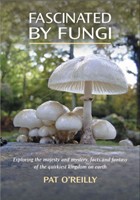
Fascinated by Fungi. Back by popular demand, Pat O'Reilly's best-selling 450-page hardback book is available now. The latest second edition was republished with a sparkling new cover design in September 2022 by Coch-y-Bonddu Books. Full details and copies are available from the publisher's online bookshop...