
Kuehneromyces mutabilis (Schaeff.) Singer & A.H. Sm. - Sheathed Woodtuft
Phylum: Basidiomycota - Class: Agaricomycetes - Order: Agaricales - Family: Strophariaceae
Distribution - Taxonomic History - Etymology - Identification - Culinary Notes - Reference Sources
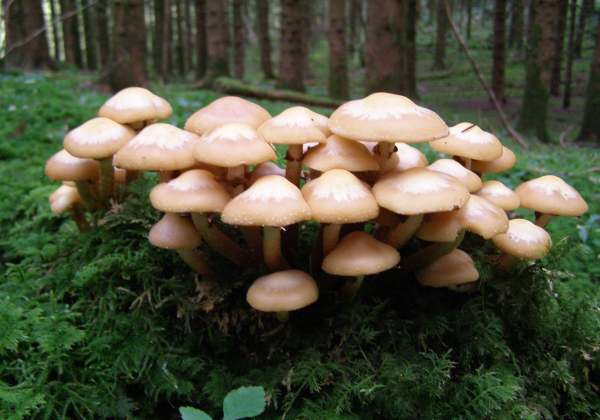
Other common names for this attractive species are Brown Stew Fungus and Two-toned Pholiota, so-called because the hygrophanous cap is a shiny cinnamon-orange when wet but it dries a much lighter tan colour.
This attractive, edible fungus appears throughout the year, often in large tufts, on stumps of hardwood (broadleaf) trees. In older field guides you may find it recorded under the synonyms Galerina mutabilis or Pholiota mutabilis.
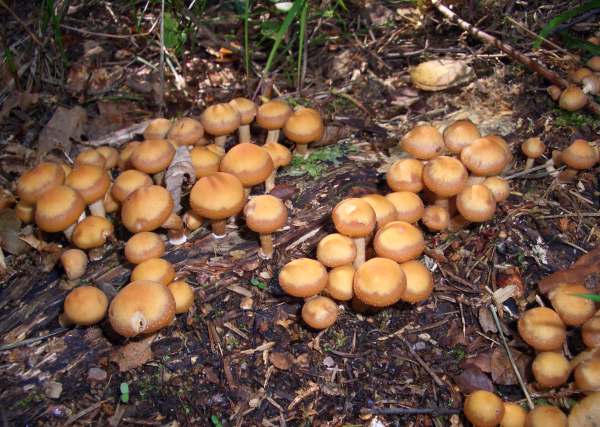
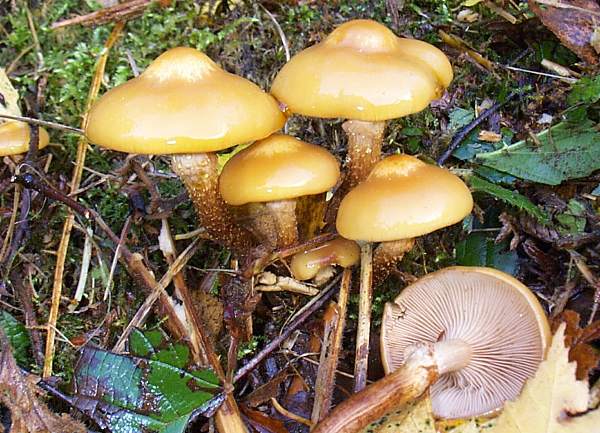
Occasionally these colourful little mushrooms appear to be growing on the forest floor, but in my experience if you scrape away the surface layer of leaf litter and twigs you will find, as in this picture taken in Finland by Lena Mickelsson, that they are feeding saprobically on buried timber.
Distribution
This wood-rotting mushroom is widespread and very common throughout Britain and Ireland as well as in all other European countries from Scandinavia to the Mediterranean and in many parts of Asia.
Kuehneromyces mutabilis is also native to Australia and to North America, where it is equally widespread and abundant. (If looking for information about this mushroom in the USA it is worth searching under the genus Pholiota, in which some American mycologists place it).
Taxonomic history
Jacob Christian Schaeffer described this species in 1762, calling it Agaricus mutabilis. (Most gilled fungi were initially placed in a giant Agaricus genus, but the majority have since been redistributed to other genera leaving the 'true mushrooms' in Agaricus.) The present scientific name Kuehneromyces mutabilis dates from 1946, when Rolf Singer and Alexander Hanchet Smith (1904 - 1986) established the Kuehneromyces genus of wood tuft fungi.
Kuehneromyces mutabilis is the type species of the genus Kuehneromyces.
Etymology
The genus name is in honour of French mycologist Robert Kühner (1903 – 1996). The specific epithet mutabilis means changeable, and this is a reference to the very variable colouring of the caps depending on how damp they are.
This mushroom has acquired quite a few common names, and one of my favourites is 'Brown Stew Fungus', although I have never been adventurous enough to try these mushrooms in a stew because of the possibility of confusion with another very similar (to look at, but not to eat!) woodland mushroom that grows in the same habitat. Funeral Bell is its common name... need I say more?
Identification guide
 |
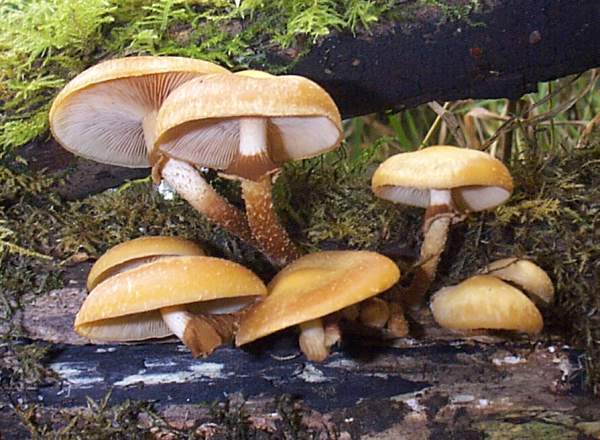
Cap3 to 8cm in diameter, convex becoming flattened with a broad umbo; bright tan, drying out to pale ochre from the centre and giving a two-toned (zonate) appearance. The cap flesh is pale tan and quite thin. This is a hygrophanous species, and it dries out from the centre so that the outer edge is darkest. This helps distinguish it from the poisonous Galerina marginata, which dries out paler from the rim towards the centre. |
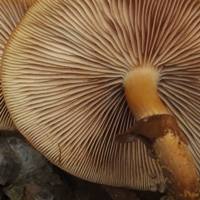 |
GillsAdnate and crowded, the gills are pale ochre at first and become cinnamon as the spores mature. StemPale and smooth above the ragged stem ring; fibrous, scaly and dark tan below, graduating to almost black at the base. 5 to 10mm in diameter and 3 to 8cm tall; usually curved. The flesh of the solid stem is pale tan at the apex, graduating to dark brown at the base. |
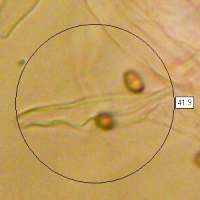 |
CheilocystidiaScattered but not abundant; most are narrowly langeniform or subcylindrical occasionally subcapitate; length 20-40µm; width 2.5-7µm. Cheilocystidia of Kuehneromyces mutabilis, Sheathed Woodtuft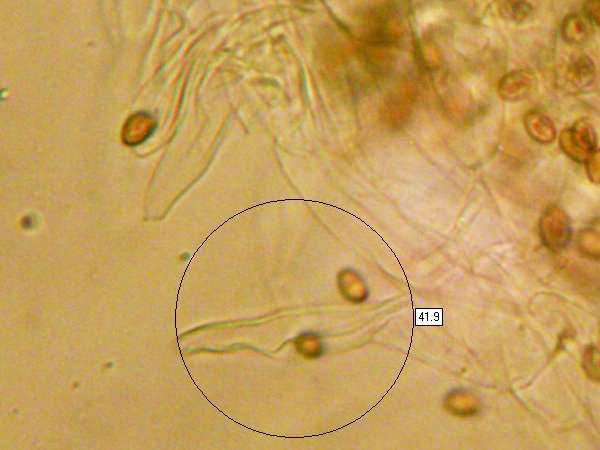 |
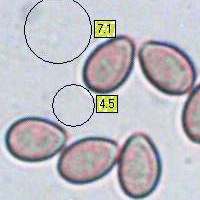 |
SporesBroadly ellipsoidal, smooth, 5.5-7.5 x 4-5µm; with an apical germ pore. Spores of Kuehneromyces mutabilis, Sheathed Woodtuft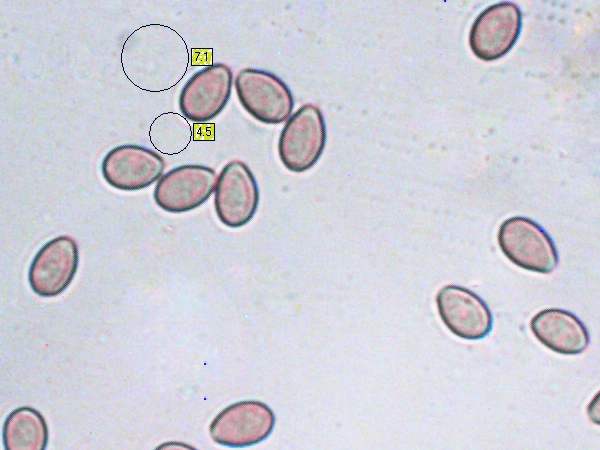 Spore printReddish-ochre to dark cinnamon brown. |
Odour/taste |
Not distinctive. |
Habitat & Ecological role |
Saprobic, on stumps, felled trunks and logs of broad-leaf trees, particularly birch. |
Season |
Throughout the year, but most plentiful in summer and autumn. |
Similar species |
Flammulina velutipes, commonly called Velvet Shank, has a darker, velvety stem and leaves a white spore print. Galerina marginata is very similar and sometimes only separable for certain by microscopic examination (e.g. it has larger spores); it is deadly poisonous. |
Culinary Notes
Most authorities say that the Sheathed Woodtuft is a fairly good edible mushroom provioded the tough fibrous stems are discarded. Only very experienced fungi foragers should consider gathering this species, because it is so easily confused with the deadly poisonous Funeral Bell,Galerina marginata. I must therefore recommend that this far-from-special mushroom should be treated as a species 'only for looking, not for cooking'.
Reference Sources
Pat O'Reilly; Fascinated by Fungi, 2016.
Dictionary of the Fungi; Paul M. Kirk, Paul F. Cannon, David W. Minter and J. A. Stalpers; CABI, 2008
British Mycological Society (2010). English Names for Fungi
Taxonomic history and synonym information on these pages is drawn from many sources but in particular from the British Mycological Society's GB Checklist of Fungi.
Fascinated by Fungi. Back by popular demand, Pat O'Reilly's best-selling 450-page hardback book is available now. The latest second edition was republished with a sparkling new cover design in September 2022 by Coch-y-Bonddu Books. Full details and copies are available from the publisher's online bookshop...