
Lacrymaria lacrymabunda (Bull.) Pat. - Weeping Widow
Phylum: Basidiomycota - Class: Agaricomycetes - Order: Agaricales - Family: Psathyrellaceae
Distribution - Taxonomic History - Etymology - Identification - Culinary Notes - Reference Sources
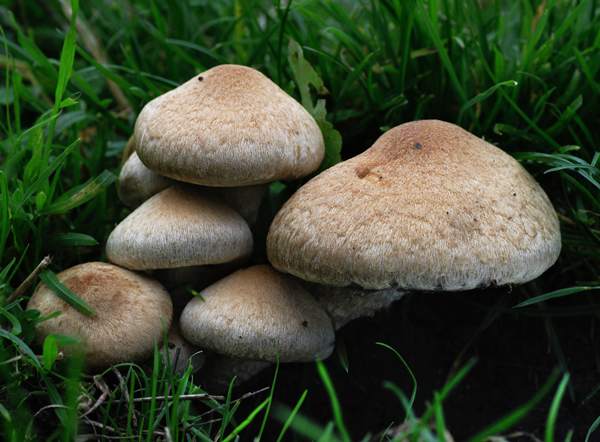
Commonly referred to as the Weeping Widow, because of the black, watery droplets that appear at the cap rim and on te edges of the gills when they are moist, this large grassland fungus is an occasional species in parkland, open woodland, lawns, fields and roadside verges.
The English name somehow seems particularly poignant when these sombre but gregarious mushrooms pop up to shed their tears beside gravestones in town and country churchyards.
Distribution
A fairly frequent find in most parts of Britain and Ireland, Lacrymaria lacrymabunda occurs throughout mainland Europe and is found also in many parts of in North America.
Taxonomic history
French mycologist Jean Baptiste Francois (Pierre) Bulliard described this species in 1785, giving it the binomial name Agaricus lacrymabundus. (In the early days of fungal taxonomy most gilled mushrooms were placed in one gigantic Agaricus grouping, which has since been broken up into many other genera, leaving in the Agaricus genus a relatively small group of the 'true mushrooms', as they are sometimes called.) It was another Frenchman, Narcisse Theophile Patouillard, whon in 1887 transferred the Weeping Widow to its present genus, establishing its currently-accepted scientific name as Lacrymaria lacrymabunda.
Synonyms of Lacrymaria lacrymabunda include Agaricus lacrymabundus Bull., Agaricus velutinus Pers., Agaricus lacrymabundus ß velutinus (Pers.) Fr., Coprinus velutinus (Pers.) Gray, Agaricus areolatus Klotzsch, Hypholoma velutinum (Pers.) P. Kumm., Psathyra lacrymabunda (Bull.) P. Kumm., Hypholoma lacrymabundum (Bull.) Sacc., Psilocybe areolata (Klotzsch) Sacc., Lacrymaria velutina (Pers.) Konrad & Maubl., Psathyrella velutina (Pers.) Singer, and Psathyrella lacrymabunda (Bull.) M.M. Moser ex A.H. Sm. From this it is clear that the Weeping Widow has caused much weeping and gnashing of teeth as mycologists down the ages have struggled to fit this oddball mushroom rationally into their nice tidy taxonomic hierarchies. Taxonomy is a human construct; Nature has the capacity and audacity to straddle any boundaries we care to erect.
Etymology
The generic name Lacrymaria means producing tears (crying), as fungi in this group do. The specific epithet lacrymabunda underlines that trend by indicating that the Weeping Widow produces an abundance of tears.
Identification guide
 |
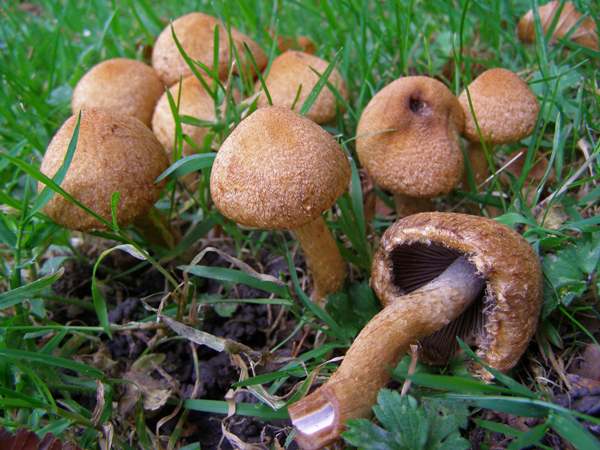
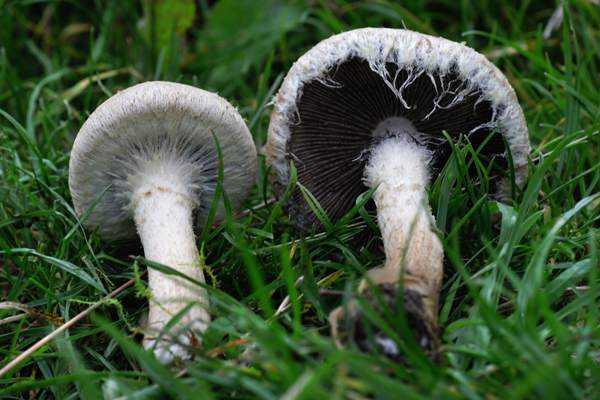
CapInitially bell-shaped and densely hairy with a woolly, in-rolled margin to which pale fragments of the veil remain attached. At maturity, caps become broadly convex, expanding to between 4 and 12cm in diameter and usually retaining a distinct umbo. The reddish cap surface is radially streaked with yellow and clay brown tinges. |
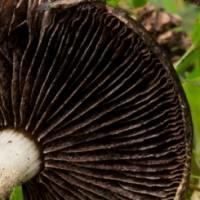 |
GillsAdnexed to free; initially yellow-brown with a very pale edge, but soon becoming mottled dark brown and eventually blackened with spores. The gill edges hold black watery droplets when moist. Stem5 to 10mm in diameter; 5 to 10cm tall; a paler brown than the cap but more russet towards the base; fibrous, with a ring zone of pale fibres that soon become stained black by falling spores. |
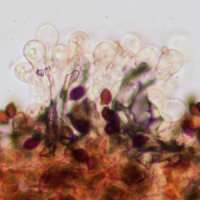 |
CheilocystidiaThese are the cystidia that occur on the gill edges. In Lacrymaria lacrymabunda the cheilocystidia occur in groups; they are clavate with swollen tips and typically 90µm tall and 12µm in diameter. Cheilocystidia of Lacrymaria lacrymabunda, Weeping Widow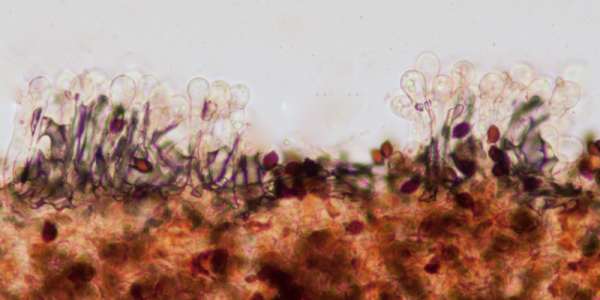 |
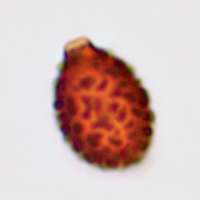 |
SporesEllipsoidal to lemon shaped, warty, 8-11 x 5-7μm, with a germ pore. Spores of Lacrymaria lacrymabunda, Weeping Widow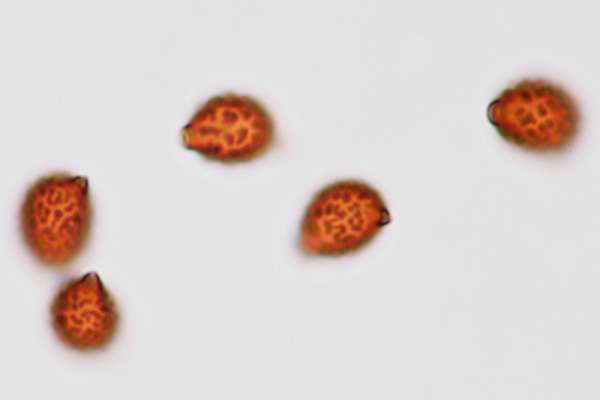 Spore printBlack. |
Odour/taste |
Not distinctive. |
Habitat & Ecological role |
Saprobic, in grassland and on verges beside lanes; occasionally also in woodland clearings. |
Season |
April to November in Britain and Ireland, but most common between early July and late September. |
Similar species |
The Weeping Widow could possibly be mistaken for a field mushroom, Agaricus campestris, when young. Psathyrella candoleana is somewhat similar but smaller and much paler |
Culinary Notes
The Weeping Widow Lacrymaria lacrymabunda is reported to be an edible mushroom; however, unless they are cooked and eaten soon after they have been gathered any meal made from these fungi is likely to end up a black soggy mess. A crying shame!
Reference Sources
Fascinated by Fungi, 2nd Edition, Pat O'Reilly 2016, reprinted by Coch-y-bonddu Books in 2022.
Bas, C. (1983). On the application of the name Agaricus lacrymabundus Bull.: Fr. Persoonia 12(1): 103-106.
Dictionary of the Fungi; Paul M. Kirk, Paul F. Cannon, David W. Minter and J. A. Stalpers; CABI, 2008
Taxonomic history and synonym information on these pages is drawn from many sources but in particular from the British Mycological Society's GB Checklist of Fungi.
Acknowledgements
This page includes pictures kindly contributed by David Adamson and David Kelly.
Fascinated by Fungi. Back by popular demand, Pat O'Reilly's best-selling 450-page hardback book is available now. The latest second edition was republished with a sparkling new cover design in September 2022 by Coch-y-Bonddu Books. Full details and copies are available from the publisher's online bookshop...