Lactarius turpis (Weinm.) Fr. - Ugly Milkcap
Phylum: Basidiomycota - Class: Agaricomycetes - Order: Russulales - Family: Russulaceae
Distribution - Taxonomic History - Etymology - Identification - Culinary Notes - Reference Sources
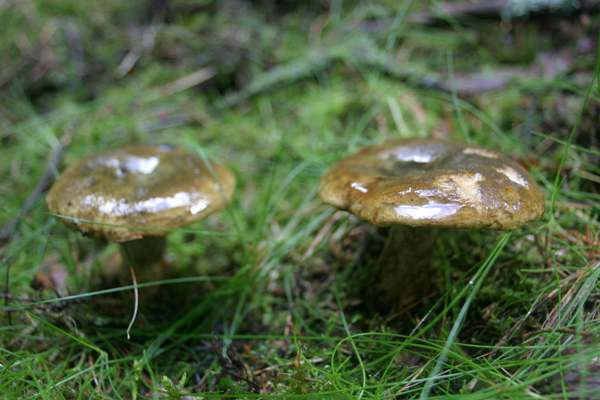
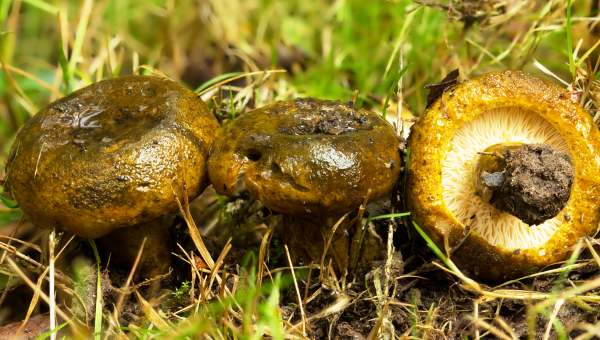
Although it is a decidedly dull olive-brown mushroom, the Ugly Milkcap is helped just a little by the fact that it is ectomycorrhizal with birch trees in wet woodland, so that when you come across these inconspicuous fungi they may make an effort by glistening when the sun shines. Even so they can be difficult to spot until you ‘get your eye in’, and particularly so during prolonged dry weather, when the caps appearance is very dull.
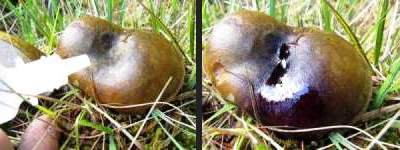
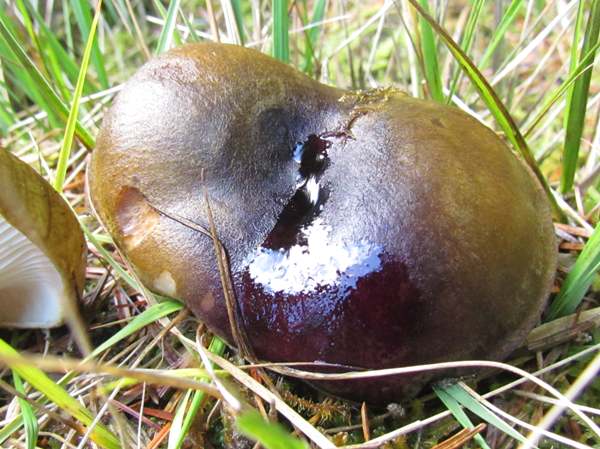
A chemical test can help confirm the identification of this mushroom. Apply potassium hydroxide (KOH) to the surface of the cap (above) and it will instantly turn purple, as in the picture below.
Distribution
Fairly common throughout much of Britain and Ireland, the Ugly Milkcaap appears under birches on acid soils, especially in wet woodland edges. This distinctive milkcap mushroom is found throughout northern and central Europe.
Taxonomic history
This mushroom was described scientifically in 1828 by German mycologist Johann Anton Weinmann.(1782 - 1858), who named it Agaricus turpis. (At that time most gilled fungi were initially placed in a gigantic Agaricus genus, which has since been slimmed down with most of its contents being transferred to other newer genera leaving only the so-called 'true mushrooms' in the genus Agaricus.)
The Ugly Milkcap was transferred to the genus Lactarius in 1838 by the great Swedish mycologist Elias Magnus Fries, whereupon it became Lactarius turpis, by which name it is generally known today.
Synonyms of Lactarius turpis include Agaricus turpis Weinm., Galorrheus turpis (Weinm.) P. Kumm., and Lactifluus turpis (Weinm.) Kuntze
Etymology
The generic name Lactarius means producing milk (lactating) - a reference to the milky latex that is exuded from the gills of milkcap fungi when they are cut or torn. The specific epithet turpis comes directly from Latin and means ugly.
Identification guide
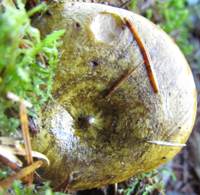 |
CapDark olive-brown with a paler margin, the cap of Lactarius turpis is slimy when wet; initially convex, the centre usually becomes slightly depressed and occasionally retains a small umbo. Caps generally range from 7 to 18cm across when fully developed. |
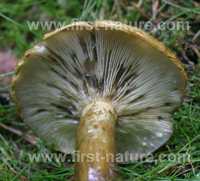 |
GillsCream to pale buff, becoming sepia tinged when bruised; decurrent; narrow and crowded. When damaged the gills exude an abundant white latex, which dries olivaceous. StemColour as cap or lighter; cylindrical, tapering near base; 4 to 7cm long, 1 to 2.5cm dia.; no stem ring. |
SporesEllipsoidal, 6.5-7.5 x 5.5-6μm, ornamented with warty ridges forming a well-developed network. Spore printCreamy white. |
|
Odour/taste |
No significant odour; taste hot and acrid. |
Habitat & Ecological role |
Mycorrhizal, under birches in wet woodland. |
Season |
August to November in Britain and Ireland. |
Similar species |
Lactarius blennius, the Beech Milkcap, is lighter and smaller; it does not develop sepia tinged areas on its gills. |
Culinary Notes
If you are not put off by the name and se;pulchral appearance of the Ugly Milkcap, there's another deterrent. In some northern European countries there was a tradition of boiling these milkcaps and then using them to spice up other mushroom dishes; however: there is now worrying evidence that the Ugly Milkcap may be carcinogenic, and so it should be considered as poisonous. This is a great pity because it is one of the few millkcaps that is easy to identify in the field with a high degree of confidence.
Reference Sources
Fascinated by Fungi, 2nd Edition, Pat O'Reilly 2016, reprinted by Coch-y-bonddu Books in 2022.
Funga Nordica, Henning Knudsen and Jan Vesterholt, 2008.
Fungi of Switzerland, volume 6: Russulaceae, Kränzlin, F.
BMS List of English Names for Fungi.
Dictionary of the Fungi; Paul M. Kirk, Paul F. Cannon, David W. Minter and J. A. Stalpers; CABI, 2008
Taxonomic history and synonym information on these pages is drawn from many sources but in particular from the British Mycological Society's GB Checklist of Fungi.
Acknowledgements
This page includes pictures kindly contributed by David Kelly.
Fascinated by Fungi. Back by popular demand, Pat O'Reilly's best-selling 450-page hardback book is available now. The latest second edition was republished with a sparkling new cover design in September 2022 by Coch-y-Bonddu Books. Full details and copies are available from the publisher's online bookshop...