
Leccinum crocipodium - Saffron Bolete
Phylum: Basidiomycota - Class: Agaricomycetes - Order: Boletales - Family: Boletaceae
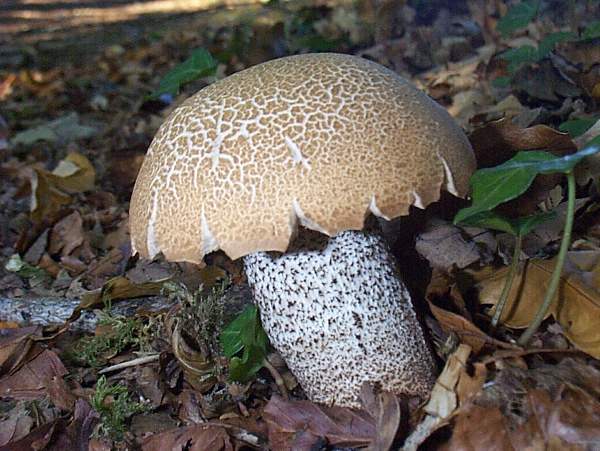
Appearing under oak trees and in coppice woodland, mainly bordering clearings or at the edge of woods, Leccinum crocipodium is an infrequent bolete; its caop is yellow when young, but as it matures the colour darkens to a brownish-yellow and cracks appear like crazy paving on the cap.
This striking mushroom appears in autumn, invariably under oak trees and often on woodland edges or beside paths and other clearings.
Identification guide
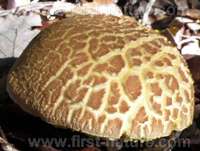 |
Cap4 to 9cm in diameter, the yellowish-brown or reddish-brown cap remains domed, and the cuticle slightly overhangs the edge of the cap. Initially the cap is downy and usually deep yellow, but as it matures the surface crazes and turns a duller yellow-brown, sometimes splitting at the margin. The cap flesh is straw coloured, blackening when cut. |
Tubes and poress |
The densely-packed tubes, 0.3 to 0.5mm in dia., are pale yellow and the rounded pores are bright lemon yellow - a helpful identifying feature - becoming darker buff when bruised. As the fruiting body ages, the pores turn dingy buff. |
Stem |
The pale, usually yellowish stem is slightly barrel shaped and typically 2cm in diameter and 6 to 12cm tall; it is often thicker towards the base. The surface is covered in brownish woolly scales in an irregular network. When bruised, the pale grey stem flesh does not turn blue but rather it reddens slightly and eventually becomes grey; cut or damaged stem flesh also blackens gradually.. |
Spore print |
Ochre. |
Odour/taste |
Not distinctive. |
Habitat & Ecological role |
Under oak trees and occasionally hornbeams, with which this bolete is mycorrhizal. The Saffron Bolete is most often found on compacted chalky loam, and is not normally found in the oakwoods of western Britain which are on strongly acid soils. |
Season |
July to September. |
Occurrence |
Rare. |
Similar species |
Leccinum scabrum has a similarly scaly stem, but the cap does not usually craze and its spore print is ochraceous-brown. |
Reference Sources
Fascinated by Fungi, 2nd Edition, Pat O'Reilly 2016, reprinted by Coch-y-bonddu Books in 2022.
Henk C. den Bakker, Barbara Gravendeel & Thomas W. Kuyper (2004). An ITS phylogeny of Leccinum and an analysis of the evolution of minisatellite-like sequences within ITS1; Mycologia, 96(1), 2004, pp. 102-118.
British Boletes, with keys to species, Geoffrey Kibby (self published) 3rd Edition 2012.
Dictionary of the Fungi; Paul M. Kirk, Paul F. Cannon, David W. Minter and J. A. Stalpers; CABI, 2008
Taxonomic history and synonym information on these pages is drawn from many sources but in particular from the British Mycological Society's GB Checklist of Fungi.
Fascinated by Fungi. Back by popular demand, Pat O'Reilly's best-selling 450-page hardback book is available now. The latest second edition was republished with a sparkling new cover design in September 2022 by Coch-y-Bonddu Books. Full details and copies are available from the publisher's online bookshop...