
Leccinum versipelle (Fr. & Hök) Snell - Orange Birch Bolete
Phylum: Basidiomycota - Class: Agaricomycetes - Order: Boletales - Family: Boletaceae
Distribution - Taxonomic History - Etymology - Identification - Culinary Notes - Reference Sources
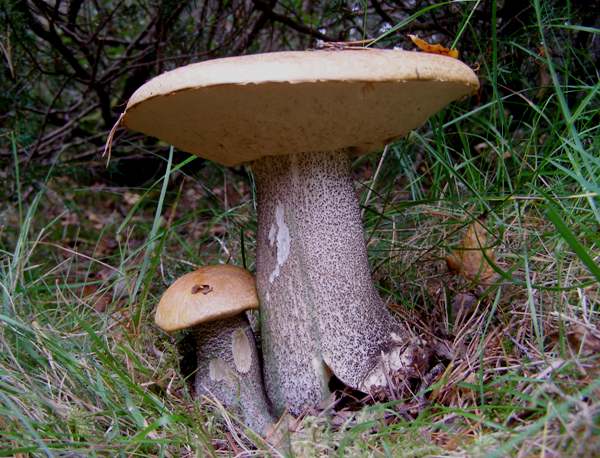
Appearing only under birch trees, sometimes together with Leccinum scabrum (the Brown Birch Bolete), Leccinum versipelle is commonly known as the Orange Birch Bolete.
Formerly considered as separate species, following DNA analysis Leccinum cerinum, Leccinum percandidum and Leccinum roseotinctum are now considered by many authorities to be merely colour forms of Leccinum versipelle.
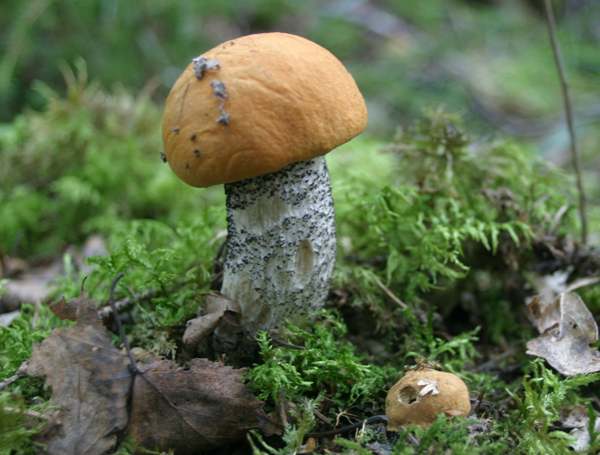
Distribution
A fairly common find in Britain and Ireland, the Orange Birch Bolete occurs throughout most of mainland Europe, from Scandinavia right down to Portugal, Spain and Italy. Leccinum versipelle is also recorded from parts of North America.
Taxonomic history
The Orange Birch Bolete was described in 1835 by Swedish mycologists Elias Magnus Fries and Fredrik Christopher Theodor Hök (1807 - 1877) in their thesis Boleti, Fungorum generis, illustratio and it was given the binomial scientific name Boletus versipellis.
American mycologist Walter Henry Snell (1889 - 1980) transferred this species to the genus Leccinum in 1944, at which point it acquired its currently-accepted scientific name Leccinum versipelle.
Synonyms of Leccinum versipelle include Boletus floccopus Rostk., Boletus testaceoscaber Secr., Boletus versipellis Fr. & Hök, Boletus rufescens Konrad, Boletus percandidus Vassilkov, Leccinum testaceoscabrum Secr. ex Singer, Leccinum percandidum (Vassilkov) Watling, Leccinum atrostipitatum A.H. Sm., Thiers & Watling, Leccinum roseotinctum Watling, Krombholziella roseotincta (Watling) Šutara, Krombholziella rufescens (Konrad) Šutara, Krombholziella versipellis (Fr. & Hök) Bon, Leccinum rufescens (Konrad) Šutara, and Leccinum cerinum M. Korhonen.
Etymology
Leccinum, the generic name, comes from an old Italian word meaning fungus. The specific epithet versipelle is a reference to the changing nature of the surface of the cap (pellicle).
Although cap colour is alluded to in the common names opf several Leccinum species, with this group of boletes it is unwise to draw any conclusion from this very variable characteristic.
Identification guide
 |
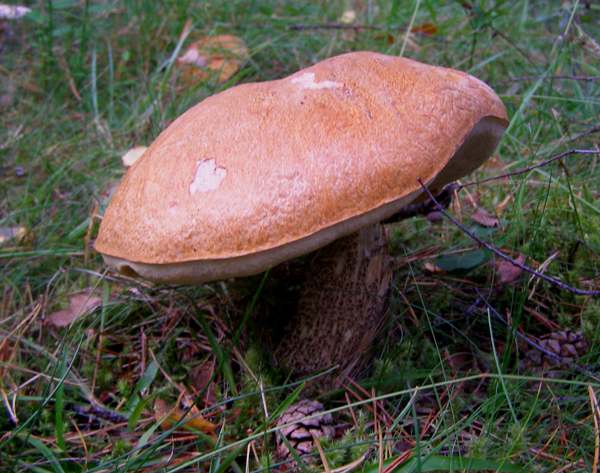
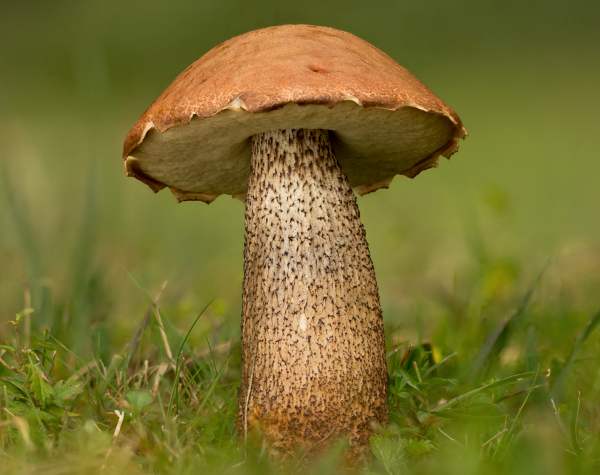
CapThis is a very large mushroom, and caps mature at between 8 and 20cm diameter, remaining broadly convex rather than flattening out completely. A distinguishing feature of this bolete is the fact that the cuticle overhangs the cap margin by typically 2-4mm. The surface is minutely downy, usually orange or yellowish brown. As with so many of the Leccinum boletes, there is also a rare pallid form whose cap is almost white, sometimes tinged with pink or orange. Beneath the cuticle, the flesh of the cap is firm and white; it does not change colour significantly when a cut or broken surface is exposed to air, but it becomes gradually greyer and eventually blackens with a violet tinge.Visible in the picture is another distinguishing feature of this bolete: the cuticle often has a ragged edge. |
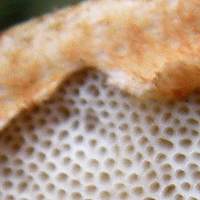 |
Tubes and PoresThe mouse-grey tubes terminate in tiny pores that turn ochraceous with age. |
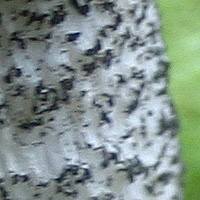 |
StemThe stipe or stem, which can be up to 20cm tall and is typically 2 to 4cm in diameter, tapering in slightly towards the apex, has a white, pale grey or yellowish-grey surface covered with dark brown or blackish woolly scales. When cut, the pale stem flesh turns greay near the apex but blue-green and then almost black, especially near the stem base. |
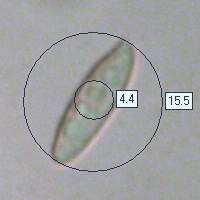 |
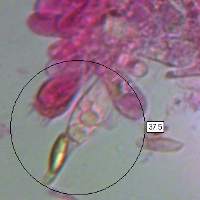
SporesFusiform, thin-walled,11-16 x 3.5-4.5µm, inamyloid. Show larger imageSpores of Leccinum versipelle, Orange Birch Bolete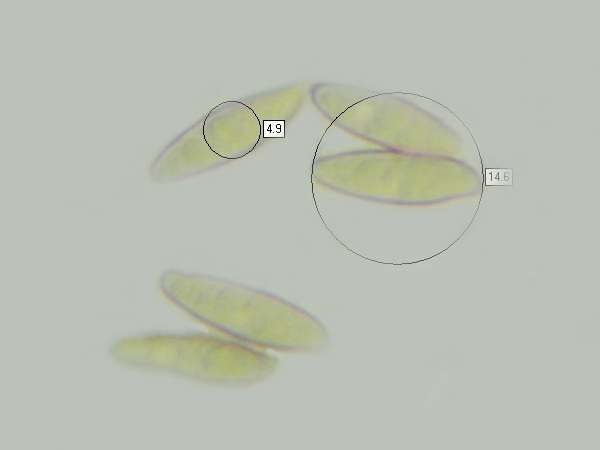 Spore printOchraceous brown. |
 |
Cystidia abd BasidiaBasidia are four-spored. Also in picture, left, are cystidia on the fertile tube surface. Show larger imageBasidia and cheilocystidia of Leccinum versipelle, Orange Birch Bolete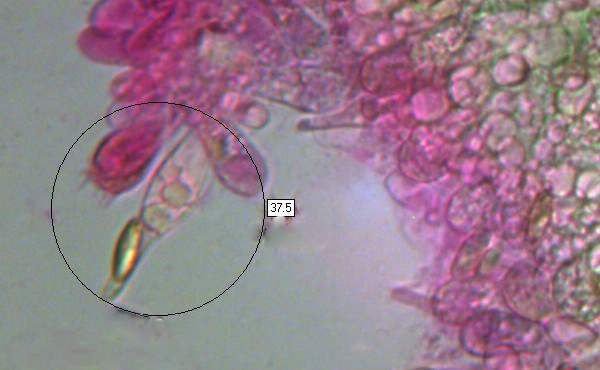 |
Odour/taste |
Not distinctive. |
Habitat & Ecological role |
Mycorrhizal, beneath birch mainly on acidic heathland, woodland edges and scrub. |
Season |
July to September in Britain and Ireland. |
Similar species |
Leccinum scabrum, which also occurs under birch, has a brown cap; its stem flesh does not display a marked colour change when it is cut. |
Culinary Notes
Leccinum versipelle is generally considered to be a good edible mushroom and can be used in recipes that call for Ceps Boletus edulis (although in both flavour and texture a Cep is superior). Alternatively, use Orange Birch Boletes to make up the required quantity if you do not have sufficient Ceps.
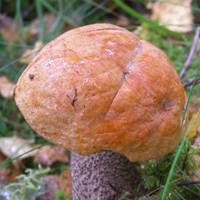
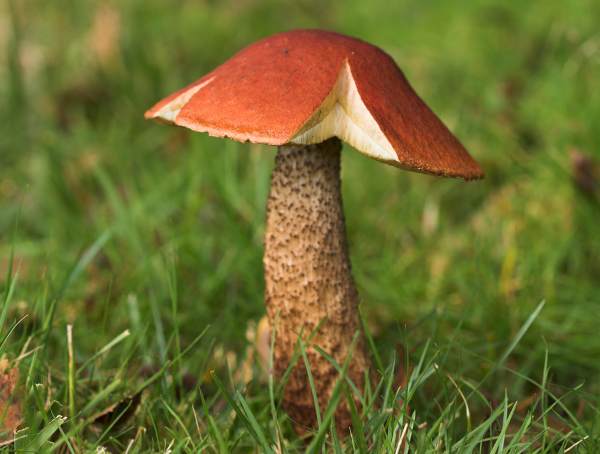
The picture on the left was taken in England by David Kelly, with whose kind permission it is shown here; it demonstrates just how deep the orange coloration of the cap of Leccinum versipelle can sometimes be.
Reference Sources
Fascinated by Fungi, 2nd Edition, Pat O'Reilly 2016, reprinted by Coch-y-bonddu Books in 2022.
Henk C. den Bakker, Barbara Gravendeel & Thomas W. Kuyper (2004). An ITS phylogeny of Leccinum and an analysis of the evolution of minisatellite-like sequences within ITS1; Mycologia, 96(1), 2004, pp. 102-118.
British Boletes, with keys to species, Geoffrey Kibby (self published) 3rd Edition 2012.
Dictionary of the Fungi; Paul M. Kirk, Paul F. Cannon, David W. Minter and J. A. Stalpers; CABI, 2008
Taxonomic history and synonym information on these pages is drawn from many sources but in particular from the British Mycological Society's GB Checklist of Fungi.
Fascinated by Fungi. Back by popular demand, Pat O'Reilly's best-selling 450-page hardback book is available now. The latest second edition was republished with a sparkling new cover design in September 2022 by Coch-y-Bonddu Books. Full details and copies are available from the publisher's online bookshop...