
Lepista irina (Fr.) H.E. Bigelow - Flowery Blewit
Phylum: Basidiomycota - Class: Agaricomycetes - Order: Agaricales - Family: Tricholomataceae
Distribution - Taxonomic History - Etymology - Identification - Culinary Notes - Reference Sources
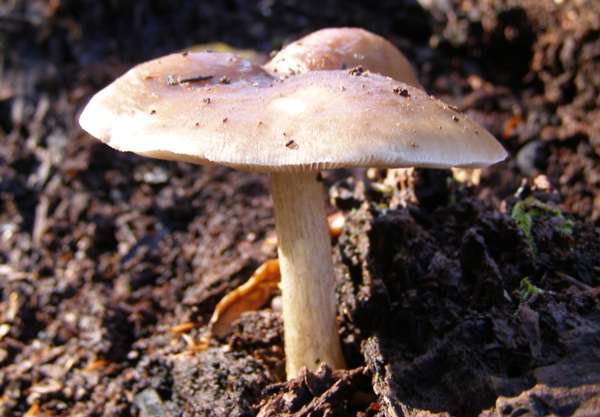
An uncommon woodland species, the Flowery Blewit owes its common name to a distinctive flowery (not floury!) odour.
Distribution
This pretty blewit is found with deciduous trees; it is most common in Beech woodland in southern England, but it is increasingly rare further north.
Flowery Blewits are found in many parts of mainland Europe, often with Beech trees.
Taxonomic history
This mushroom was described in 1838 and named Agaricus nudus by the great Swedish mycologist Elias Magnus Fries. (Most gilled fungi were placed in the Agaricus genus in the early days of fungal taxonomy.) The Flowery Blewit acquired its currently-accepted scientific name Lepista irina via a 1959 publication by American mycologist Howard E Bigelow (1923 - 1987).
Synonyms of Lepista irina include Agaricus irinus Fr. Tricholoma irinum (Fr.) P. Kumm., and Rhodopaxillus irinus (Fr.) Métrod.
Etymology
Lepista is derived from Latin and means a wine pitcher or a goblet, and when fully mature the caps of Lepista species do indeed tend to become concave (sometimes referred to as being infundibuliform) like shallow chalices or goblets. The specific epithet irina means pertaining to irises (in particular to their scent).
Identification guide
Cap |
5 to 10cm across; hemispherical then broadly convex with an undulating margin; smooth; pale beige, becoming pinkish brown towards the centre when moist, drying paler. |
Gills |
Adnate or sinuate; narrow; crowded; cream, turning buff-pink when mature. |
Stem |
4 to 9cm long and 0.5 to 1.0cm dia.; fibrillose; sometimes slightly swollen at base; pinkish brown; no ring. |
SporesEllipsoidal, 7-9 x 3.5-4µm; ornamented with tiny spines. Spore printCreamy-white to pale greyish pink. |
|
Odour/taste |
Perfumed, like flowers (irises and violets, in particular). |
Habitat & Ecological role |
In deciduous woodland - in Britain, mainly in beechwoods on calcareous soil. |
Season |
July to November in Britain. |
Similar species |
Lepista nuda, the Wood Blewit, occurs in similar habitats; it is a more common species and has a violet-tinged cap. |
Culinary notes
Although generally considered edible (but inferior to Wood Blewits and Field Blewits), the Flowery Blewit can upset some stomachs. Flowery Blewits must be cooked; never eat them raw. Edible blewits are very good if sauteed and served with pale meat such as veal, pork or chicken; they are also fine with cheese, rice and pasta dishes. (A minority of people find even thoroughly cooked blewits of any type indigestible.) In Britain and Ireland this mushroom is uncommon to rare and so many people consider that its collection for the pot is inappropriate.
Reference Sources
Fascinated by Fungi, 2nd Edition, Pat O'Reilly 2016, reprinted by Coch-y-bonddu Books in 2022.
Funga Nordica: 2nd edition 2012. Edited by Knudsen, H. & Vesterholt, J. ISBN 9788798396130
British Mycological Society. English Names for Fungi
Dictionary of the Fungi; Paul M. Kirk, Paul F. Cannon, David W. Minter and J. A. Stalpers; CABI, 2008
Taxonomic history and synonym information on these pages is drawn from many sources but in particular from the British Mycological Society's GB Checklist of Fungi.
Fascinated by Fungi. Back by popular demand, Pat O'Reilly's best-selling 450-page hardback book is available now. The latest second edition was republished with a sparkling new cover design in September 2022 by Coch-y-Bonddu Books. Full details and copies are available from the publisher's online bookshop...