
Lycoperdon nigrescens Pers. - Dusky Puffball
Phylum: Basidiomycota - Class: Agaricomycetes - Order: Agaricales - Family: Agaricaceae
Distribution - Taxonomic History - Etymology - Identification - Culinary Notes - Reference Sources
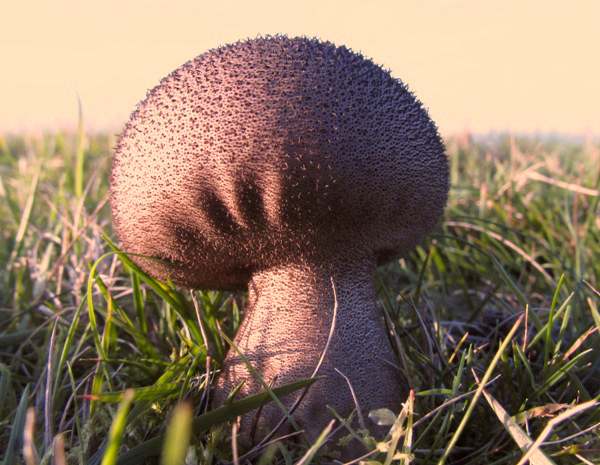
Very similar to the Common Puffball, but darker skinned and with small dark warts that persist longer than those of other frequently-encountered puffballs, the Dusky Puffball is a frequent find in acid coniferous woodland. This ubiquitous mushroom also occurs on heathland and in sand dunes, either singly or in small groups.
The Dusky Puffball rarely occurs in large numbers, which is perhaps just as well because there is a suspicion that it may be slightly poisonous.
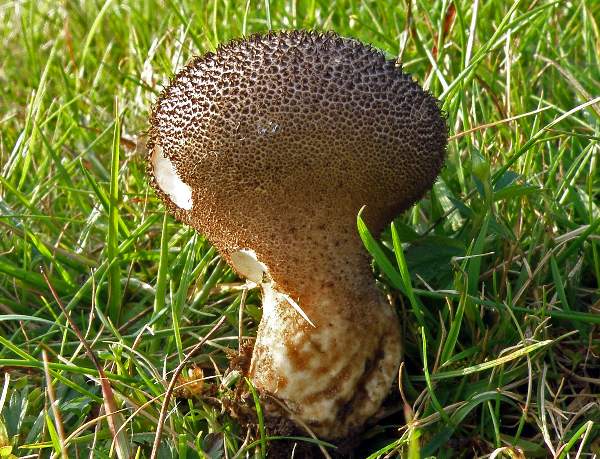
Some people refer to this fungus as the Blackening Puffball, but the common name recommended in the latest 'List of English Names of Fungi' published by the British Mycological Society is Dusky Puffball. Both names seem appropriate, as these puffballs start off dusky (compared with most other members of the Lycoperdon genus) and they blacken gradually as they age.
Empty black cases (exoperidia) can be found rolling aroung in the breeze a year or more after these puffballs first appear.
Distribution
An occasional find in Britain and Ireland, the Dusky Puffball is widespread across most of mainland Europe but tends to be localised by its habitat needs. This species is also recorded in North America..
Taxonomic history
Early in 1794 this species was described in scientific literature by Swedish botanist Göran Wahlenbergn (1780 - 1851) under its present scientific name; however, many authorities report that the basionym dates from Christiaan Hendrik Persoon's publication of 1794, ratified in his Synopsis Methodicae Fungorum of 1801.
Lycoperdon nigrescens has several synonyms including Lycoperdon perlatum var. nigrescens (Pers.) Pers., Lycoperdon perlatum ß nigrescens (Pers.) Pers., and Lycoperdon foetidum Bonord.
Etymology
The specific epithet nigrescens means blackening while the genus name Lycoperdon literally means 'wolf's flatulence' and begs the question who was foolhardy enough to get close enough to a wolf to become an expert on the matter.
For most of us, surely an odour of wolf's flatulence cannot be considered a particularly helpful diagnostic feature for identifying the Dusky Puffball, Lycoperdon nigrescens.
Identification guide
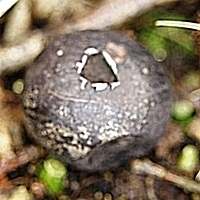 |
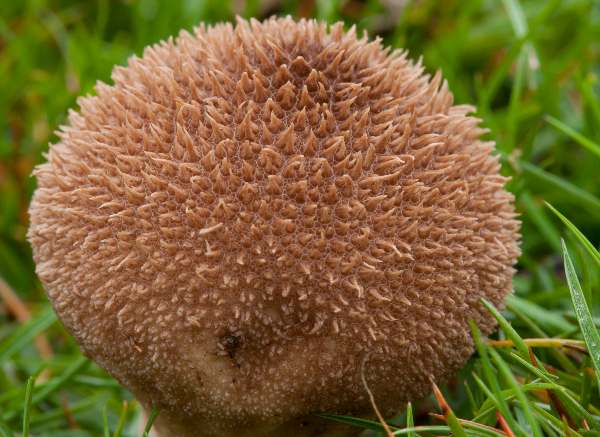
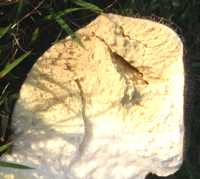
Fertile head2 to 4cm across, and 2 to 3.5cm tall; pear shaped; the surface background initially pale brown turning mid to dark brown, covered in dark-brown spines 1 to 2mm long; spines fall off at maturity leaving a mottled, smooth surface; an apical pore opens, through which spores are released when either raindrops hit the mature puffball or a breeze blows across the pore hole. Stems are 1 to 2cm tall and typically 1.5cm in diameter; colour as the fertile head but with shorter spines. The aged fruitbody on the left has lost its spines and turned very dark. The peridium has fractured at the apex, allowing wind and rain to disperse the spores. |
 |
SporesSpherical, weakly warted, 4.5-5µm in diameter. Spore massWhite and firm at first, turning yellowish-brown and eventually dark brown and powdery. |
Odour/taste |
Gives off a faint but rather unpleasant gassy smell when the flesh is cut. (The synonym Lycoperdon foetidum reflects this characteristic.) |
Habitat & Ecological role |
Mainly found under conifers in woodlands but also in grass on heathland. |
Season |
June to September in Britain and Ireland. |
Similar species |
Lycoperdon perlatum is paler and covered in warts rather than spines. Lycoperdon echinatum, the Spiny Puffball, has a very short stem and is covered in buff spines in groups of three. |
Culinary notes
Unlike many members of its genus, Lycoperdon nigrescens is reported to be inedible and possibly suspect; this is perhaps just as well in view of its relative scarcity and good camouflage against a background of conifer debris in the dark woodland locations where this puffball usually lurks.
For a very easy to recognise edible puffball that cannot be mistaken for any other mushroom, see Calvatia gigantea, the Giant Puffball. Unfortunately it's not every day that you stumble across Giant Puffballs, as they are not only uncommon but also very localised in their distribution. If you find a good spot for these mighty meaty meal sources, make a note of it because Giant Puffballs usually reappear in the same places for many years.
Reference Sources
Fascinated by Fungi, 2nd Edition, Pat O'Reilly 2016, reprinted by Coch-y-bonddu Books in 2022.
Pegler, D.N., Laessoe, T. & Spooner, B.M (1995). British Puffballs, Earthstars and Stinkhorns. Royal Botanic Gardens, Kew.
British Mycological Society. English Names for Fungi
Dictionary of the Fungi; Paul M. Kirk, Paul F. Cannon, David W. Minter and J. A. Stalpers; CABI, 2008
Taxonomic history and synonym information on these pages is drawn from many sources but in particular from the British Mycological Society's GB Checklist of Fungi.
Acknowledgements
This page includes pictures kindly contributed by David Kelly.
Fascinated by Fungi. Back by popular demand, Pat O'Reilly's best-selling 450-page hardback book is available now. The latest second edition was republished with a sparkling new cover design in September 2022 by Coch-y-Bonddu Books. Full details and copies are available from the publisher's online bookshop...