
Meripilus giganteus (Pers.) P. Karst. - Giant Polypore
Phylum: Basidiomycota - Class: Agaricomycetes - Order: Polyporales - Family: Meripilaceae
Distribution - Taxonomic History - Etymology - Identification - Culinary Notes - Reference Sources
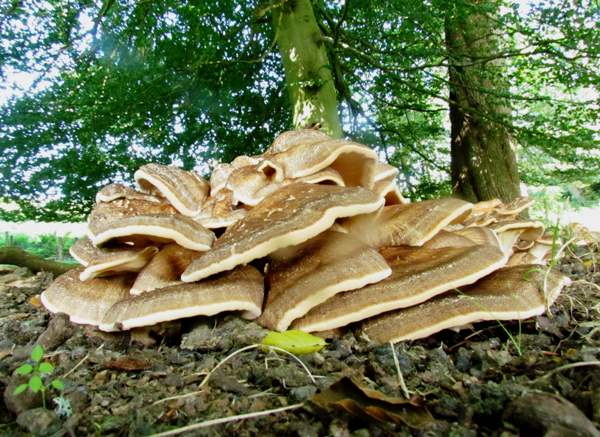
Meripilus giganteus is a very large polypore that appears on stumps and at the base of some living broadleaftrees - most notably beech. The caps can be half a metre wide.
Distribution
Common throughout most of Britain and Ireland, the Giant Polypore is more scarce in northern Scotland. This species occurs in most of mainland Europe, while a very similar fungus, Meripilus sumstinei, is found in North America.
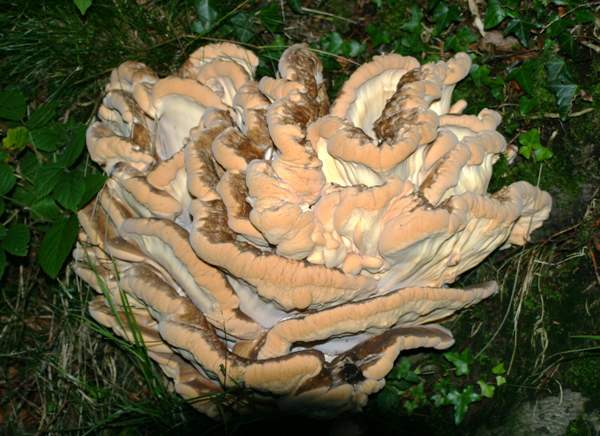
One of the difficulties in identifying this species is its variability, not only in colour and edge thickness during development (the edges are blunt and rounded when young, becoming much thinner and sharper as the fruitbodies mature) but they also look very different when growing on buried roots; then they can form beautiful, symmetrical rosettes.
The cabbage-like form of the rosette shown on the left is very different from the more common bracket form. There is no sign of the substrate in this picture, but just a few cm below the ivy-covered soil surface lie the roots of an old Beech tree. The tree itself had no brackets on its lower trunk in the year when this picture was taken.
The pore surface of Meripilus giganteus quickly stains dark brown or black when it is bruised, and some people refer to this fungus by an alternative common name the Black-staining Polypore.
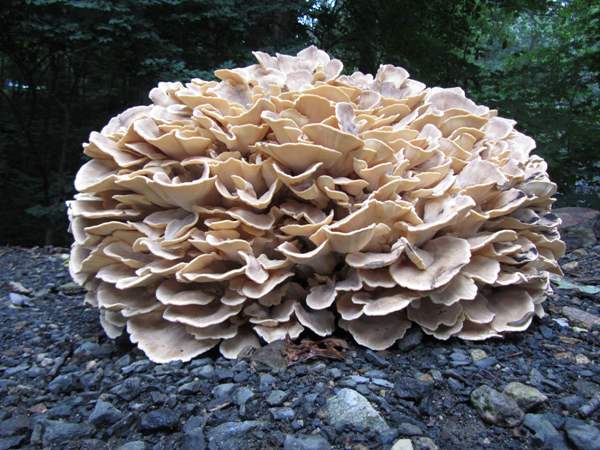
Meripilus sumstinei, the Blackening Polypore
Taxonomic history
Originally described by Christiaan Hendrik Persoon, who named it Boletus ngiganteus, this polypore was given its current scientific name in 1882 by the Finnish mycologist Petter Adolf Karsten (1834-1917).
Synonyms of Meripilus giganteus include Boletus giganteus(Pers., Polyporus giganteus (Pers.) Fr., and Grifola gigantea (Pers.) Pilát.
Meripilus giganteus is the type species of the Meripilus genus, in which it is the ony species known to occur in Britain.
A very similar species, Meripilus sumstinei (Murrill) M.J. Larsen & Lombard, occurs in North America and is commonly referred to as the Blackening Polypore or the Black-staining Polypore. The fine rosette of Meripilus sumstinei shown above was photographed by Al Gratrix, to whom we are grateful for permission to use this picture. (Note the intense black bruising.) Like its European cousin, Meripilus sumstinei is a weak parasite that becomes saprobic once its host tree dies, and so the relatively short-lived rosettes and brackets can appear on the same dead stump and root system for several years after the tree has died.
Etymology
Meripilus, the genus name, comes from the prefix meri- meaning a part and pil or pile meaning a cap - hence the implication is that caps of fungi in this genus comprise many parts. The specific epithet giganteus means, of course, gigantic, an adjective wholly appropriate to these imposing fungi.
Identification guide
 |
These polypores are short lived and very quickly rot away. In this picture the fruiting bodies are attached to the base of a beech tree. Sometimes they grow attached to shallow roots at a distance of several metres from the trunk. |
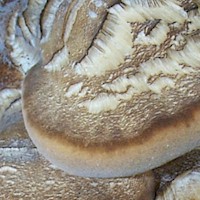 |
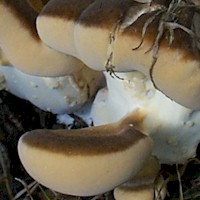
FruitbodyThis massive polypore grows as a rosette of fan-shaped caps at or near the base of hardwood trees and on stumps. The individual tan or light brown caps range from 10 to 30cm across and 1 to 3cm thick, while the complete fruitbody typically grows to between 50 and 80cm and occasionally more than a metre across. |
 |
Tubes and PoresThe off-white tubes are 4 to 6mm deep and terminate in tiny round white pores packed to a density of between 3 and 5 per mm. When bruised, the pores turn dark brown or black. |
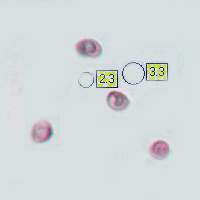 |
SporesOvoid or ellipsoidal, smooth, 5-6.5 x 4.5-6µm; hyaline; inamyloid. Spore printWhite. BasidiaClavate (club shaped), four-spored, typically 8 x 30µm. |
Odour/taste |
No distinctive odour; taste slightly acidic. |
Habitat & Ecological role |
Parasitic and then saprobic when its host dies; found at the base of beech trees and on stumps of recently-felled trees; also, although less frequently, on oaks, elms, poplars, limes and several other kinds of broadleaf trees - even on eucalyptus; known to occur, although only very occasionally, on some types of pines, larches and firs. |
Season |
Late June to late September in Britain and Ireland . |
Similar species |
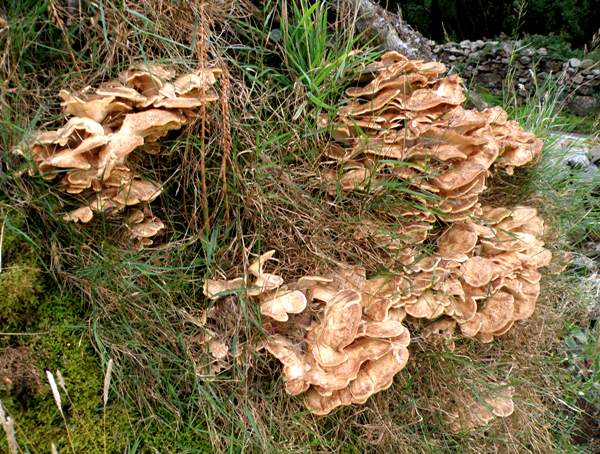
Laetiporus sulphureus is more yellow-orange and its pores do not turn black when bruised. |
Culinary Notes
If cooked very slowly, young specimens are reportedly edible; however, they have been known to cause stomach upsets in some people and so are probably best avoided altogether. (There are plenty of much tastier fungi, so why eat a cardboard taste-alike?)
Reference Sources
Pat O'Reilly 2016, Fascinated by Fungi; First Nature
BMS List of English Names for Fungi
Mattheck, C., and Weber, K. Manual of Wood Decays in Trees. Arboricultural Association 2003.
Dictionary of the Fungi; Paul M. Kirk, Paul F. Cannon, David W. Minter and J. A. Stalpers; CABI, 2008
Taxonomic history and synonym information on these pages is drawn from many sources but in particular from the British Mycological Society's GB Checklist of Fungi.
Fascinated by Fungi. Back by popular demand, Pat O'Reilly's best-selling 450-page hardback book is available now. The latest second edition was republished with a sparkling new cover design in September 2022 by Coch-y-Bonddu Books. Full details and copies are available from the publisher's online bookshop...