
Mycena arcangeliana Bres. - Angel's Bonnet
Phylum: Basidiomycota - Class: Agaricomycetes - Order: Agaricales - Family: Mycenaceae
Distribution - Taxonomic History - Etymology - Identification - Culinary Notes - Reference Sources
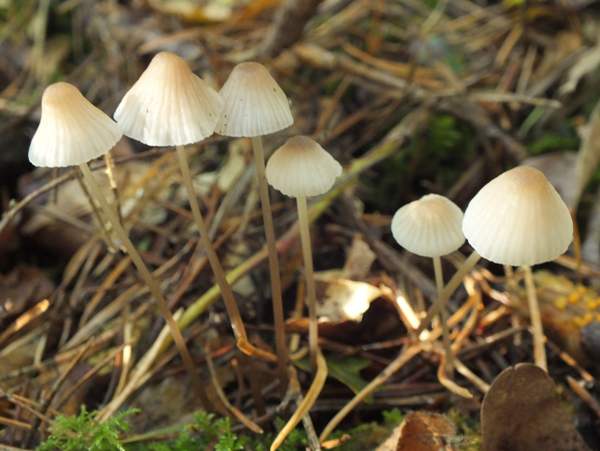
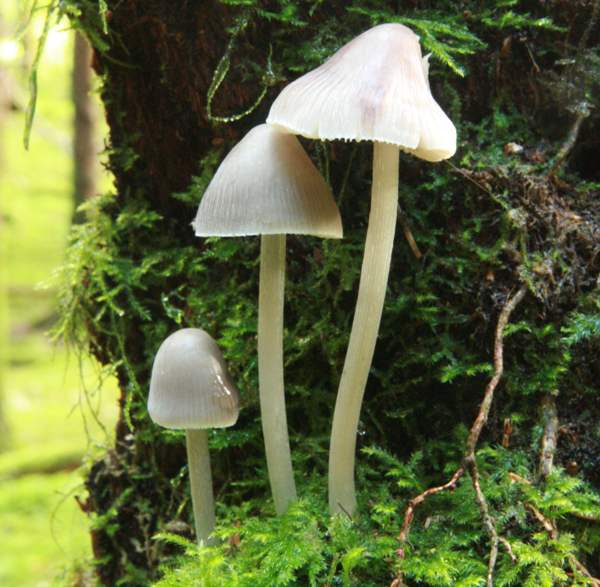
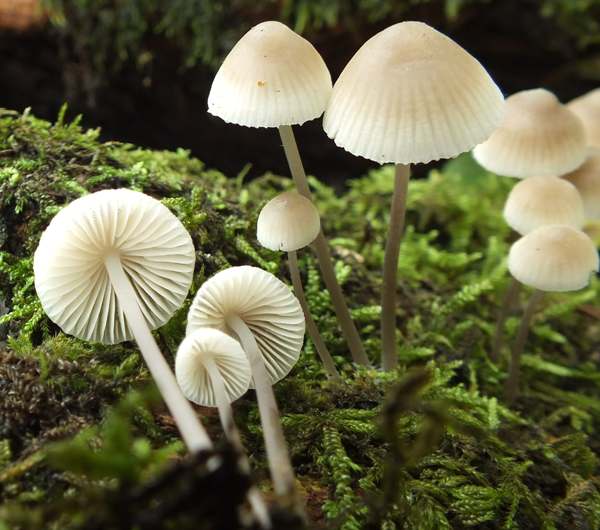
Most often found on stumps, fallen trunks and branches of Beech or Ash trees, but occasionally on other dead hardwoods, the Angel’s Bonnet is distinguished by its odour of iodine, which is most noticeable in dried specimens. Occasionally this mushroom is recorded growing on conifer timber.
Although usually occurring in tufts (termed being 'fasciculate'), Angel's Bonnets quite often fruit as singletons, and so a gregarious habit is far from a reliable identifying characteristic.
Distribution
This lovely bonnet mushroom is common and widespread in Britain and Ireland as well as in most of mainland Europe. Look out for it in broadleaf woodlands, in particular, because Angel's Bonnet is particularly fond of trunks and branches of these broadleaf trees once they have been uprooted by high winds or, having succumbed to disease, they have fallen and other fungi have stripped the bark and begun the softening up process.
Taxonomic history
Angel's Bonnet mushrooms have been well known since the 18th century and probably much earlier, but they were lumped in with the somewhat similar Mycena galericulata. In 1904, Italian mycologist Giacopo Bresadola (1847 - 1929) described this species as Mycena arcangeliana, the scientific name by which it is still generally referred to today.
Synonyms of Mycena arcangeliana include Mycena lineata var. olivascens Quél., Mycena arcangeliana var. oortiana Kühner, Mycena vitilis var. olivascens (Quél.) Kühner, and Mycena oortiana Hora.
Etymology
The specific epithet of these angelic little mushrooms, arcangeliana, apparently refers to Michael the archangel.
Identification guide
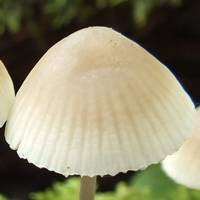 |
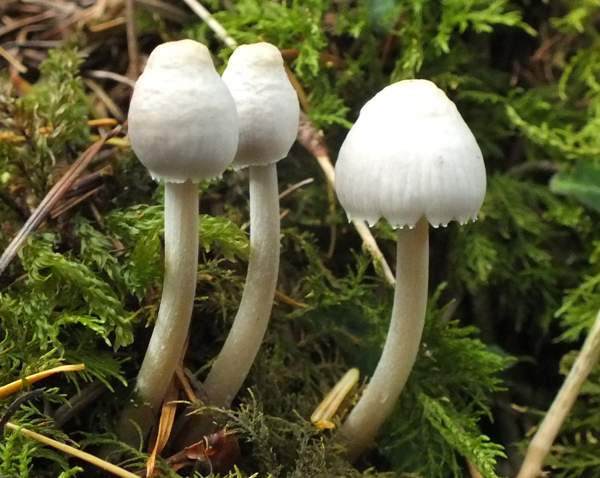
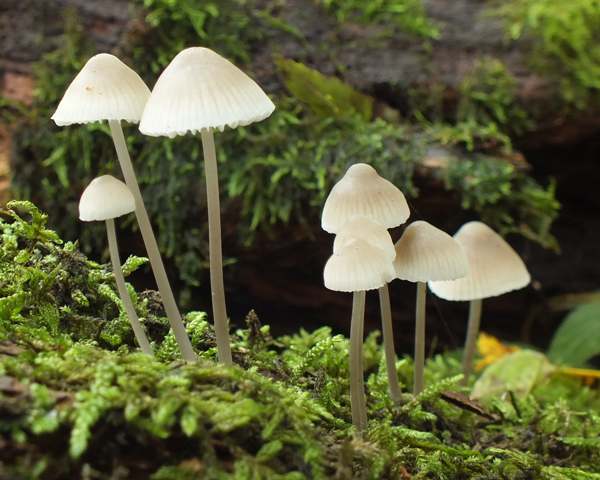
Cap0.7 to 2.5cm across; conical, becoming bell shaped and eventually broadly umbonate; smooth with translucent striations; hygrophanous, greyish brown tinged with yellow or olive when moist, drying pale grey. |
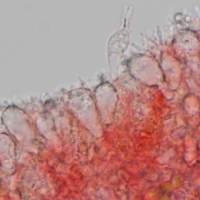 |
CheilocystidiaThe abundant cheilocystidia (standing out from the gill edges) of the Angel's Bonnet mushroom are up to 55µm long; they are pyriform (pear-shaped), with their tips bearing numerous short, thin 'brushcells'. The pleurocystidia (on gill faces) are similar. Cheilocystidia of Mycena arcangeliana, Angel's Bonnet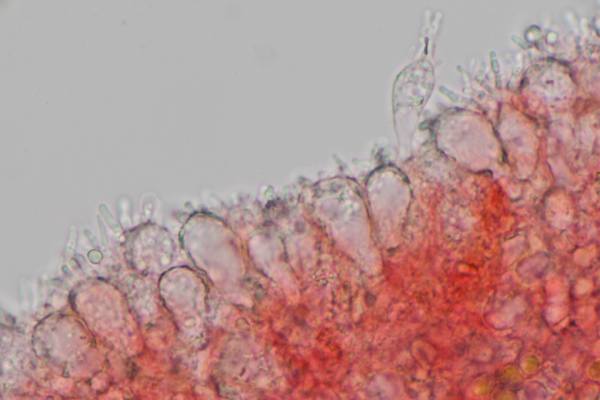 |
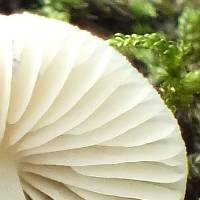 |
GillsAdnate or slightly decurrent; crowded; white, turning pinkish grey. The gill edges are slightly toothed. (A hand lens may be necessary to see this feature.) Stem4 to 8cm long and 2 to 4mm in diameter; white at the apex (with a lilac tinge when young), the lower part grey tinged with olive; the base covered in white downy hairs; no ring. |
SporesBroadly ellipsoidal to pip-shaped, smooth, 7-9 x 5-6µm; amyloid. Spore printWhite. |
|
Odour/taste |
Odour of iodine; taste mild but not distinctive. |
Habitat & Ecological role |
Mostly on fallen Beech and Ash, but occasionally on other fallen hardwood trees; exceptionally this species is found on rotting conifer wood. |
Season |
July to November in Britain and Ireland. |
Similar species |
There are many other small, bell-shaped fungi in the Mycena genus including Mycena polygramma and Mycena inclinata; however, the iodine odour of the Angel's Bonnet is a distinguishing feature. |
Culinary Notes
Although some field guides suggest that these little mushrooms are edible, they are quite insubstantial and certainly not highly prized, and so we feel that Angel's Bonnet mushrooms are not worth collecting to eat. This is a feature that Angel's Bonnets share with the other (Mycena) bonnet mushrooms, some of which are known to be poisonous.
Reference Sources
Fascinated by Fungi, 2nd Edition, Pat O'Reilly 2016, reprinted by Coch-y-bonddu Books in 2022.
Penny Cullington, (Oct. 2013). British Mycenas - Brief Descriptions.
Giovanni Robich, (2003). Mycena d'Europa; Associazione Micologica Bresadola; Vicenza : Fondazione Centro Studi Micologici.
British Mycological Society. English Names for Fungi
Dictionary of the Fungi; Paul M. Kirk, Paul F. Cannon, David W. Minter and J. A. Stalpers; CABI, 2008
Taxonomic history and synonym information on these pages is drawn from many sources but in particular from the British Mycological Society's GB Checklist of Fungi.
Fascinated by Fungi. Back by popular demand, Pat O'Reilly's best-selling 450-page hardback book is available now. The latest second edition was republished with a sparkling new cover design in September 2022 by Coch-y-Bonddu Books. Full details and copies are available from the publisher's online bookshop...