
Mycena pura (Pers.) P. Kumm. - Lilac Bonnet
Phylum: Basidiomycota - Class: Agaricomycetes - Order: Agaricales - Family: Mycenaceae
Distribution - Taxonomic History - Etymology - Identification - Toxicity - Reference Sources
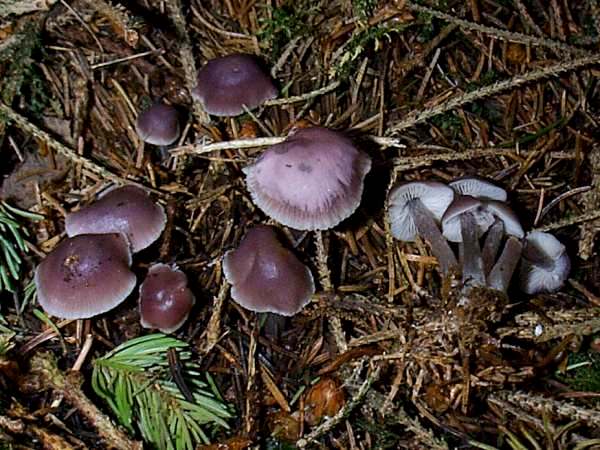
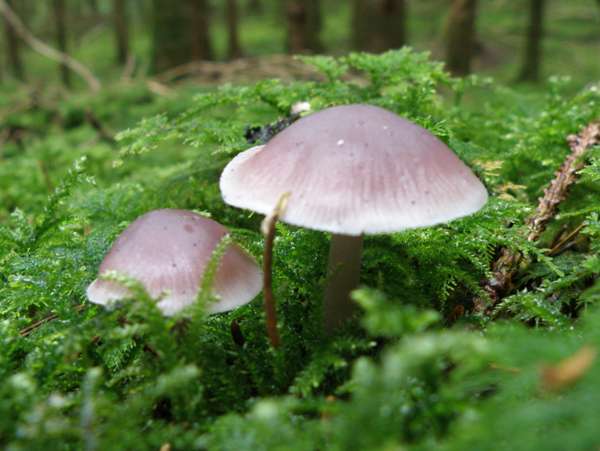
Mycena pura, the Lilac Bonnet (also referred to as the Lilac Bellcap), contains a small amount of the poison muscarine; therefore it should not be eaten. Like many other species in the genus Mycena, the Lilac Bonnet is reported to be bioluminescent, emitting a weak green light (wavelength in the region of of 520 to 530 nanometres). This is a common species in both deciduous and coniferous woodland, but it also occurs in some grassland sites.
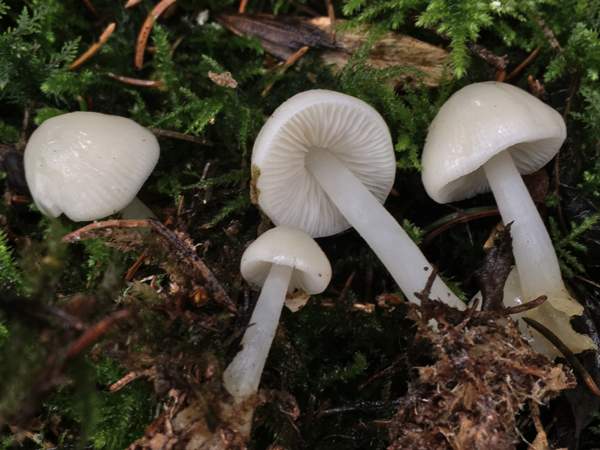
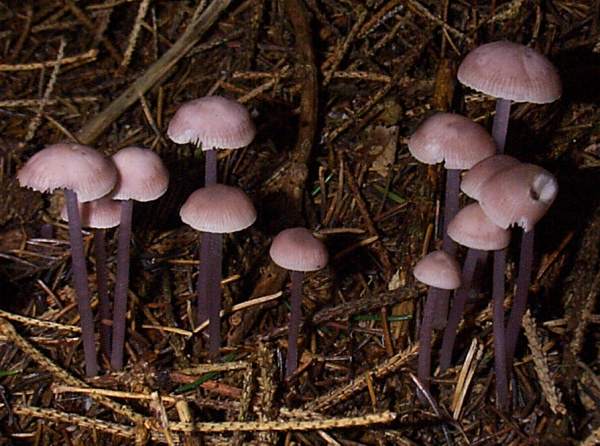
Despite its common name the lilac coloration of this mushroom cannot be relied upon for identification: bright-yellow and white forms are quite common, and caps may even be blue.
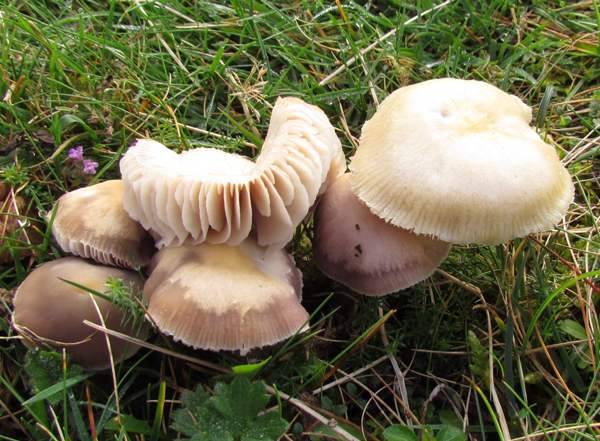
In woodlands, the colours of this very common mushroom seems to depend upon the nature of the habitat and the amount of light that breaks through the tree canopy; however, particularly when in grassland they can be difficult to identify, as seen in the yellowish forms (above) found in dune grassland.
Distribution
More common and less localised than the very similar but typically larger Mycena rosea, which is commonly known as the Rosy Bonnet, Mycena pura is found throughout Britain and Ireland as well as in most parts of mainland Europe. Mycena pura also occurs in North America, so also do pure pink bonnet mushrooms which correspond macroscopically and microscopically to the formal description of Mycena rosea; however, in the USA not all mycologists accept that these are two separate species despite evidence that the toxic chemicals in the two are not quite the same.
Taxonomic history
The basionym of this species was defined when, in 1794 Christiaan Hendrik Persoon described this species scientifically, calling it Agaricus purus. Its currently accepted scientific name dates from 1871, when the German mycologist Paul Kummer transferred this species to the genus Mycena, its name then becoming Mycena pura.
Synonyms of Mycena pura include Agaricus purus Pers., Gymnopus purus (Pers.) Gray, and Agaricus pseudopurus Cooke. Over the past 150 years many other mycologists have proposed varieties of Mycena pura, but (in Britain at least) currently they are all now treated as either Mycena pura or Mycena rosea.
Etymology
The specific epithet pura comes from the Latin adjective purum and means pure or clean.
Identification guide
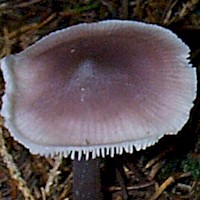 |
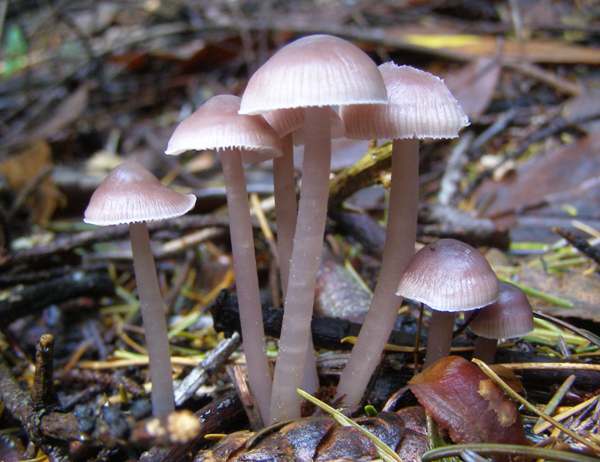
Cap2 to 5cm in diameter when fully mature, the caps are usually lilac with a pale, almost white edge, but other colour forms do occur. In dry weather a pale area develops in the middle and gradually spreads until it covers the whole of the cap. Initially bell-shaped, the caps flatten with a slight umbo and eventually the edge turns up to reveal the pale gills. When moist, the cap margins are distinctly lined. |
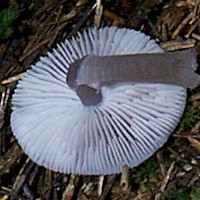 |
GillsAdnate or slightly decurrent, the crowded gills are pale grey with a slight lilac tint. |
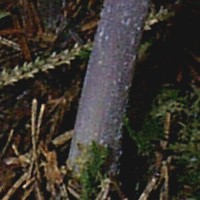 |
Stem3 to 8mm in diameter, the smooth stem is grey and untapering and 4 to 8cm long. Quite often the stems of this bonnet mushroom are radially twisted. |
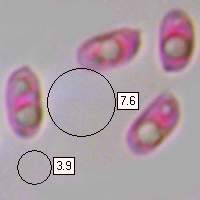 |
SporesEllipsoidal to subcylindrical, smooth, 6-9 x 3-4μm; amyloid. Spores of Mycena Pura, Lilac Bonnet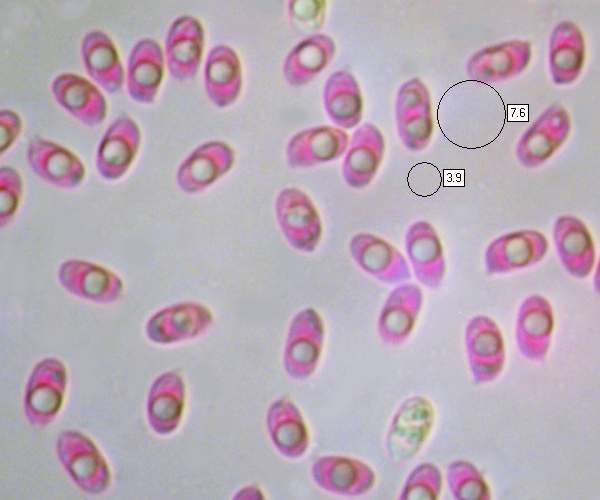 Spore printWhite.
|
Odour/taste |
Strong odour of radish when crushed; slight taste of radish. (Note: this is a poisonous species.) |
Habitat & Ecological role |
Saprobic in broadleaf and coniferous woodland; less commonly in open grassland. |
Season |
June to October in Britain and Ireland. |
Similar species |
Mycena rosea, a similar bell-shaped fungus found in the same kinds of habitats, is considered by most mycologists to be a separate species; it is larger, with a rose-red cap, and its spores are also larger. Mycena rosea tends to appear a little later than Mycena pura. |
Toxicity
Mycena pura contains the deadly toxin muscarine, albeit in low concentrations; it must therefore be considered inedible and potentially poisonous. Do not eat these toxic toadstools!
Reference Sources
Fascinated by Fungi, 2nd Edition, Pat O'Reilly 2016, reprinted by Coch-y-bonddu Books in 2022.
Penny Cullington, (Oct. 2013). British Mycenas - Brief Descriptions.
Giovanni Robich, (2003). Mycena d'Europa; Associazione Micologica Bresadola ; Vicenza : Fondazione Centro Studi Micologici.
British Mycological Society. English Names for Fungi
Dictionary of the Fungi; Paul M. Kirk, Paul F. Cannon, David W. Minter and J. A. Stalpers; CABI, 2008
Taxonomic history and synonym information on these pages is drawn from many sources but in particular from the British Mycological Society's GB Checklist of Fungi.
Acknowledgements
This page includes pictures kindly contributed by Simon Harding.
Fascinated by Fungi. Back by popular demand, Pat O'Reilly's best-selling 450-page hardback book is available now. The latest second edition was republished with a sparkling new cover design in September 2022 by Coch-y-Bonddu Books. Full details and copies are available from the publisher's online bookshop...