
Panaeolus fimicola (Pers.) Gillet - Turf Mottlegill
Phylum: Basidiomycota - Class: Agaricomycetes - Order: Agaricales - Family: Insertae sedis (Not yet assigned)
Distribution - Taxonomic History - Etymology - Toxicity - Identification - Reference Sources
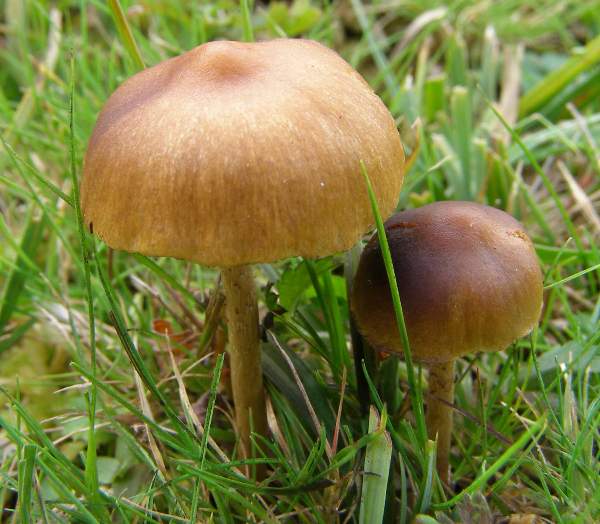
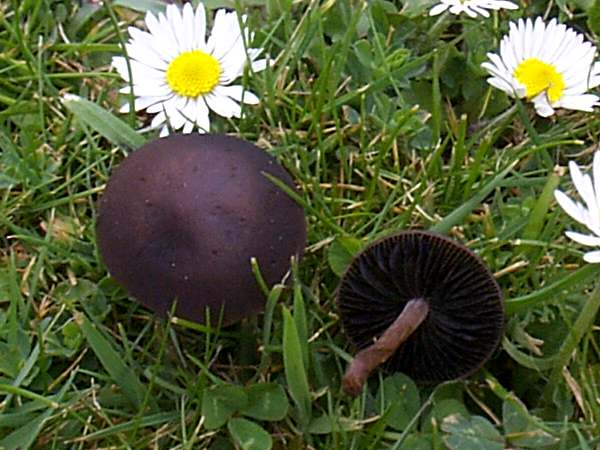
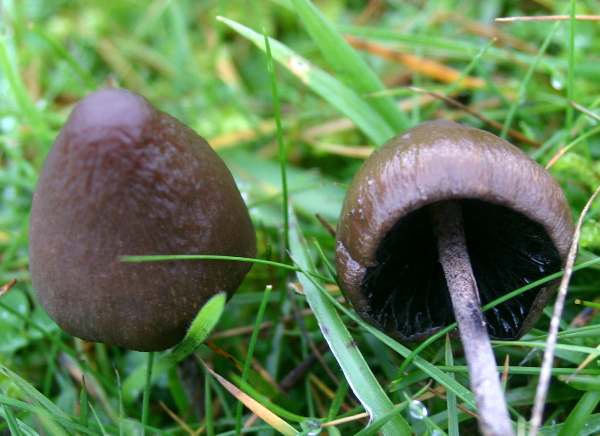
It is hard to imagine a duller mushroom, but this swarthy mottlegill somehow manages to make itself conspicuous on lawns after rain. The red-brown to dark-brown caps – sometimes almost black – fade when they dry out, covering a range of shades of brown; as a result the Turf Mottlegill is often wrongly recorded as Brown Mottlegill Panaeolina foenisecii, a more common and widespread lawn fungus. (If you have an old field guide, this grassland species is more likely to be recorded under its synonymous name Panaeolus ater.)
Distribution
In Britain and Ireland the Turf Mottlegill is common and widespread in lawns and dung-fertilised short-sward lowland grassland, but it is less plentiful in mountainous areas. This often misidentified toadstool is also found throughout most of mainland Europe, and it occurs in many other parts of the world including North America.
Taxonomic history
In 1788 a British mycologist, James Bolton, who first described this species scientifically and gave it the (invalid) name Agaricus varius (at a time when gilled fungi were generally placed into the genus Agaricus, since largely redistributed across many other newer genera). It was the great Christiaan Hendrik Persoon who established its first valid species name (its basionym) in his milestone publication of 1801, naming it Agaricus fimicola.
Nearly three quarters of a century later, in 1874, the currently accepted scientific name Panaeolus fimicola came about when French mycologist Claude-Casimir Gillet (1806 - 1896) transferred this species to the genus Panaeolus.
Synonyms of Panaeolus fimicola include Agaricus varius Bolton, Agaricus fimicola Pers., Prunulus varius (Bolton) Gray, Panaeolus fimicola var. ater J. E. Lange, Panaeolus obliquoporus Bon, and Panaeolus ater (J. E. Lange) Kühner & Romagn. ex Bon.
There is no concensus about the correct taxonomic position of fungi in the genera Panaeolus and Panaeolina, which some authorities include in the family Strophariaceae and others in the Bolbitiaceae. (I have placed our pictures of this species in with those of other members of the family Bolbitiaceae.)
Etymology
Panaeolus, the genus name of this mushroom, means variegated and is a reference to the mottled or variegated colouring of the gills. The specific epithet fimicola comes from the Latin noun fimum, meaning dung, and the Latin verb colo, to inhabit - hence it means living on dung. These little brown mushrooms do often inhabit dung-enriched grassland, but they can also appear on lawns that have not been dolloped with dung.
Toxicity
This is a slightly toxic toadstool and most definitely not edible. (There can be small amounts of the hallucinogen psilocybin in these fungi, which lack the umbonate pips of Psilocybe semilanceata, the Liberty Cap or Magic Mushroom.)
Identification guide
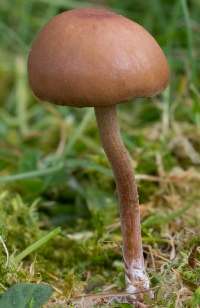 |
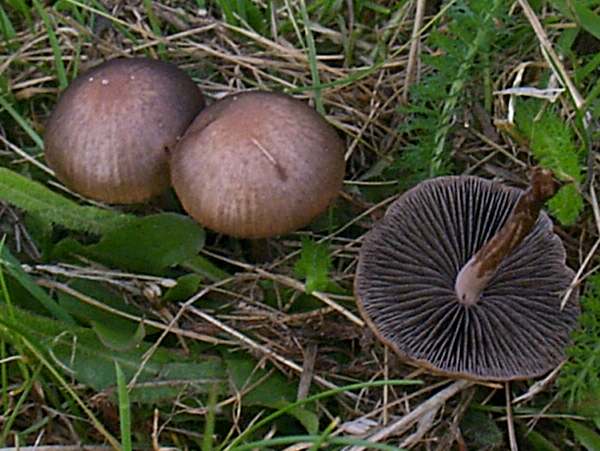
CapCaps of Panaeolus fimicola are 1.5 to 4cm across; initially hemispherical or convex, expanding to become broadly convex; hygrophanous, reddish-brown to dark reddish-brown, sometimes tinged with purple, drying paler brown; smooth, with a satin surface. Stem4 to 8cm long and 3 to 5mm diameter; dusted with a white bloom at apex, the middle and lower stem colour is as the cap; cylindrical; no stem ring. |
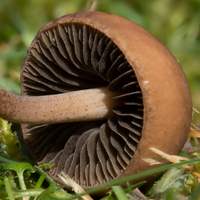 |
GillsGills of the Turf Mottlegill are adnate; grey-brown with white (initially) toothed edges and somewhat mottled, becoming black as the spores mature. |
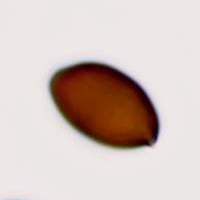 |
SporesEllipsoidal or lemon shaped; smooth, 10.8-14.2 x 6.9-9.5µm. Spores of Panaeolus fimicola, Turf Mottlegill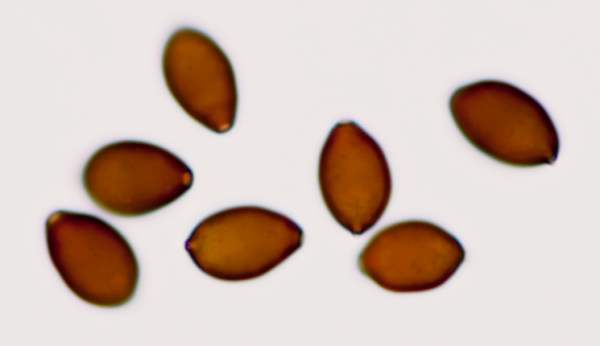 Spore printBlack. |
Odour/taste |
Not distinctive. |
Habitat & Ecological role |
Panaeolus fimicola is saprobic and appears on lawns, roadside verges and other grassy places. |
Season |
May to November in Britain and Ireland. |
Similar species |
Stropharia semiglobata, the Dung Roundhead, has a transient ring and leaves a brown spore print. Panaeolina foenisecii, the Brown Mottlegill, is a paler brown when wet and dries out from the cap centre to become creamy-beige. |
Reference Sources
Fascinated by Fungi, 2nd Edition, Pat O'Reilly 2016, reprinted by Coch-y-bonddu Books in 2022.
Dictionary of the Fungi; Paul M. Kirk, Paul F. Cannon, David W. Minter and J. A. Stalpers; CABI, 2008
Taxonomic history and synonym information on these pages is drawn from many sources but in particular from the British Mycological Society's GB Checklist of Fungi.
Acknowledgements
This page includes pictures kindly contributed by David Kelly.
Fascinated by Fungi. Back by popular demand, Pat O'Reilly's best-selling 450-page hardback book is available now. The latest second edition was republished with a sparkling new cover design in September 2022 by Coch-y-Bonddu Books. Full details and copies are available from the publisher's online bookshop...