
Panus rudis Fr.
Phylum: Basidiomycota - Class: Agaricomycetes - Order: Polyporales - Family: Polyporaceae
Distribution - Taxonomic History - Etymology - Identification - Culinary Notes - Reference Sources
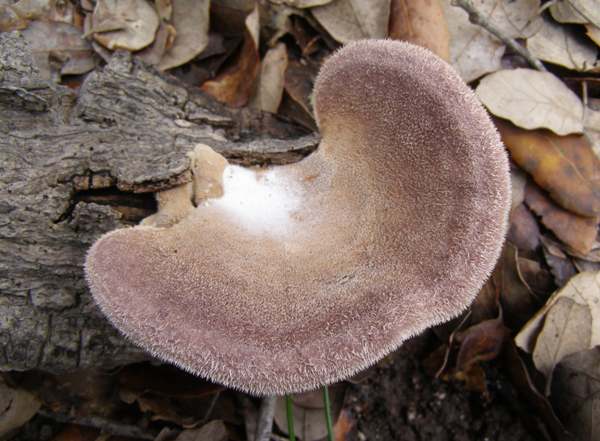
Panus is a small genus of tough wood-rotting fungi whose fruitbodies are usually purple tinged when young and fresh; they grow rather like oyster mushrooms or Split Gill fungi, with a very short eccentric stem, wavy margins, and shallowish gills that fork.
Distribution
Panus rudis occurs on dead deciduous hardwood in southern Europe. The few records from Britain might be due to confusion with Panus conchatus.
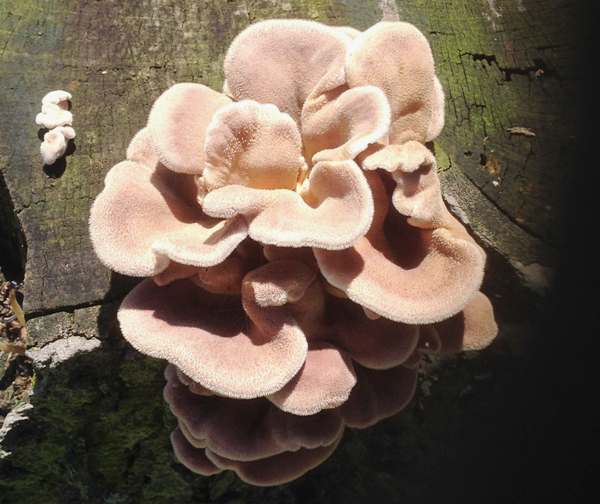
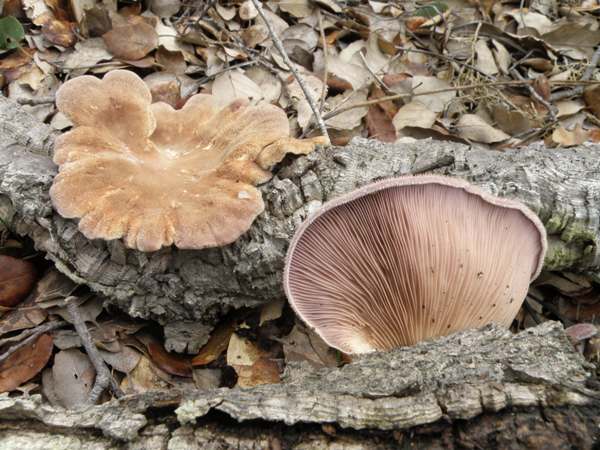
The picture immediately above shows a rosette of Panus rudis fruitbodies on a dead tree stump in Lacrosse, WI, USA and was kindly contributed by Andrea Aspenson.
Taxonomic history
Despite having gills, fungi in the genus Panus are now thought to be much more closely related to the Polypores than to the Agaricales - another example of parallel evolution. (Oyster mushrooms of the Pleurotus genus are, in contrast, classified in the order Agaricales.)
Etymology
Panus, the genus name, probably comes from Greek and means a swelling or tumour (a growth, therefore). Swedish mycologist Elias Magnus Fries described and named this species in 1838.
Just as it sounds, the specific epithet rudis comes from the same stem as 'rudimentary' and means basic, rough or raw (in the sense of uncultivated); this suggests a mushroom of lower esteem than other (oyster-like) species of similar appearance.
Identification guide
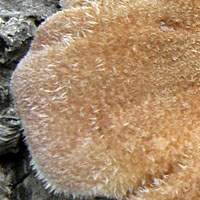 |
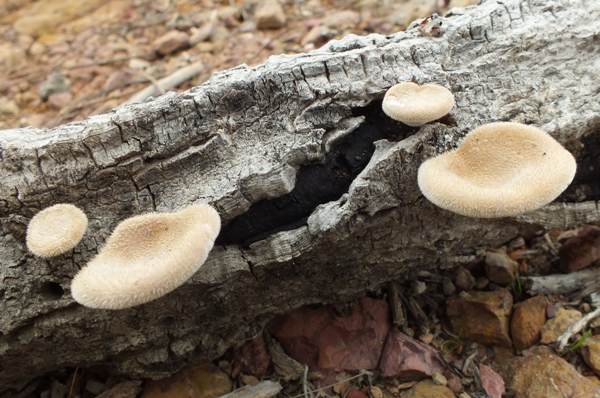
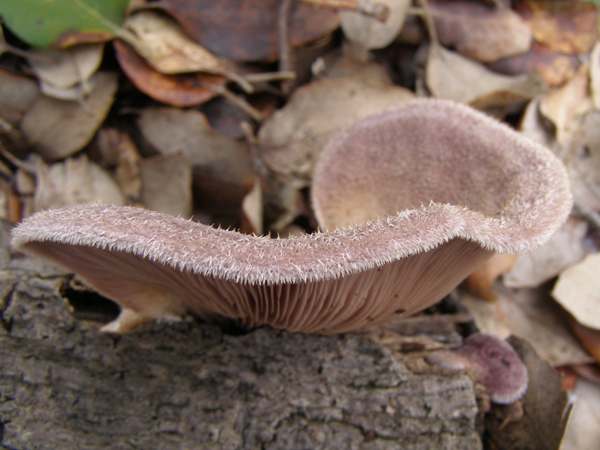
CapUsually semi-circular or oyster-shaped when growing on standing wood, but as shown in the picture above rosette forms sometimes occur when fruiting on dead wood lying on the ground. Caps are up to 10cm across, developing wavy margins; tough; densely fuzzy; reddish to purplish-brown when young, fading to tan with age. StemNearly always eccentrically attached; very stubby and often invisble because it is embedded within the substrate; paler than the cap; usually fuzzily textured. |
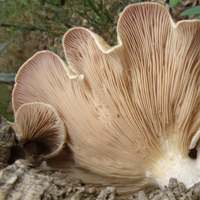 |
GillsPale mauve or pale purple when young and fresh, turning paler and later browning with age; decurrent to the stem. |
SporesEllipsoidal, smooth, 4.5-6.5 x 2.5-4µm; inamyloid. Spore printWhite or very pale yellow. |
|
Odour/taste |
Not distinctive. |
Habitat & Ecological role |
Restricted to dead hardwood - usually on fallen trunks and branches, particularly oaks. |
Season |
Summer through to winter and often into spring in mild parts of southern Europe. |
Similar species |
Panrus conchatus is similar but scaly rather than fuzzy, and its spores are slightly longer and narrower (a higher Q value); it is occasionally found in Britain and other northern European countries. |
Culinary Notes
This species is not generally considered edible, and we have no information about whether it contains toxins; however, Panus rudis as found in North America is stated by Clyde Martin Christensen (see Reference Sources, below) to be edible but tough.
Reference Sources
Fascinated by Fungi, 2nd Edition, Pat O'Reilly 2016, reprinted by Coch-y-bonddu Books in 2022.
Clyde Martin Christensen (1981), Edible Mushrooms; ISBN: 0-8166-1049-5; University of Minnesota Press.
Dictionary of the Fungi; Paul M. Kirk, Paul F. Cannon, David W. Minter and J. A. Stalpers; CABI, 2008
Taxonomic history and synonym information on these pages is drawn from many sources but in particular from the British Mycological Society's GB Checklist of Fungi.
Fascinated by Fungi. Back by popular demand, Pat O'Reilly's best-selling 450-page hardback book is available now. The latest second edition was republished with a sparkling new cover design in September 2022 by Coch-y-Bonddu Books. Full details and copies are available from the publisher's online bookshop...