
Peziza ammophila Durieu & Mont. - Dune Cup
Phylum: Ascomycota - Class: Pezizomycetes - Order: Pezizales - Family: Pezizaceae
Distribution - Taxonomic History - Etymology - Identification - Culinary Notes - Reference Sources
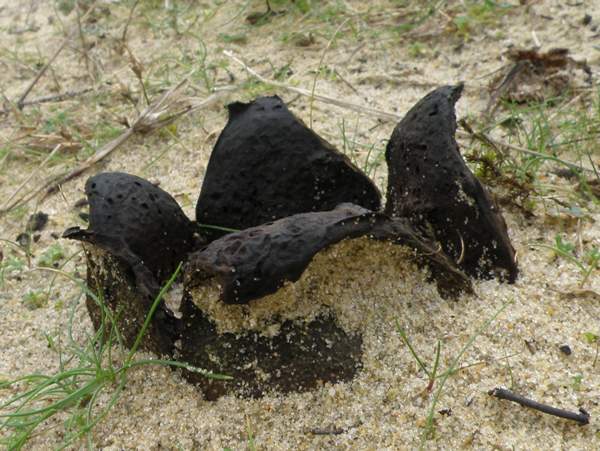
Cup fungi, and brown ones in particular, are particularly difficult to identify with certainty; however, the Dune Cup is distinctive not merely because of its growing habitat but also because of the way it develops. A globose fruitbody grows beneath the sand, breaking the surface when fully developed; then the peridium splits into between five and ten pointed petals, which peel backwards to expose the inner surface of the cup. At this stage the Dune Cup looks like an earthstar that has lost its central spore sac.
The fertile surface is inside the cup, as with all Peziza species. (The first time I saw one of these strange fungi I assumed that it was the empty dried-up case of an earthball, but there was no sign of any of the spore mass inside and yet clearly it was not a particularly old fruitbody.)
As dry sand blows across the dunes, specks inevitably fall into the cup and trigger the discharge of ripe spores; these are then carried away on the breeze – quite a cunning system for releasing spores at those times that are best for their long-range distribution!
Distribution
Peziza ammophila is quite a rare find in Britain and Ireland, where it is restricted to coastal sand dunes. This cup fungus occurs also in coastal dune systems in other parts of Europe and is recorded from North America.
Taxonomic history
The Dune Cup was described scientifically in 1847 by French botanists (both of whom were soldiers) Michel Charles Durieu de Maisonneuve (1796 - 1878) and Jean Pierre François Camille Montagne (1784 - 1866), who gave it the scientific name Peziza ammophila by which is it still generally referred to today.
Synonyms of Peziza ammophila include Geopyxis ammophila (Durieu & Mont.) Sacc.
Etymology
Peziza, the genus name, may come from a Latin root referring to a foot - most fungi in this group being sessile (footless or stemless). The specific epithet ammophila means 'lover of sand' - a reference to the growing habitat of this cup fungus.
Identification guide
FruitbodyInitially buried in or sometimes just below the surfacve of the sand; 2 to 4cm across and 1.5 to 3cm tall; globose at first, opening into a crown-like form as several pointed star-like rays fold back to reveal the inner surface of the cup. Outer and inner surfaces are various shades of ochre or brown. Sometimes the fruitbody is seated on a pseudostipe consisting of sand grains bound together by mycelium, but more often there is no stem. |
|
SporesEllipsoidal, smooth, 14-16 x 9.5-10.5µm. Spore printWhite. |
|
Odour/taste |
Not distinctive. Like nearly all of the cup fungi, this species in inedible. |
Habitat & Ecological role |
The Dune Cup is a saprophyte and, as the specific epithet implies, it is usually found in sand dunes, often with Marram Grass Ammophila arenaria. |
Season |
June to November in Britain and Ireland. |
Similar species |
There are at least 100 Peziza species and most are various shades of fawn or brown. Definite identification is rarely possible without microscopic examination, but the distinctive crown-like form and marram grass sand-dune habitat make the Dune Cup a notable exception. |
Culinary Notes
This cup fungus is not considered edible (invariably it is encrusted with sand particles) and it is most probably poisonous if eaten raw or inadequately cooked, when it could at least cause seriously unpleasant stomach upsets. (The same is true of most edible ascomycetes including Morchella esculenta, the Morel, and Morchella elata, the Black Morel.)
Reference Sources
Fascinated by Fungi, 2nd Edition, Pat O'Reilly 2016, reprinted by Coch-y-bonddu Books in 2022.
Dennis, R.W.G. (1981). British Ascomycetes; Lubrecht & Cramer; ISBN: 3768205525.
Breitenbach, J. & Kränzlin, F. (1984). Fungi of Switzerland. Volume 1: Ascomycetes. Verlag Mykologia: Luzern, Switzerland.
Medardi, G. (2006). Ascomiceti d'Italia. Centro Studi Micologici: Trento.
Donadini J.C. 1981. Le genre Peziza dans le sud-est de la France, avec clef du genre pour la France; Universite d'Aix-Marseille
Dictionary of the Fungi; Paul M. Kirk, Paul F. Cannon, David W. Minter and J. A. Stalpers; CABI, 2008
Taxonomic history and synonym information on these pages is drawn from many sources but in particular from the British Mycological Society's GB Checklist of Fungi.
Fascinated by Fungi. Back by popular demand, Pat O'Reilly's best-selling 450-page hardback book is available now. The latest second edition was republished with a sparkling new cover design in September 2022 by Coch-y-Bonddu Books. Full details and copies are available from the publisher's online bookshop...