
Peziza micropus Pers. - Pedicel Cup
Phylum: Ascomycota - Class: Pezizomycetes - Order: Pezizales - Family: Pezizaceae
Distribution - Taxonomic History - Etymology - Identification - Culinary Notes - Reference Sources
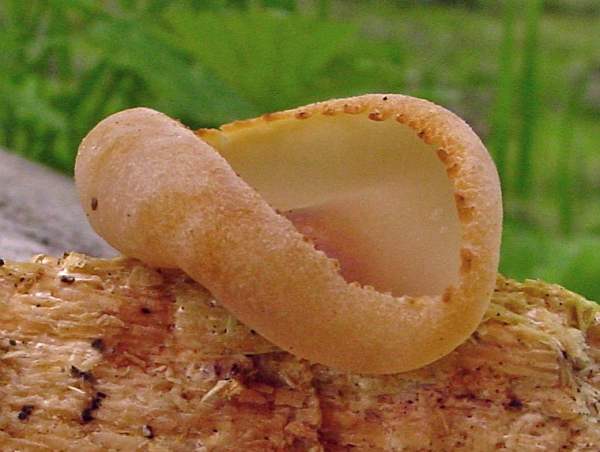
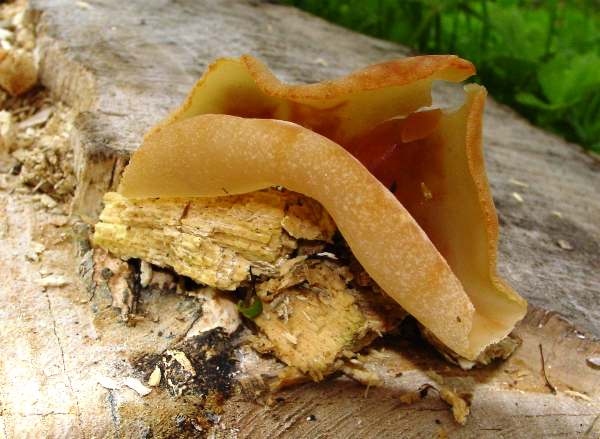
This common pezizoid fungus appears on very rotten hardwood, often inside hollow dead stumps, particularly of Beech trees. Like so many of the commonly encountered cup fungi, identification is made more difficult by its range of colours, which vary with substrate and stage of development.
Distribution
Peziza micropus is fairly common and widespread in Britain and Ireland, and it occurs also in many other parts of Europe and in Asia.
Taxonomic history
This wood-rotting cup fungus was described in 1800 by Christiaan Hendrik Persoon, who gave it the binomial scientific name Peziza micropus by which it is still generally known today.
Synonyms of Peziza micropus include Aleuria micropus (Pers.) Gillet, Geopyxis cocotina (Cooke) Massee, Lachnea cocotina (Cooke) W. Phillips, Otidea micropus (Pers.) Sacc., Aleuria cerea var. cocotina (Cooke) Boud., and Sarcoscypha cocotina (Cooke) Sacc.
Etymology
Peziza, the genus name, may come from a Latin root referring to a foot - most fungi in this group being sessile (footless or stemless). The specific epithet micropus means 'with a small leg' - a reference to the very short stem of this cup fungus.
Identification guide
 |
FruitbodyA shallow cup 1 to 5cm across; inner surface smooth, ochre; outer surface slightly paler and finely granular or floury; margin inrolled; its short, narrow stem is usually buried in the substrate timber and not visible without excavating some of the surrounding substrate. |
SporesEllipsoidal, smooth, 15-17 x 8.5-9.5µm. Spore printWhite. |
|
Odour/taste |
Not distinctive. Like nearly all of the cup fungi, this species in inedible. |
Habitat & Ecological role |
On rotten hardwoods, notably Beech and elms. |
Season |
June to November in Britain and Ireland. |
Similar species |
There are at least 100 Peziza species and most are various shades of fawn or brown. Definite identification is rarely possible without microscopic examination. |
Culinary Notes
This cup fungus is not considered edible, and it is most probably poisonous if eaten raw or inadequately cooked, when it could at least cause seriously unpleasant stomach upsets. (The same is true of most edible ascomycetes including Morchella esculenta, the Morel, and Morchella elata, the Black Morel.)
Reference Sources
Fascinated by Fungi, 2nd Edition, Pat O'Reilly 2016, reprinted by Coch-y-bonddu Books in 2022.
Dennis, R.W.G. (1981). British Ascomycetes; Lubrecht & Cramer; ISBN: 3768205525.
Breitenbach, J. & Kränzlin, F. (1984). Fungi of Switzerland. Volume 1: Ascomycetes. Verlag Mykologia: Luzern, Switzerland.
Medardi, G. (2006). Ascomiceti d'Italia. Centro Studi Micologici: Trento.
Donadini J.C. 1981. Le genre Peziza dans le sud-est de la France, avec clef du genre pour la France; Universite d'Aix-Marseille
Dictionary of the Fungi; Paul M. Kirk, Paul F. Cannon, David W. Minter and J. A. Stalpers; CABI, 2008
Taxonomic history and synonym information on these pages is drawn from many sources but in particular from the British Mycological Society's GB Checklist of Fungi.
Fascinated by Fungi. Back by popular demand, Pat O'Reilly's best-selling 450-page hardback book is available now. The latest second edition was republished with a sparkling new cover design in September 2022 by Coch-y-Bonddu Books. Full details and copies are available from the publisher's online bookshop...