
Phaeolepiota aurea (Matt.) Konrad & Maubl. - Golden Bootleg
Phylum: Basidiomycota - Class: Agaricomycetes - Order: Agaricales - Family: Agaricaceae
Distribution - Taxonomic History - Etymology - Toxicity - Identification - Reference Sources
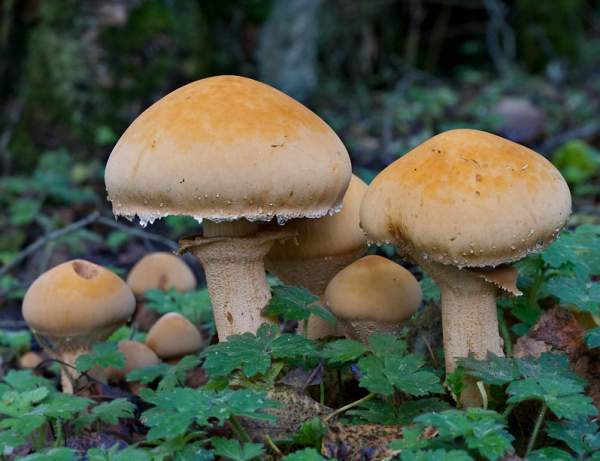
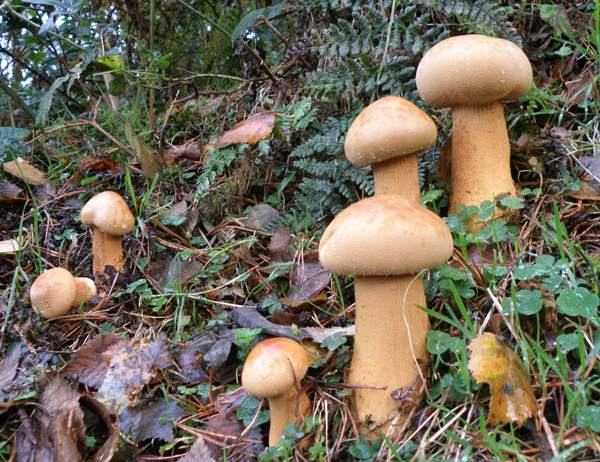
Phaeolepiota aurea, a rare species (at one time Red Data listed, and hence considered rare and probably threatened, but not now a Biodiversity Action Plan or BAP species) generally referred to as Golden Bootleg or Golden Cap, is a large mushroom and very easy to spot; however, it is also easily overlooked because it bears a strong resemblance to another large but abundant species, the equally spectacular orange wood-rotting mushroom Gynopilus junonius.
Distribution
Quite uncommon and in many vice counties of Britain rare, although locally plentiful in other parts of England, Wales, Scotland and Ireland, Phaeolepiota aurea was included as 'Rare' on the 1992 Red Data List.
Many of the specimens shown on this page were photographed in Wiltshire, England, during October 2009.
When this beautiful mushroom is misidentified (a common occurrence) it is nearly always misidentified as the Spectacular Rustgill Gymnopilus junonius. If it wasn't suchan enormous mushroom I can imagine it being more often mistaked for the (much smaller) Earthy Powdercap Cystoderma amianthinum.
Taxonomic history
This oddball mushroom has confounded mycologists down the ages as they struggled to fit it in to existing genera. There has been much debate as to whether this mushroom should be considered a member of the Agaricaceae (grouped with field mushrooms and their kin, as we have it here); some suggest it has more in common with Pholiota species, which belong to the family Strophariaceae. Now placed in a genus all on its own (the technical term for this is 'monotypic'), the Golden Bootleg's basionym dates from 1779, when German botanist Heinrich Gottfried von Mattuschka (1734 - 1779) described this species and gave it the binomial name Agaricus aureus. (At the time most gilled mushrooms were placed in a gigantic Agaricus genus, who contents have since been largely redistributed across many newer genera.) It was not until 1928 that French mycologists Paul Konrad (1877 - 1948) and André Maublanc (1880 - 1958) renamed the Golden Bootleg as Phaeolepiota aurea, which remains its accepted scientific name.
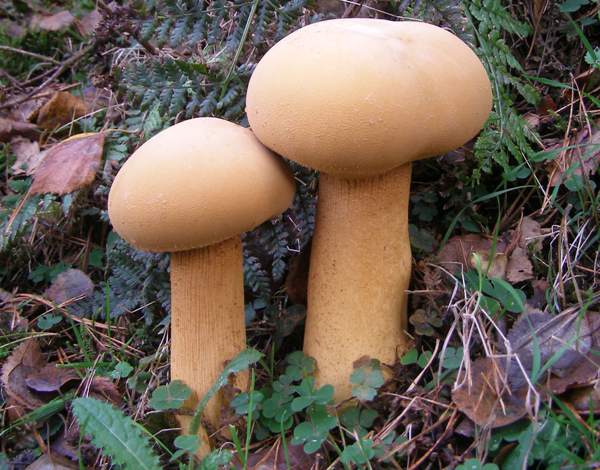
Synonymy is often an indication of the degree of perplexity caused by a species, and in this respect the Golden Bootleg is quite exceptiona, with at least 20 synonyms among which are Agaricus aureus Matt., Agaricus vahlii Schumach., Agaricus spectabilis Weinm., Pholiota aurea (Matt.) P. Kumm., Pholiota spectabilis (Weinm.) P. Kumm., Togaria aurea (Matt.) W.G. Sm., Pholiota vahlii (Schumach.) J. E. Lange, Fulvidula spectabilis (Weinm.) Romagn., Gymnopilus spectabilis (Weinm.) A.H. Sm., Cystoderma aureum (Matt.) Kühner & Romagn.
Etymology
The genus name Phaelepiota indicates that species in this group (and there is only one) are dusky (from the prefix phae-) and scaly (from Lepis, meaning scales). The caps are actually covered in tiny granules rather than flaky scales.
The specific epithet aurea comes from Latin and refers to the golden-orange colouring of this mushroom.
Toxicity
Despite its attractive appearance and substantial proportions this rare mushroom is inedible and has been known to cause severe stomach upsets when eaten; it is known to contain hydrogen cyanide (hydrocyanic acid), which is seriously toxic to humans. Although in the past Phaeolepiota aurea was indeed listed as edible, this mushroom is no longer considered safe to eat. It's true that cooking reduces the concentration of the toxic acid, but it is still potentially quite dangerous. Shun this risky snack!
Identification guide
 |
CapThe cap, and indeed initially the whole of the mushroom, is covered by a grainy sheath that eventually tears at the cap rim to form a pendent ring so substantial that it might better be described as a 'skirt' on the stem. Cap diameter at maturity is typically 8 to 20cm, exceptionally 30cm, and rounded at first becoming almost flat with a small central umbo (a slight hump). In very dry weather caps can develop upturned wavy margins. The colour is usually orange-tan or golden brown, with a dry and granulose surface, and the margin is often fringed with irregular veil fragments. |
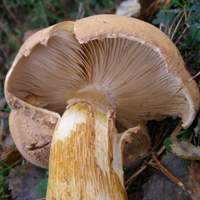 |
GillsThe adnate crowded gills have short decurrent teeth and are a pale golden colour, turning slightly darker with age. Stem10 to 20cm tall and typically 2 to 3cm across, the stipe increases in diameter towards the clavate (club-shaped) base. Above the ring, which persists through the life of the fruitbody, the stem is smooth and glossy and lighter in colour than the cap; below the ring the stem is striate and coloured much the same as the cap, with a similarly granulose surface.When cut, the light yellow stem flesh gradually darkens. |
SporesEllipsoidal, smooth or minutely warty, 10-14 x 5-6µm. Spore printLight yellow-brown |
|
Odour/taste |
Odour of bitter almonds (suggesting the presence of hydrocyanic acid); mild and slightly sweet taste. |
Habitat & Ecological role |
Saprobic, in groups beneath deciduous and coniferous trees on disturbed ground, often together with nettles. |
Season |
September to November in Britain and Ireland. |
Similar species |
Gymnopilus junonius (syn. Gymnopilus spectabilis) is quite similar in appearance but does not have a grainy surface; its spores are much darker. |
Reference Sources
Fascinated by Fungi, 2nd Edition, Pat O'Reilly 2016, reprinted by Coch-y-bonddu Books in 2022.
Dictionary of the Fungi; Paul M. Kirk, Paul F. Cannon, David W. Minter and J. A. Stalpers; CABI, 2008
Taxonomic history and synonym information on these pages is drawn from many sources but in particular from the British Mycological Society's GB Checklist of Fungi.
Acknowledgements
This page includes pictures kindly contributed by David Adamson.
Fascinated by Fungi. Back by popular demand, Pat O'Reilly's best-selling 450-page hardback book is available now. The latest second edition was republished with a sparkling new cover design in September 2022 by Coch-y-Bonddu Books. Full details and copies are available from the publisher's online bookshop...