
Pholiota squarrosa (Weigel) P. Kumm. - Shaggy Scalycap
Phylum: Basidiomycota - Class: Agaricomycetes - Order: Agaricales - Family: Strophariaceae
Distribution - Taxonomic History - Etymology - Identification - Culinary Notes - Reference Sources
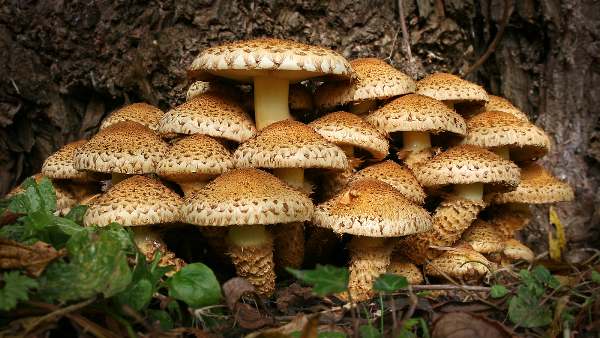
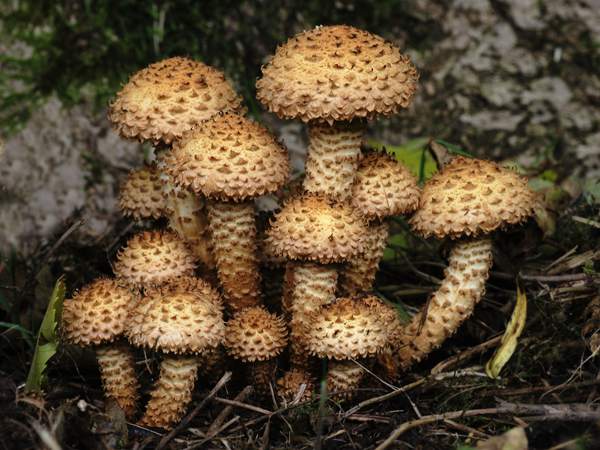
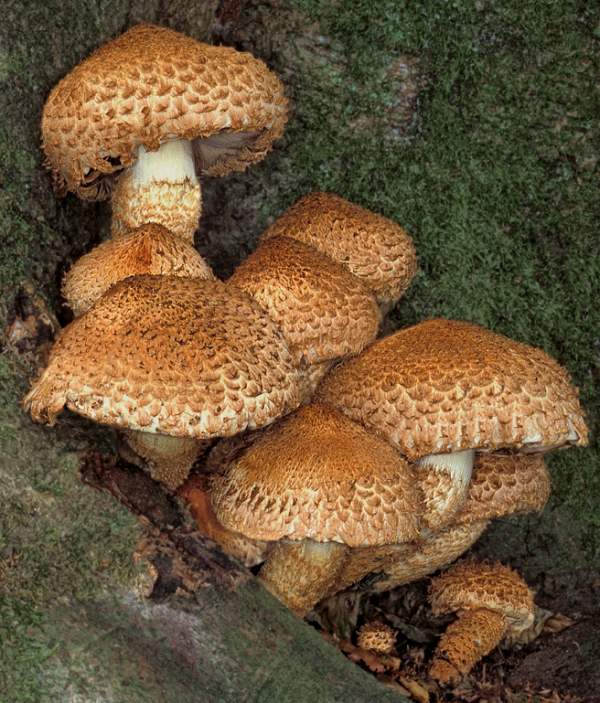
Pholiota squarrosa appears at the bases of old trees and sometimes on the stumps of felled trees - mainly broadleaf species but also occasionally conifers, notably spruces.
The Shaggy Scalycap is often confused with Honey Fungus (Armillaria mellea and similar species). The two groups can be distinguished easily by taking a spore print: Armillaria species produce white spore prints while all Pholiota fungi have brown spores.
Distribution
Locally common but otherwise an infrequent find in most parts of Britain and Ireland, particularly where Beech trees grow in open grassland or in hedgerows on alkaline soil. The Shaggy Scalycap, also referred to in some field guides as the Shaggy Pholiota, is found throughout mainland Europe and in the USA and parts of Canada.
Taxonomic history
This species was described in 1771 by the German scientist Christian Ehrenfried Weigel (1748 - 1831) who named it Agaricus squarrosus - in the early days of fungal taxonomy most gilled mushrooms were placed in the genus Agaricus, which was later broken up into the many other genera that we use today. The Shaggy Scalycap was transferred to its present genus by German mycologist Paul Kummer in 1871, at which time its scientific name became Pholiota squarrosa.
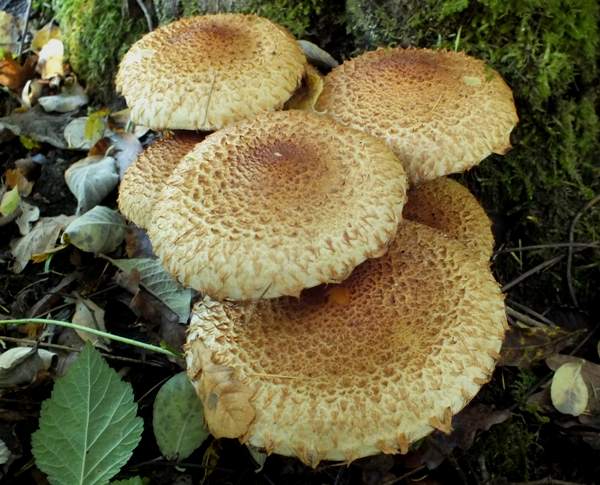
Pholiota squarrosa is the type species of the genus Pholiota, which contains some 150 known species worldwide. Fungi in this group generally have glutinous cap surfaces, especially in wet weather, and usually scales cover part or all of the cap surface and often also the stem. Their brown (in mass) spores are smooth-surfaced ellipsoids each with a germ pore (a small hole or a very thin region in the spore wall where the germinating mycelium emerges).
Synonyms of Pholiota squarrosa include Agaricus floccosus Schaeff., Agaricus squarrosus Weigel, Lepiota squarrosa (Weigel) Gray, Agaricus verruculosus Lasch, and Dryophila squarrosa (Weigel) Quél.
Etymology
Derived from the Greek word Pholis, meaning a scale, the generic name Pholiota means scaly.
The specific epithet squarrosa adds just a little more detail because it translates to 'with upright scales'.
Identification guide
 |
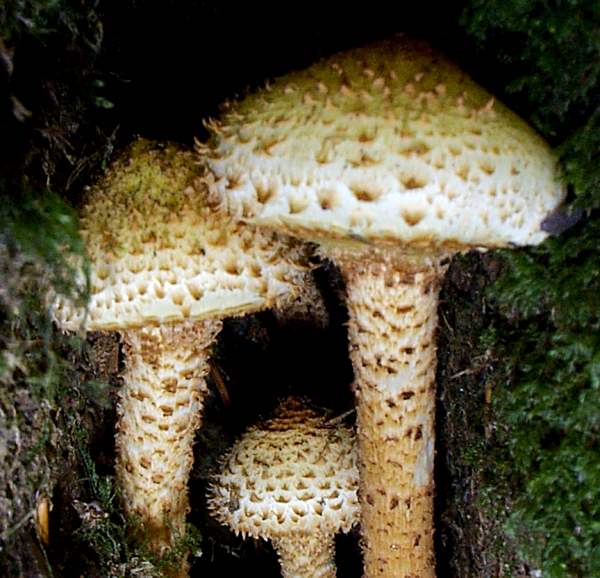
CapCaps of Pholiota squarrosa are 4 to 12cm in diameter; yellow-ochre or straw-yellow; covered in upturned triangular brown scales in more or less concentric rings. Convex at first, the caps flatten with age but retain an in-rolled margin. The cap flesh is very pale yellow, and it is quite firm. |
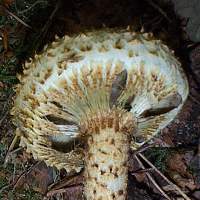 |
GillsThe crowded adnate gills of the Shaggy Scalycap are pale greyish yellow at first, becoming cinnamon as the spores mature. A cortina-like veil covers the young gills. Stem7 to 15mm in diameter and 6 to 15cm tall, the stem has a distinctly scaly ring below which it is covered in scales very similar to those on the cap. The upper section of the stem above the ring is paler and smooth. |
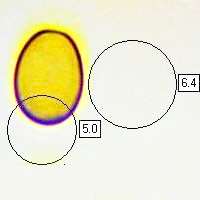 |
SporesEllipsoidal, smooth; 5.5-9 x 3.5-5μm, with an apical germ pore. Spores of Pholiota squarrosa, Shaggy Scalycap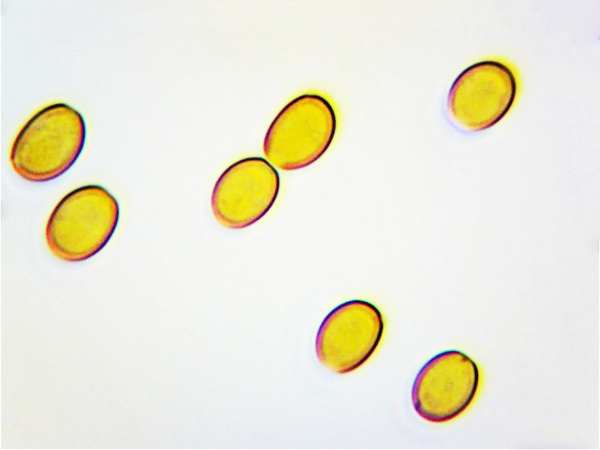 Spore printRusty brown. |
Odour/taste |
Smells and tastes like radish (a slightly bitter taste). |
Habitat & Ecological role |
Saprobic or possibly weakly parasitic; In small clusters at the base of stumps or standing living or dead broad-leaf trees, particularly beech; also occasionally at the base of conifer stumps. |
Season |
August to November in Britain and Ireland. |
Similar species |
Pholiota flammans is of similar form and size, but its colour is bright orange or yellow-orange and it is a saprobe, occurring on rotting conifer stumps. Some forms of Armillaria mellea, the Honey Fungus, are scaly but their spore prints are white rather than brown and the gills do not darken significantly with age. |
Culinary Notes
Despite their attractive appearance, these and other scalycaps (Pholiota species) are definitely not edible mushrooms, although in the past some members of this genus were considered to be so.
Reference Sources
Fascinated by Fungi, 2nd Edition, Pat O'Reilly 2016, reprinted by Coch-y-bonddu Books in 2022.
British Mycological Society (2010). English Names for Fungi
Funga Nordica, Henning Knudsen and Jan Vesterholt, 2008.
Dictionary of the Fungi; Paul M. Kirk, Paul F. Cannon, David W. Minter and J. A. Stalpers; CABI, 2008
Taxonomic history and synonym information on these pages is drawn from many sources but in particular from the British Mycological Society's GB Checklist of Fungi.
Acknowledgements
This page includes pictures kindly contributed by David Adamson, Rob Evans and Simon Harding.
Fascinated by Fungi. Back by popular demand, Pat O'Reilly's best-selling 450-page hardback book is available now. The latest second edition was republished with a sparkling new cover design in September 2022 by Coch-y-Bonddu Books. Full details and copies are available from the publisher's online bookshop...