
Pluteus umbrosus (Pers.) P. Kumm. - Velvet Shield
Phylum: Basidiomycota - Class: Agaricomycetes - Order: Agaricales - Family: Pluteaceae
Distribution - Taxonomic History - Etymology - Identification - Culinary Notes - Reference Sources
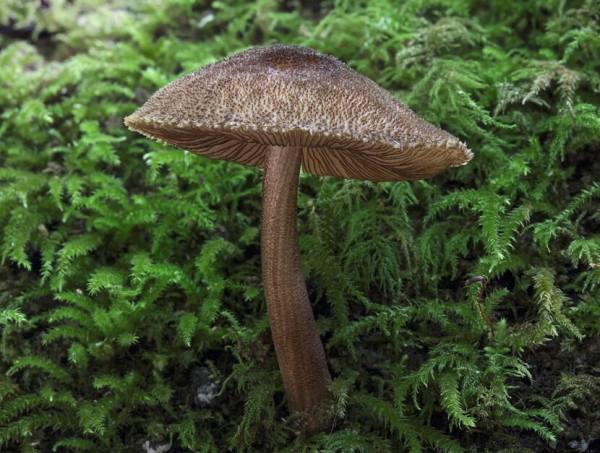
Pluteus umbrosus is a fairly rare late summer and autumn fungus that grows on the rotting wood debris of deciduous trees. The radially wrinkled cap and pale pink gills are distinctive.
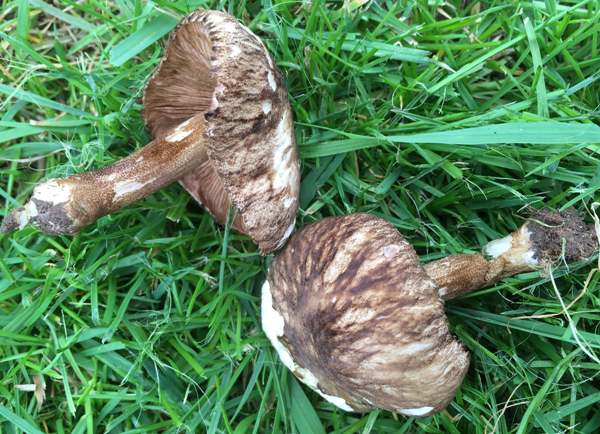
The Velvet Shield is a beautiful mushroom. The specimen shown on the left was found in Cambridgeshire in mixed woodland that was dominated by old coppiced lime trees interspersed with hazel as well as a few spruces, some of which had died and rotted to ragged stumps.
Distribution
Widespread but far from common in Britain and Ireland. This species is also found throughout much of northern and central mainland Europe, and it is also recorded in North America.
Taxonomic history
This wood-rotting mushroom was described scientifically in 1798 by South African mycologist Christiaan Hendrik Persoon, who gave it the name Agaricus umbrosus. (In the early years of fungal taxonomy most gilled fungi were initially placed in a giant Agaricus genus, most of the contents of which have now redistributed to many other genera.)
It was the celebrated German mycologist Paul Kummer who, in 1871, transferred this species to the genus Pluteus, thereby establishing its currently-accepted scientific name Pluteus umbrosus.
Synonyms of Pluteus umbrosus include Agaricus umbrosus Pers.
Etymology
Pluteus, the genus name, comes from Latin and literally means a protective fence or screen - a shield for example!
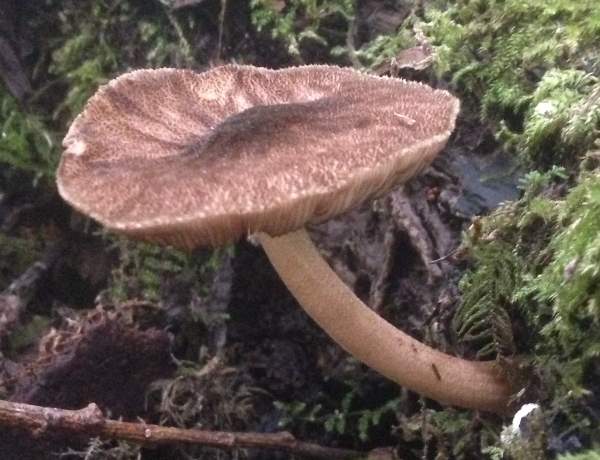
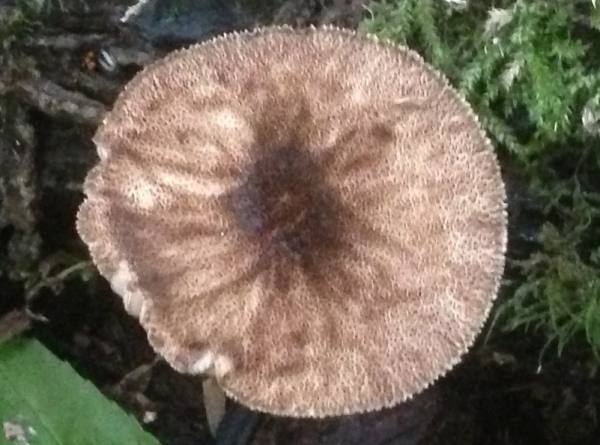
The specific epithet umbrosus comes from Old Latin umbra, meaning a shadow - a reference to the darkly shaded area in the centre of the cap of this shield mushroom.
Identification guide
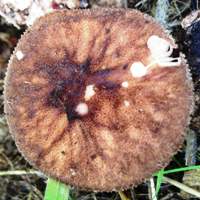 |
Cap3 to 9cm in diameter, the cap is sepia to mid brown, darkest towards the centre, usually with slightly darker irregularly radial marks. Convex at first and then almost flattened, with a radially wrinkled fibrous surface. Beneath the cuticle, the cap flesh is white and firm. StemThe stem is 3 to 8cm long and 5 to 12mm in diameter of more or less constant diameter or very slightly bulbous at the base. Its background colour is white to pale fawn, covered in small brown soft scales.
|
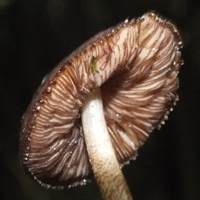 |
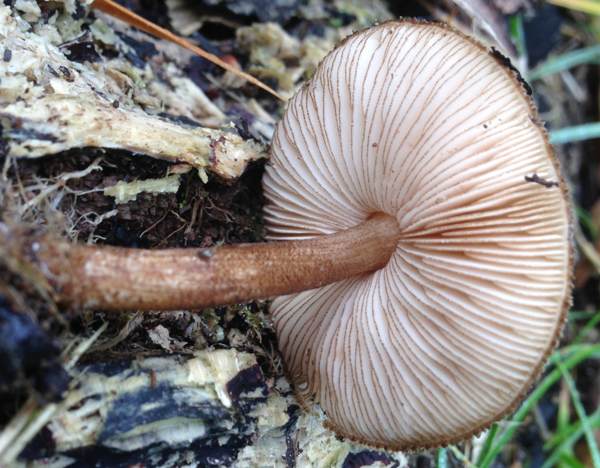
GillsWhite at first, becoming pale pink with distinctive dark brown edges, the gills are broad, crowded and free of the stem. |
SporesSubglobose, 6-7 x 4-5µm. Spore printPale pink. |
|
Odour/taste |
Not distinctive. |
Habitat & Ecological role |
Solitary or in small groups on stumps, rotting fallen branches and other woody debris of broadleaf trees; very occasionally on conifer stumps. This species also appears on sawdust heaps. |
Season |
Fruiting through most of the year provided the weather is mild, the Velvet Shield is seen mainly in Britain and Ireland during late summer and autumn. |
Similar species |
Pluteus cervinus does not have a wrinkled cap and is often rather larger. |
Culinary Notes
Pluteus umbrosus is reported to be edible; however, it is far too uncommon to be a significant source of food for anyone but the most anorexic of fungiphages.
Reference Sources
Fascinated by Fungi, 2nd Edition, Pat O'Reilly 2016, reprinted by Coch-y-bonddu Books in 2022.
Orton, P.D. (1986). British Fungus Flora: Agarics and Boleti. Vol 4. Pluteaceae: Pluteus & Volvariella. Royal Botanic Garden: Edinburgh, Scotland.
BMS List of English Names for Fungi
Dictionary of the Fungi; Paul M. Kirk, Paul F. Cannon, David W. Minter and J. A. Stalpers; CABI, 2008
Taxonomic history and synonym information on these pages is drawn from many sources but in particular from the British Mycological Society's GB Checklist of Fungi.
Acknowledgements
This page includes pictures kindly contributed by Simon Harding and Wayne Hicks.
Fascinated by Fungi. Back by popular demand, Pat O'Reilly's best-selling 450-page hardback book is available now. The latest second edition was republished with a sparkling new cover design in September 2022 by Coch-y-Bonddu Books. Full details and copies are available from the publisher's online bookshop...