
Psathyrella piluliformis (Bull.) P. D. Orton - Common Stump Brittlestem
Phylum: Basidiomycota - Class: Agaricomycetes - Order: Agaricales - Family: Psathyrellaceae
Distribution - Taxonomic History - Etymology - Identification - Culinary Notes - Reference Sources
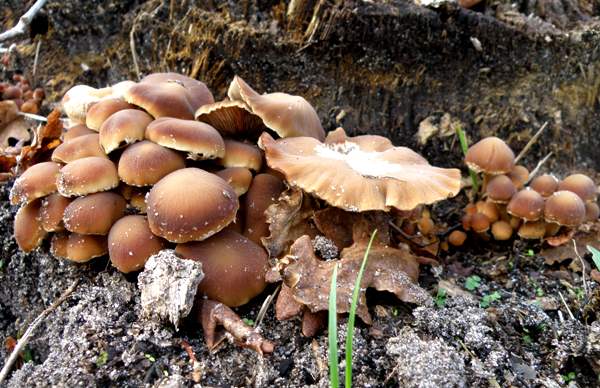
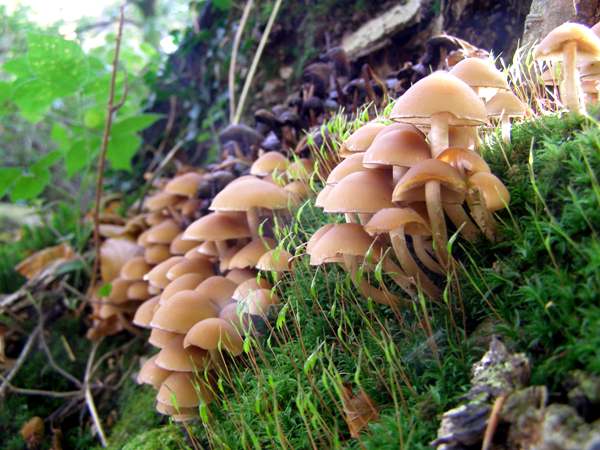
Psathyrella piluliformis is a very common wood-rotting fungus in broadleaf woodlands, where it is found on and around the stumps of dead deciduous trees.
Distribution
Very common and widespread in woodlands throughout Britain and Ireland, the Common Stump Brittlestem is also found throughout the European mainland and in many other countries including North America.
Taxonomic history
The basionym of this species dates from 11783, when French mycologist Jean Baptiste Francois (Pierre) Bulliard described the Clustered Brittlestem, giving it the binomial scientific name Agaricus piluliformis. It was not until 1969 that this mushroom was given its currently-accepted scientific name; that was when British mycologist Peter Darbishire Orton (1916 - 2005) transferred this species to the genus Psathyrella, whereupon its name became Psathyrella piluliformis.
Synonyms of Psathyrella piluliformis include Agaricus piluliformis Bull., Agaricus hydrophilus Bull., Hypholoma hydrophila (Bull.) Quél., Hypholoma piluliforme (Bull.) Gillet, Hypholoma subpapillatum P. Karst., Drosophila hydrophila (Bull.) Quél., Drosophila piluliformis (Bull.) Quél., Psathyrella hydrophila (Bull.) Maire, and Psathyrella subpapillata (P. Karst.) Romagn.
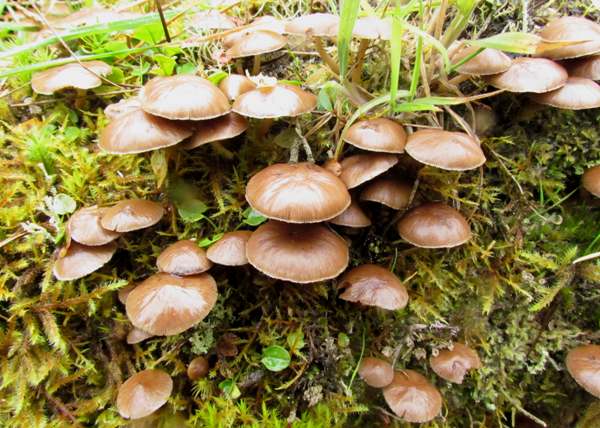
Many recent field guides have this species listed under Psathyrella hydrophila. The specific epithet hydrophila means water loving, and this wood-rotting mushroom certainly does seem to prefer damp places, although occasionally I find clumps on dead wood in sunny locations where the caps soon shrivel.
This woodland species is distinguished microscopically from several similar convex-capped mushrooms by its small spores; however, if you do not have a microscope then try to find some immature caps and you will see that the gills are enclosed beneath a partial veil that is fibrillose-cortinate (rather like the cortina of a Cortinarius species whose cobweb-like veil consists of unusually coarse fibres). As the cap of the mushroom expands fibres of the partial veil remain attached to the rim of the cap and form a continuous dark band (see the picture below).
Etymology
Psathyrella, the genus name, is the diminutive form of Psathyra, which comes from the Greek word psathuros meaning straw-like, fragile or friable; it is a reference to the crumbly nature of the caps, gills and stems of mushrooms in this genus. The specific epithet piluliformis may come from the Latin noun Pila, meaning a ball (or a bullet), or perhaps Pilum meaning a javelin; with the suffix -formis meaning in the form (or shape) of.
Identification guide
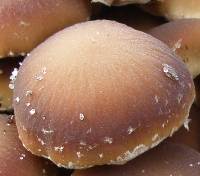 |
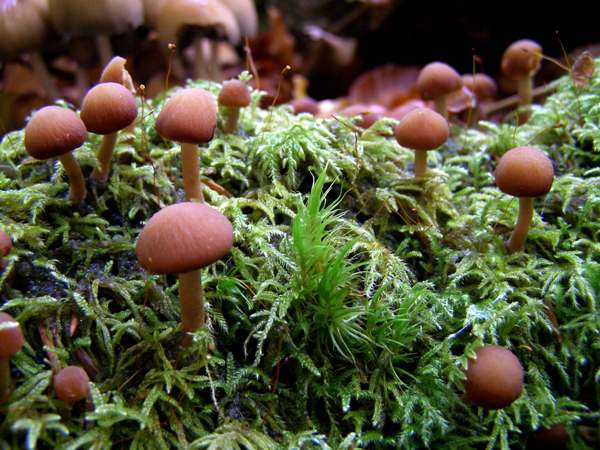
CapThe cap of the Common Stump Brittlestem is initially hemispherical, becoming bell-shaped and eventually almost flat and 2-4cm across. White veil fragments adhere to and overhang the rim; they get smaller as the fruitbody ages, eventually becoming blackened by spores. The fragile caps crowd together in clumps, some of the caps getting broken as others expand beside them. Initially caps are dark red-brown, fading through date-brown to yellow-brown. Mature specimens are noticeably hygrophanous: they change colour depending on whether the surface is moist or dry, becoming pale tan or beige from the edge of the cap in dry weather. |
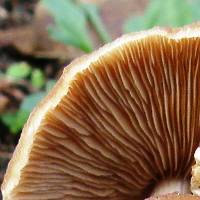 |
GillsThe narrow gills of Psathyrella piluliformis are adnate and quite closely spaced; initially pinkish beige, they gradually turn dark brown and eventually almost black. The gills of this mushroom are very brittle. |
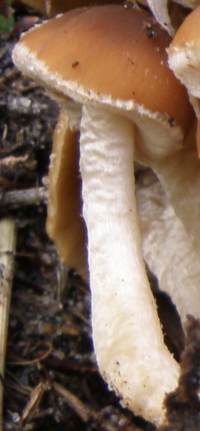 |
StemTypically 4 to 8mm in diameter and up to 8 cm long, the stems of this caespitose (clump-forming) fungus are straight or slightly curved and often lined with silky fibres. The partial veil that covers the young gills soon tears as the cap expands, leaving white fragments attached to the cap rim and little or no evidence on the stem, which has a matt, floury (pruinose) surface near the apex and is much smoother towards the base. As the fruit bodies mature, falling spores darken the stems, most noticeably towards the base. |
 |
Cheilocystidia25-50 x 9-18μm variably lageniform (flask-like), utriform or broadly fusiform; pleurocystidia similar; intermixed with smaller narrow cystidia. Cheilocystidia of Psathyrella piluliformis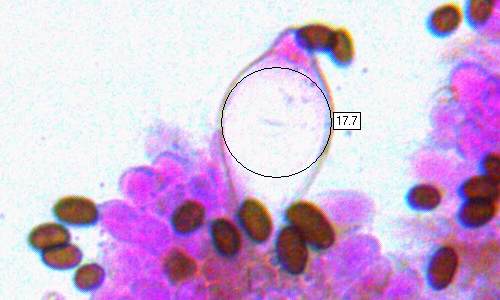 |
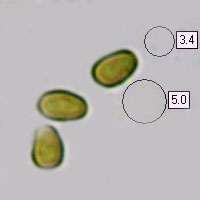 |
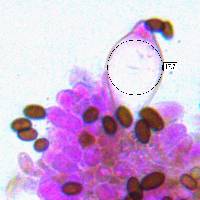
SporesOvoid, oblong or ellipsoidal, somewhat irregular in outline, 4.5-6.5 x 3-4μm. Spores of Psathyrella piluliformis, Common Stump Brittlestem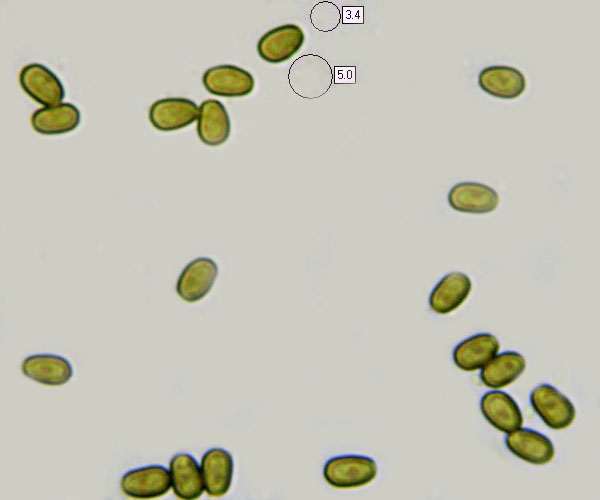 Spore printDark brown, almost black. |
Odour/taste |
Odour not distinctive; taste bitter. |
Habitat & Ecological role |
Saprobic, on the stumps and buried dead branches of broadleaf trees; very occasionally on conifer stumps. Favouring damp, darkish woods. |
Season |
March to December in Britain and Ireland, but most plentiful in summer and autumn. |
Similar species |
Kuehneromyces mutabilis, the Clustered Woodtuft or Brown Stew Fungus, also grows in tufts on stumps; it has a ring on the stem, and the stem is brown and, rather than being smooth, is covered in scales at the base. |
Culinary Notes
Although edible once it has been cooked, the Common Stump Brittlestem is not greatly valued for its culinary qualities. There is always a danger in gathering small brownish mushrooms to eat: some seriously or even deadly poisonous fungi have brownish convex or bell-shaped caps. The Funeral Bell Galerina marginata is one such.
Reference Sources
Fascinated by Fungi, 2nd Edition, Pat O'Reilly 2016, reprinted by Coch-y-bonddu Books in 2022.
Bertrand, G. (1913). Quelques notes sur les Psathyra et les Psathyrella récoltés en Lorraine. Bulletin Trimestriel de la Société Mycologique de France 29: 185-188, tab. 8.
BMS List of English Names for Fungi
Dictionary of the Fungi; Paul M. Kirk, Paul F. Cannon, David W. Minter and J. A. Stalpers; CABI, 2008
Taxonomic history and synonym information on these pages is drawn from many sources but in particular from the British Mycological Society's GB Checklist of Fungi.
Acknowledgements
This page includes pictures kindly contributed by David Kelly.
Fascinated by Fungi. Back by popular demand, Pat O'Reilly's best-selling 450-page hardback book is available now. The latest second edition was republished with a sparkling new cover design in September 2022 by Coch-y-Bonddu Books. Full details and copies are available from the publisher's online bookshop...