Pseudohydnum gelatinosum (Scop.) P. Karst. - Toothed Jelly Fungus
Phylum: Basidiomycota - Class: Tremellomycetes - Order: Auriculariales - Family: Insertae sedis (not yet determined)
Distribution - Taxonomic History - Etymology - Identification - Culinary Notes - Reference Sources
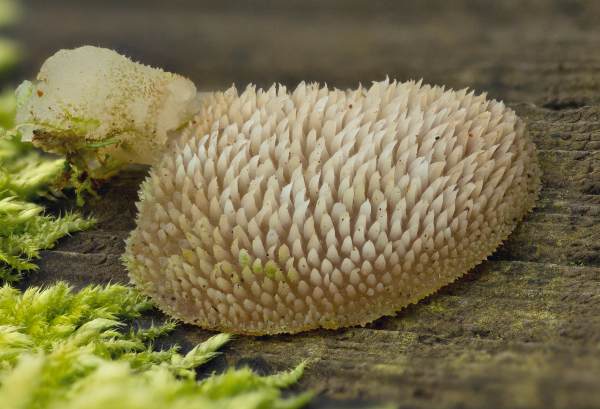
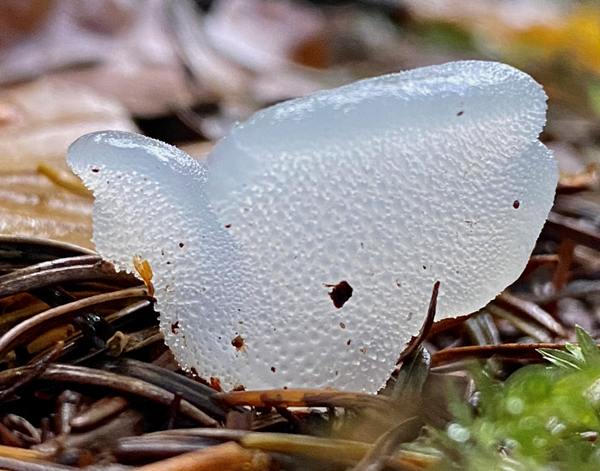
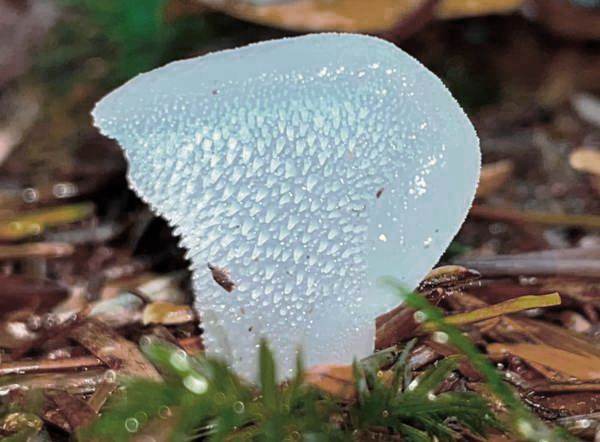
Pseudohydnum gelatinosum is variously referred to as the Toothed Jelly Fungus, the False Hedgehog Fungus, or the White Jelly Mushroom. This rather strange fungus occurs on well-rotted coniferous wood, most commonly on spruce varieties.
The underside of this jelly fungus - a member of the Tremellales order - is toothed and similar in form to the spiny under-surfaces of the Wood Hedgehog, Hydnum repandum. Despite a superficial similarity, this rubbery tooth fungus is not a close relative of either the Wood Hedgehog or the Bearded Tooth, both of which also occur in woodland habitats.
Distribution
Seen only occasionally in Britain and Ireland, the Toothed Jelly Fungus occurs throughout Europe and is also recorded in many parts of North America.
Taxonomic history
When Italian naturalist Giovanni Antonio Scopoli described this jelly-like fungus in 1772 he gave it the binomial scientific name Hydnum gelatinosum. It was Finnish mycologist Petter Adolf Karsten (1834 - 1917) who, in 1868, transferred this species to the genus Pseudohydnum, whereupon it acquired its currently-accepted scientific name Pseudohydnum gelatinosum.
Synonyms of Pseudohydnum gelatinosum include Hydnum gelatinosum Scop., Steccherinum gelatinosum (Scop.) Gray, Hydnogloea gelatinosa (Scop.) Curr. ex Berk., and Tremellodon gelatinosum (Scop.) Pers.
Etymology
Pseudohydnum, the generic name, comes from Pseudo- meaning similar too or easily confused with, and -hydnum, which is an ancient term for a mushroom; however, in this case Pseudohydnum means 'similar to fungi of the genus Hydnum'.
Hydnum repandum is commonly referred to as the Wood Hedgehog fungus, and as with other mushrooms in that genus its fertile lower surface is covered in tooth-like spines very similar in form to those of the Toothed Jelly Fungus Pseudohydnum gelatinosum. , but this does not mean that they are closely related; indeed, toothed fungi also occur in many other fungus families.
The specific epithet gelatinosum refers to the gelatinous texture of these jelly-like fungi.
Identification guide
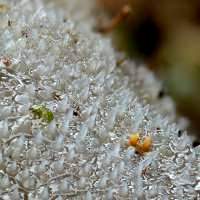 |
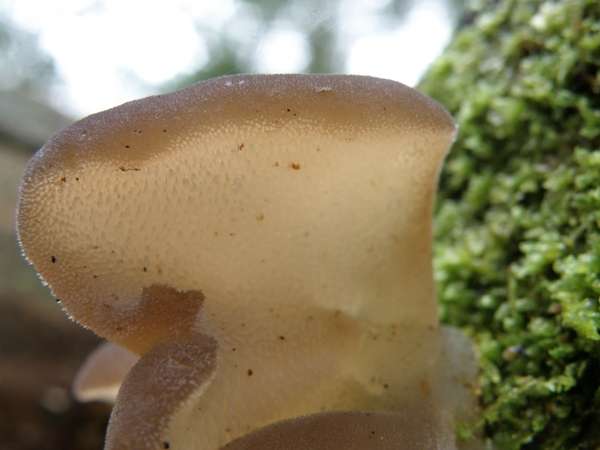
FruitbodyCaps range from 2 to 10cm across with a total height, including stem, of up to 12cm but more typically 6cm. The upper surface is generally slightly convex (domed) and greyish white (sometimes brown in the centre) with translucent margins. The white or grey stems are laterally or eccentrically connected to the cap; they taper towards the base, being typically almost as tall as the cap diameter. The underside of the cap has blunt spines typically 3mm long. |
SporesSpherical or nearly so, smooth, 5-6 x 5-5.5µm; inamyloid. Spore printWhite. |
|
Odour/taste |
Not distinctive. |
Habitat & Ecological role |
Mainly on dead and decaying coniferous wood - notably spruce but also pine. Felled trunks left to rot in shady, damp parts of the forest are likely to be hosts to this unusual species. |
Season |
Fruitbodies can be seen at any time of the year but they are most commonly found from late summer to early winter. |
Similar species |
Tremella lutescens is cream when dry and sulphur yellow when wet; it has no spines and lacks a distinct stem. Hydnum repandum. the Wood Hedgehog, is not translucent and has a more solid fruitbody. |
Culinary Notes
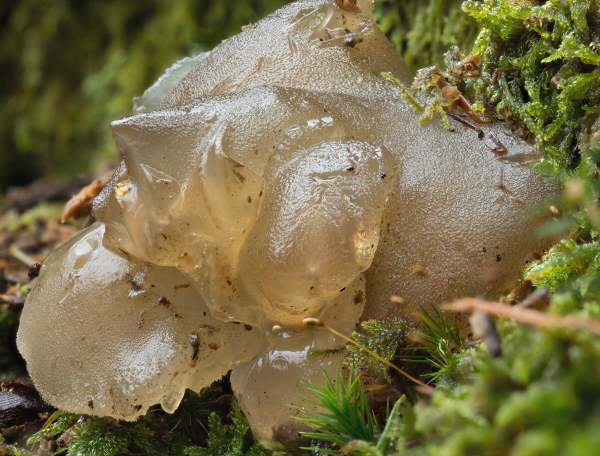
Some authorities in the USA suggest that Toothed Jelly Fungus is an edible fungus, while others, particularly in Europe, have reported it as being inedible. In any case this is a relatively uncommon find and so it is certainly not worth gathering.
Reference Sources
Fascinated by Fungi, 2nd Edition, Pat O'Reilly 2016, reprinted by Coch-y-bonddu Books in 2022.
Dictionary of the Fungi; Paul M. Kirk, Paul F. Cannon, David W. Minter and J. A. Stalpers; CABI, 2008
Taxonomic history and synonym information on these pages is drawn from many sources but in particular from the British Mycological Society's GB Checklist of Fungi.
Acknowledgements
This page includes pictures kindly contributed by Natalia Gutnik and David Kelly.
Fascinated by Fungi. Back by popular demand, Pat O'Reilly's best-selling 450-page hardback book is available now. The latest second edition was republished with a sparkling new cover design in September 2022 by Coch-y-Bonddu Books. Full details and copies are available from the publisher's online bookshop...