
Russula aurora (Krombh.) Bres. - Dawn Brittlegill
Phylum: Basidiomycota - Class: Agaricomycetes - Order: Russulales - Family: Russulaceae
Distribution - Taxonomic History - Etymology - Identification - Culinary Notes - Reference Sources
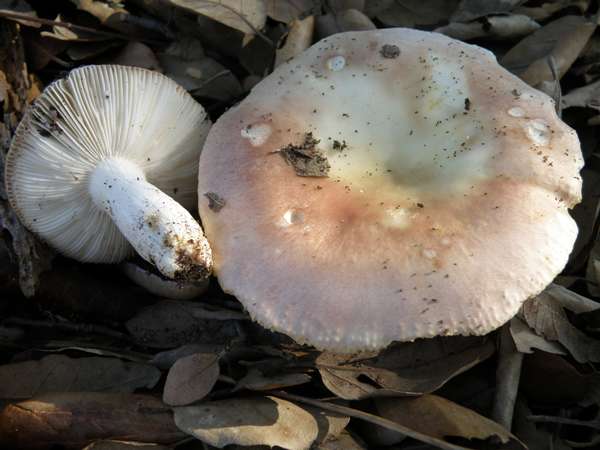
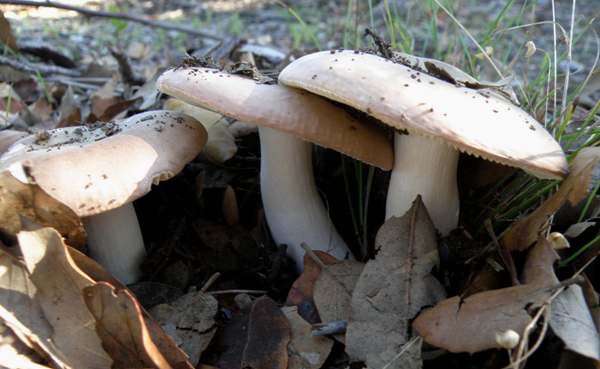
The Dawn Brittlegill appears under deciduous broadleaf trees, including Beech, Sweet Chestnut and hornbeams. Its cap edge and gill extremities tend to wrinkle and distort in dry weather.
Distribution
This lovely brittlegill mushroom is widespread and fairly common in Britain and Ireland as well as in other European countries, but it tends to be localised. I can find no reference to this brittlegill mushroom occurring in North America.
Taxonomic history
In 1888 the famous French mycologist Lucien Quélet applied the name Russula rosea to the Dawn Brittlegill; however, the species that we now generally refer to as Russula rosea (or strictly that should be Russula rosea Pers. 1796) is commonly called the Rosy Brittlegill. It happened so often in the past that not only was the same mushroom given two or more scientific names by different people but also two or more mushroom species sometimes ended up with the same name given to them by different authorities. The full citation reference intended here is Russula aurora (Krombh.) Bres. 1892.
The basionym of this brittlegill mushroom dates from 1836, when Czech-born mycologist Julius Vincenz von Krombholz described this species and called it by the binomial scientific name Agaricus aurora.
It was not until 1892 that Italian mycologist Giacopo Bresadola (1847 - 1929) gave this species its currently-accepted scientific name Russula aurora.
Synonyms of Russula aurea (Krombh.) Bres. include Agaricus aurora Krombh., Russula rosea Quél., Russula lactea var. incarnata Cooke, Russula velutipes Velen., Russula lepida var. aurora (Krombh.) Rea, and Russula rosea var. aurora (Krombh.) R.W. Rayner.
The Dawn Brittlegill as defined above and described below has a flesh-pink cap, whereas caps of the Rosy Brittlegill are usually more of an orange-red colour. Beware, however, of treating cap colour as more than a clue: brittlegills are very variable in their colours and so other macroscopic and microscopic characters (including taste, peeling ability and response to chemical tests) are critically important.
Etymology
Russula, the generic name, means red or reddish, and indeed many of the brittlegills have red caps (but many more are not, and several of those that are usually red can also occur in a range of other colours!). The specific epithet comes from the Latin name Aurora, Roman goddess of the dawn - hence also the common name Dawn Brittlegill.
Identification guide
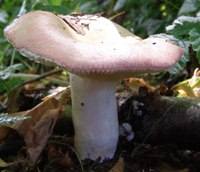 |
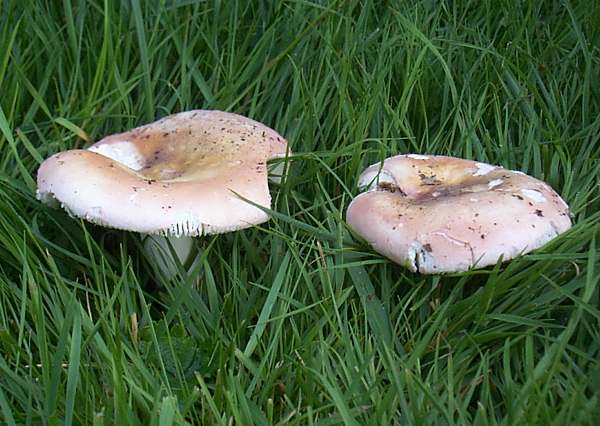
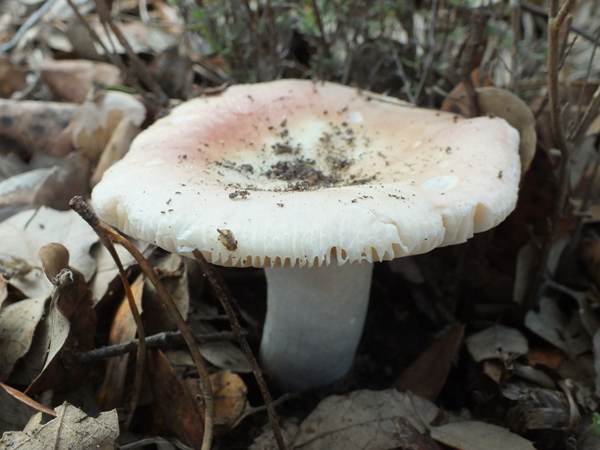
CapUsually flesh pink (but sometimes a brighter red), often creamy pink towards the centre; usually matt or slightly pruinose; peeling about half-way to centre; developing slight striations at the margin; 4 to 10cm across; convex, eventually becoming centrally depressed; flesh white and very brittle. |
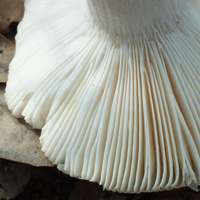 |
GillsWhite, turning pale cream with age; adnate or adnexed; fairly crowded, with some forked gills.. StemWhite, slightly pruinose; 4 to 8cm long and 1 to 2 cm diameter; flesh white and brittle; no stem ring. |
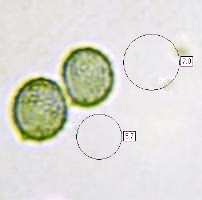 |
SporesOvoid; 6.5-8.5 x 5.5-6.5µm; warts 0.25 to 0.5µm tall with just a few fine connectives. Spores of Russula aurora, the Dawn Brittlegill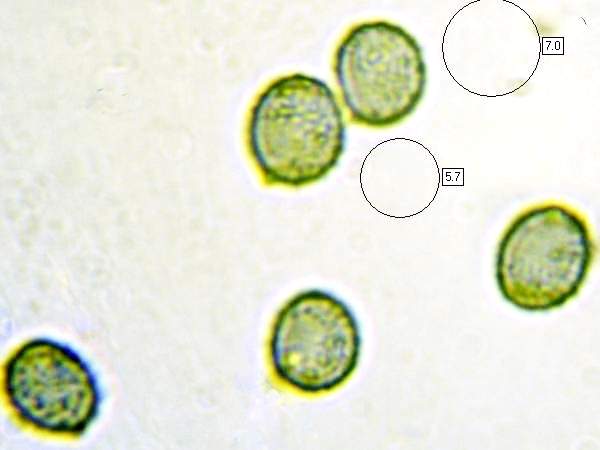 Spore printWhite. |
Odour/taste |
Slight fruity odour; mild taste. |
Habitat & Ecological role |
Under broadleaf trees, notably Beech, Sweet Chestnut, hornbeams and oaks but also occasionally under birches and limes. In common with other members of the Russulaceae, Russula aurora is an ectomycorrhizal mushroom. |
Season |
August to November in Britain and Ireland. |
Similar species |
Russula sanguinaria has a red-flushed stipe. Russula paludosa is usually larger and has cream gills even when young. |
Culinary Notes
The Dawn Brittlegill is generally considered an edible mushroom, but it is a small and rather localised mushroom that does not often occur in large enough quantities to be worth seeking specifically when in search of fungi for food.
Reference Sources
Pat O'Reilly (2016). Fascinated by Fungi, First Nature Publishing
Geoffrey Kibby (2011).The Genus Russula in Great Britain, published by G Kibby.
Roberto Galli (1996). Le Russule. Edinatura, Milan.
Paul M. Kirk, Paul F. Cannon, David W. Minter and J. A. Stalpers. (2008). Dictionary of the Fungi; CABI.
Taxonomic history and synonym information on these pages is drawn from many sources but in particular from the British Mycological Society's GB Checklist of Fungi.
Fascinated by Fungi. Back by popular demand, Pat O'Reilly's best-selling 450-page hardback book is available now. The latest second edition was republished with a sparkling new cover design in September 2022 by Coch-y-Bonddu Books. Full details and copies are available from the publisher's online bookshop...