
Russula densifolia Secr. ex Gillet - Crowded Brittlegill
Phylum: Basidiomycota - Class: Agaricomycetes - Order: Russulales - Family: Russulaceae
Distribution - Taxonomic History - Etymology - Identification - Culinary Notes - Reference Sources
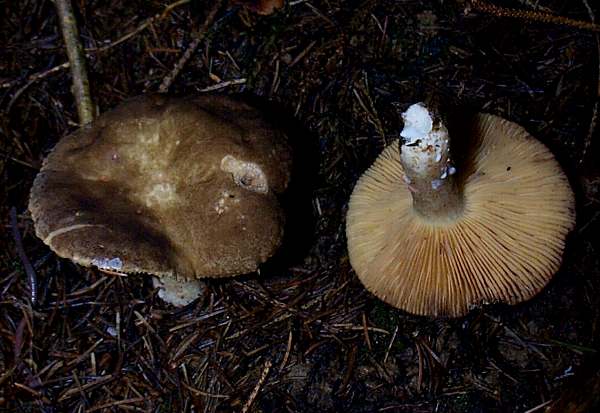
Russula densifolia is a large species with crowded gills. It is often mistakenly recorded as Russula nigricans, another blackening species but with thick, distant gills. This species is also superficially similar to several other blackening brittlegill mushrooms including Russula anthracina, which differs macroscopically in having only moderately crowded gills (unlike Russula nigricans which has very widely-spaced gills) and Russula adusta, which has an earthy smell reminiscent of old wine casks (or wine corks).
Distribution
Russula densifolia is an infrequent find throughout Britain and Ireland. On mainland Europe this brittlegill can be found from Scandinavia right down to the Mediterranean region, and its range extends eastwards into temperate parts of Asia. There are also records of the Crowded Brittlegills occurring in North America, but whether they are co-specific with the European Russula densifolia is unclear.
Taxonomic history
The Crowded Brittlegill was described in 1876 by French mycologist Claude-Casimir Gillet (1806 - 1896) under the scientific name Russula densifolia.
Synonyms of Russula densifolia Secr. ex Gillet include Russula acrifolia Romagn.
Etymology
Russula, the generic name, means red or reddish, and indeed many of the brittlegills have red caps (but many more including Russula nigricans do not, and several of those that are usually red can also occur in a range of other colours!). The specific epithet densifolia means 'with densely packed leaves' - and in mushrooms that means closely-spaced gills.
Identification guide
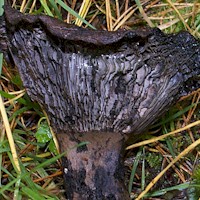 |
Fruitbodies of this large mushroom are slow to rot, and they can be found standing or lying more or less intact on woodland floors throughout the winter months and into early spring. Several small agaric fungi parasitise aged fruiting bodies of the Russulaceae - notably Asterophora parasitica, and Asterophora lycoperdiodes. |
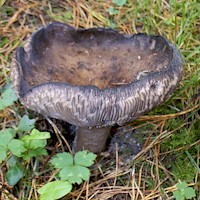 |
Cap6 to 10cm in diameter, slightly sticky, convex with an inrolled margin and later slightly depressed or occasionally funnel shaped, the caps are at first dirty-white, becoming brownish-black as the fruiting body matures. |
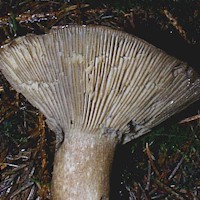 |
GillsShortly decurrent and crowded, the gills of Russula densifolia are buff or straw-coloured at first, blackening at much the same rate as the cap does. Stem15 to 30mm in diameter and 3 to 6cm tall, the brittle stems are smooth and more or less cylindrical. The surface and the flesh of the cap blacken at much the same rate as the cap blackens. There is no stem ring. |
SporesOvoid; 7-9 x 6.5-7µm; blunt warts to 0.6µm tall linked in a partial to near-complete reticulum (mesh-like network). Spore printWhite. |
|
Odour/taste |
No distinctive odour; slightly bitter taste. |
Habitat & Ecological role |
Mainly on acid soil in coniferousforests and occasionally in broadleaf woodland. In common with other members of the Russulaceae, Russula densifolia is an ectomycorrhizal mushroom. |
Season |
August to October in Britain and Ireland. |
Similar species |
Russula nigricans has adnate, widely spaced gills and turns reddish-brown before blackening. |
Culinary Notes
Although a few older field guides suggest that these are edible fungi, Crowded Brittlegills are now generally considered to be inedible mushrooms and possibly even slightly poisonous. In any case they are rather bitter tasting and they quickly become tough as they blacken.
Reference Sources
Pat O'Reilly (2016). Fascinated by Fungi, First Nature Publishing.
Geoffrey Kibby (2011).The Genus Russula in Great Britain, published by G Kibby.
Andreas Gminder (2008). Mushrooms & Toadstools of Britain and Europe. A&C Black, London.
Roberto Galli (1996). Le Russule. Edinatura, Milan.
Paul M. Kirk, Paul F. Cannon, David W. Minter and J. A. Stalpers. (2008). Dictionary of the Fungi; CABI.
Taxonomic history and synonym information on these pages is drawn from many sources but in particular from the British Mycological Society's GB Checklist of Fungi.
Fascinated by Fungi. Back by popular demand, Pat O'Reilly's best-selling 450-page hardback book is available now. The latest second edition was republished with a sparkling new cover design in September 2022 by Coch-y-Bonddu Books. Full details and copies are available from the publisher's online bookshop...