Russula fellea (Fr.) Fr. - Geranium Brittlegill
Phylum: Basidiomycota - Class: Agaricomycetes - Order: Russulales - Family: Russulaceae
Distribution - Taxonomic History - Etymology - Identification - Culinary Notes - Reference Sources
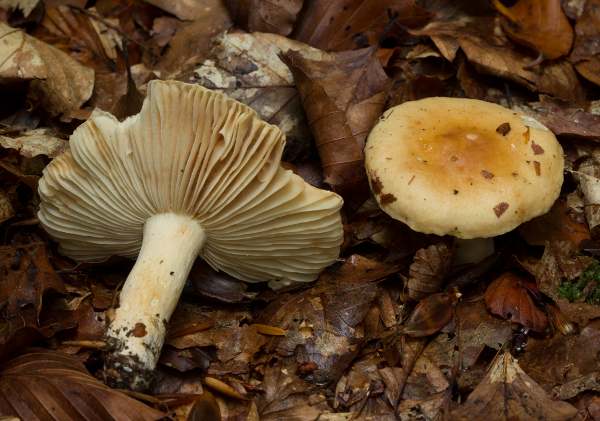
Many other brittlegills occur sometimes in yellow forms, but the distinctive odour of the Geranium Brittlegill makes it one of the few that can be identified with a high degree of certainty in the field. (The claimed scent of 'geraniums' is not universally accepted, however - see below.)
Years can go by without this fungus fruiting in any significant numbers, and then we get a season like 2010 when the woods are spattered with enormous numbers of these attractive brittlegills.
Distribution
Common and widespread in woodland that contains Beech trees, Russula fellea occurs throughout Britain and Ireland but is reported more frequently from regions of alkaline or neutral soil. On mainland Europe this brittlegill occurs from Scandinavia down to the Mediterranean countries; its range extends into temperate parts of Asia.
I have found no records of this species from North America, but a very similar brittlegill Russula simillima is reported to be common in broadleaf woodland across much of the USA.
Taxonomic history
The currently-accepted scientific name of the Geranium Brittlegill, Russula fellea, dates from an 1825 publication in whikch the great Swedish mycologist Elias Magnus Fries transferred this species to the genus Russula.
Some four years earlier, in 1821, it was Fries who had established this brittlegill mushroom's basionym when he described it scientifically under the binomial name Agaricus felleus. (Most gilled fungi were initially placed in a giant Agaricus genus, but the majority have since been redistributed to other genera leaving the 'true mushrooms' in Agaricus.)
Synonyms of Russula fellea include Agaricus felleus Fr., and Russula ochracea.
Etymology
Russula, the generic name, means red or reddish, and indeed many of the brittlegills have red caps (but many more are not, and several of those that are usually red can also occur in a range of other colours!).
The specific epithet fellea means 'very bitter'.
Identification guide
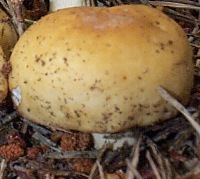 |
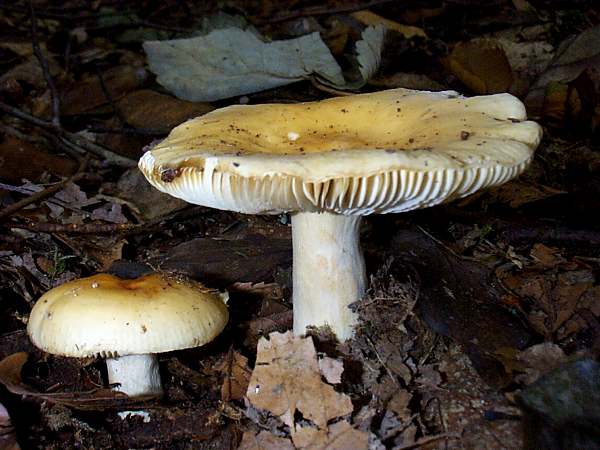
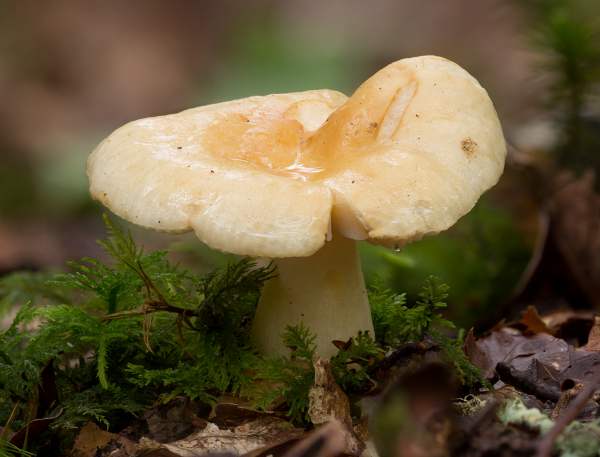
CapUsually honey yellow but sometimes tawny-buff or orange towards the cap centre; smooth; convex, soon developing a slight central depression; margin not lined or with only very short lines; cuticle peels 1/3 to 1/2 from the margin; 4 to 9cm across when fully expanded. |
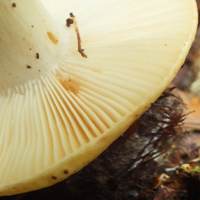 |
GillsPaler than the cap, usually straw yellow at first but turning more buff with age; moderately crowded; adnexed to adnate. |
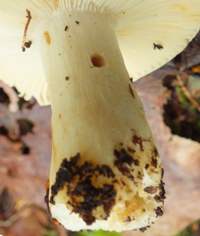 |
StemColour as cap or somewhat paler; sometimes slightly clavate; 4 to 6cm long, 1 to 2cm diameter, tapering slightly towards the cap. |
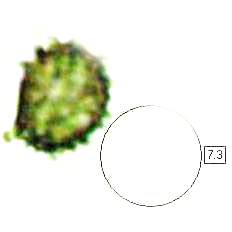 |
SporesEllipsoidal, 7.5-9 x 6-7µm, ornamented with warts to 0.75um tall joined by many connecting lines forming an incomplete network (reticulum). Show larger imageSpores of Russula fellea, Geranium Brittlegill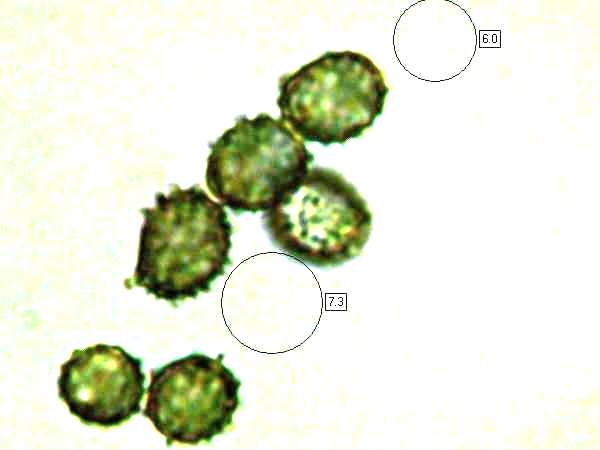 Spore printWhitish to pale cream. |
Odour/taste |
This honey-coloured brittlegill smells like stewed apples, although some insist that the scent is more reminiscent of pot geraniums (pelargoniums, that is!) – hence the common name. The taste is usually very hot and bitter. |
Habitat & Ecological role |
This mushroom is particularly common in Beech woodland on alkaline and neutral soil in Britain and Ireland; however, particularly on mainland Europe, it is also found in spruce plantations on acid soil. In common with other members of the Russulaceae, Russula fellea is an ectomycorrhizal mushroom. |
Season |
August to October in Britain and Ireland. |
Similar species |
Russula ochroleuca, the Ochre Brittlegill, has much whiter gills and stem and lacks a distinctive odour. |
Culinary Notes
Although not generally considered poisonous, the Geranium Brittlegill has an acrid taste that makes it unpalatable.
Reference Sources
Pat O'Reilly (2016). Fascinated by Fungi, First Nature Publishing
Geoffrey Kibby (2011).The Genus Russula in Great Britain, published by G Kibby.
Roberto Galli (1996). Le Russule. Edinatura, Milan.
Paul M. Kirk, Paul F. Cannon, David W. Minter and J. A. Stalpers. (2008). Dictionary of the Fungi; CABI.
Taxonomic history and synonym information on these pages is drawn from many sources but in particular from the British Mycological Society's GB Checklist of Fungi.
Acknowledgements
This page includes pictures kindly contributed by David Kelly.
Fascinated by Fungi. Back by popular demand, Pat O'Reilly's best-selling 450-page hardback book is available now. The latest second edition was republished with a sparkling new cover design in September 2022 by Coch-y-Bonddu Books. Full details and copies are available from the publisher's online bookshop...