
Russula nobilis Velen. - Beechwood Sickener
Phylum: Basidiomycota - Class: Agaricomycetes - Order: Russulales - Family: Russulaceae
Distribution - Taxonomic History - Etymology - Toxicity - Identification - Reference Sources
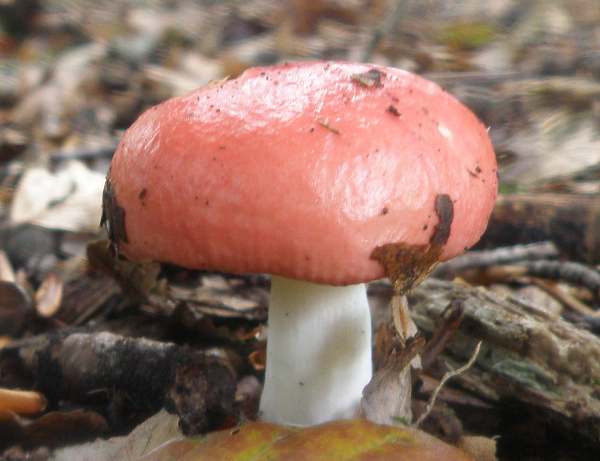
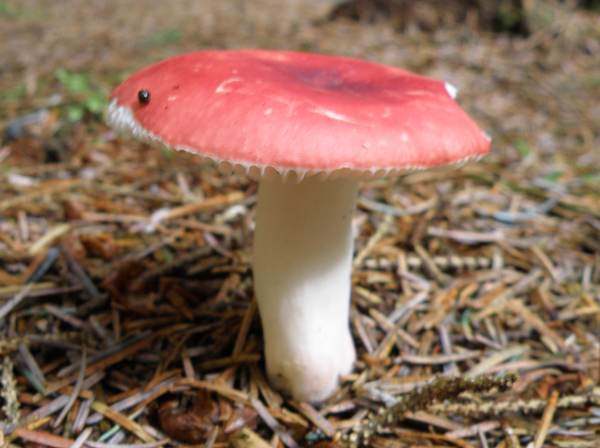
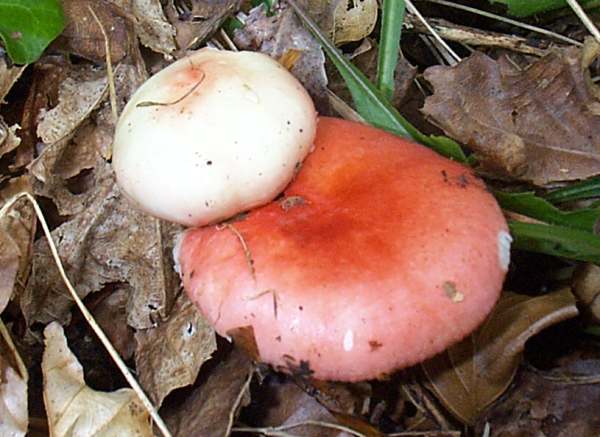
Russula nobilis (syn. Russula mairei) is commonly known as the Beechwood Sickener. It has a bitter taste, and if eaten it usually causes sickness, stomach pains and vomiting. The caps vary from almost white to a rich rosy pink.
Brittlegill identification is far from easy, and red-capped species are among the toughest to untangle. If you plan on gathering any brittlegills to eat, avoid the red-capped ones unless you can identify them with confidence.
Identification from observed macroscopic features alone is unreliable, as many other red-capped brittlegills are also mycorrhizal with Beech trees.
Distribution
Very common and widespread in woodland that contains Beech trees (Fagus species), Russula nobilis occurs throughout Britain and Ireland and wherever there are beechwoods on mainland Europe, this attractive brittlegill occurs also in several Asian countries. Russula nobilis is also recorded in parts of North America.
Taxonomic history
Described in 1920 by Czech mycologist Josef Velenovský (1858 - 1949) , who gave it the name Russula nobilis, this brittlegill retains that scientific name to the present time. It's not that this beautiful brittlegill had gone unnoticed in the preceeding two centuries when mycological exploration was underway in most parts of Europe, but it had simply not been recognised as a species distinct from The Sickener Russula emetica which is found in coniferous woodlands.
Russula nobilis has several synonyms including Russula mairei Singer, Russula fageticola Melzer ex S. Lundell, and Russula mairei var. fageticola Romagn.
Etymology
Russula, the generic name, means red or reddish, and indeed many of the brittlegills have red caps (but many more are not, and several of those that are usually red can also occur in a range of other colours!). The specific epithet nobilis means noble, distinct or famous - take your pick. This species was until recently better known as Russula mairei, and that specific epithet, conferred by Rolf Singer, honoured French botanist-mycologist René Charles Joseph Ernest Maire (1878 - 1949).
Toxicity
As its common name implies, if eaten raw or inadequately cooked the Beechwood Sickener can make people ill. Early symptoms of poisoning are nausea and vomiting, and these are accompanied by stomach pains that are followed ultimately by diarrhoea. Except in the case of frail or immune-compromised people or very young children, poisoning by this mushroom is unlikely to be fatal. Thorough cooking is said to remove the majority if not all of the toxins, but most authorities still treat this species as a toxic toadstool that should not be collected for human consumption.
The fact that this mycorrhizal mushroom is toxic to humans does not mean that finding complete specimens should be easy: slugs love the Beechwood Sickener, and so the best time to hunt for photogenic specimens is after a few dry days following a rainy period.
Identification guide
 |
A very red brittlegill found only beneath Beech trees, sometimes in mixed woodland but more often in beechwoods, Russula nobilis is not easily distinguished from some of the other red-capped members of the Russula genus. This particular species is poisonous, as indeed is the rather similar Russula emetica which grows under conifers. Distinguishing features are the greater brittleness of Russula nobilis; its convex cap shape even when fully mature; and its pinkish-red cap (Russula emetica usually has a deeper red cap) of which the cuticle peels only 1/3 to the centre, whereas the cap of Russula emetica peels at least 2/3 to the centre. |
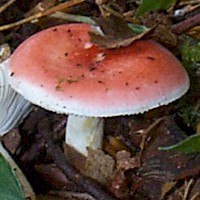 |
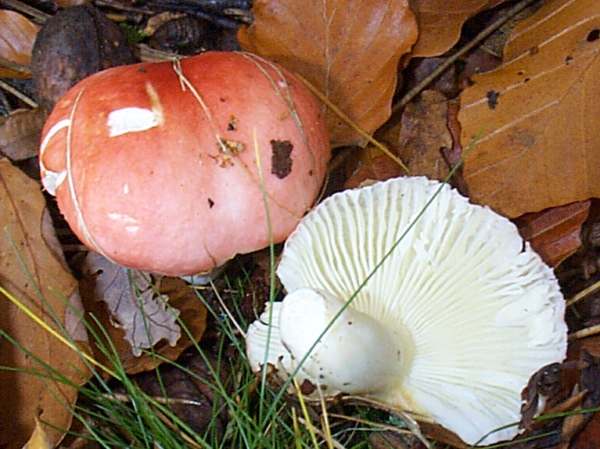
CapCaps of the Beechwood Sickener are 3 to 9cm dia., smooth, non-striate and bright red or pink (very occasionally almost completely white). The cap of this species generally remains convex with at most only a shallow central depression, whereas caps of the (conifer associated) Sickener Russula emetica become funnel-shaped when fully mature. Slightly sticky when wet, the cap surface dries to a matt finish. The flesh of this brittlegill is red or pink immediately beneath the cuticle; elsewhere the flesh is white. |
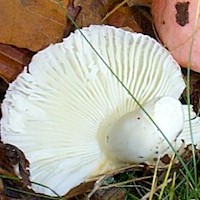 |
GillsWhite, sometimes with a greenish tinge, the adnexed, crowded gills of the Beechwood Sickener Russula nobilis are very brittle indeed and easily crumble if they are handled. StemStems of Russula nobilis are 10 to 15mm in diameter and 20 to 40mm tall, the white stems are smooth and slightly clavate. The stem flesh is white, and as with other brittlegill mushrooms there is no stem ring. |
SporesOvoid, 7-8 x 6-6.5µm; with warts up to 0.5µm tall, joined by narrow connectives in a nearly complete reticulum. Spore printWhite. |
|
Odour/taste |
Faint odour of coconut in young specimens; tastes rapidly very hot and acrid. |
Habitat & Ecological role |
Under Beech trees, with which it is ectomycorrhizal. |
Season |
August to October in Britain and Ireland. |
Similar species |
Russula emetica is found under conifers; its cap becomes depressed when fully mature and the cap cuticle peels more readily. It is just as poisonous as Russula nobilis and so both should be avoided when gathering mushrooms for food. |
Reference Sources
Pat O'Reilly (2016). Fascinated by Fungi, First Nature Publishing
Geoffrey Kibby (2011).The Genus Russula in Great Britain, published by G Kibby.
Roberto Galli (1996). Le Russule. Edinatura, Milan.
Paul M. Kirk, Paul F. Cannon, David W. Minter and J. A. Stalpers. (2008). Dictionary of the Fungi; CABI.
Taxonomic history and synonym information on these pages is drawn from many sources but in particular from the British Mycological Society's GB Checklist of Fungi.
Fascinated by Fungi. Back by popular demand, Pat O'Reilly's best-selling 450-page hardback book is available now. The latest second edition was republished with a sparkling new cover design in September 2022 by Coch-y-Bonddu Books. Full details and copies are available from the publisher's online bookshop...