
Russula xerampelina (Schaeff.) Fr. - Crab Brittlegill
Phylum: Basidiomycota - Class: Agaricomycetes - Order: Russulales - Family: Russulaceae
Distribution - Taxonomic History - Etymology - Identification - Culinary Notes - Reference Sources
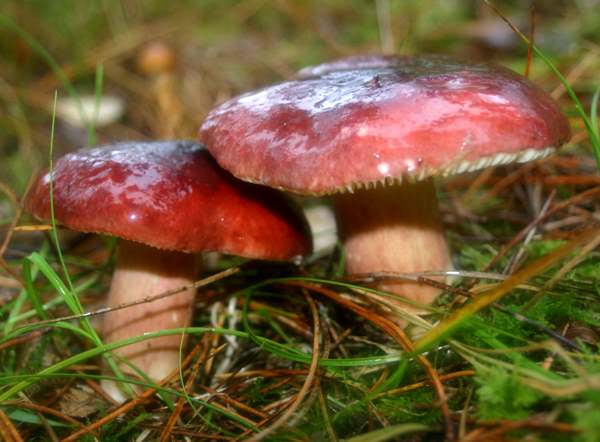
It seems that most people agree on the odour of this fairly large and very common and widespread woodland mushroom; however, while young specimens smell slightly fishy, older ones stink of boiled shellfish.
A complex of species has traditionally been covered by the scientific name Russula xerampelina (sensu lato, as mycologists call it).
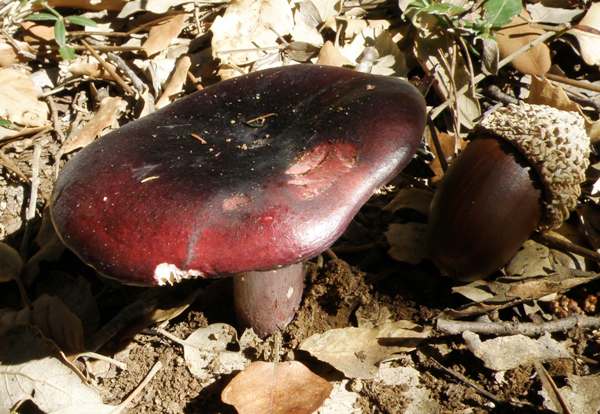
The Crab Brittlegill Russula xerampelina is generally accepted as a particular taxon at species level, to which the description included on this page referers.
Taxonomic history
The Crab Brittlegill mushroom was first described scientifically in 1770 by the German botanist Jacob Christian Schaeffer, who gave it the binomial scientific name Agaricus xerampelina. (Most gilled fungi were initially placed in a giant Agaricus genus, now largely redistributed across many other genera.) In 1838 the great Swedish mycologist Elias Magnus Fries transferred this species to the genus Russula, thus establishing its currently-accepted scientific name Russula xerampelina.
Synonyms of Russula xerampelina include Agaricus xerampelina Schaeff., Russula xerampelina var. xerampelina (Schaeff.) Fr., Russula alutacea var. erythropus Fr., Russula erythropus (Fr.) Pelt., Russula xerampelina var. erythropus (Fr.) Kühner Romagn., and Russula erythropus var. ochraceus J. Blum.
Etymology
Russula, the generic name, means red or reddish, and indeed many of the brittlegills have red caps (but many more are not red, and several of those that are usually red can also occur in a range of other colours!). The specific epithet xerampelina comes from the Greek words xeros meaning dry, and ampělinos meaning 'of the vine' - indicating that this mushroom is the colour of dried vine leaves.
Distribution
Common and widespread in Britain and Ireland, the Crab Brittlegill occurs also on mainland Europe. A similar mushroom, currently recorded as Russula xerampelina, is found in parts of North America, where it is commonly referred to as the Shrimp Russula; it is probably a different species (or even a complex of several closely-related brittlegill mushrooms).
Identification guide
 |
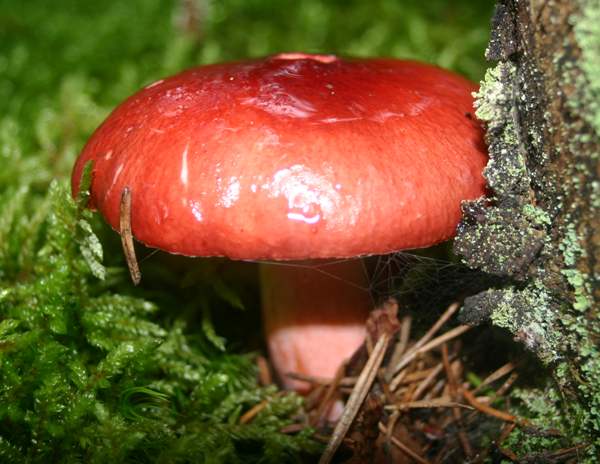
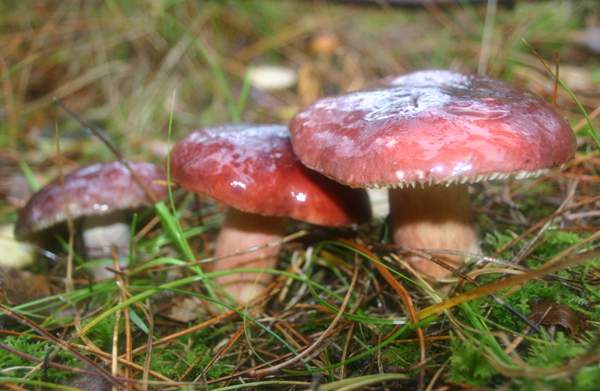
CapVarious shades of reddish purple, wine, cinnamon, brown or ochre, often in blotches, usually darker towards the centre; peels only 1/4 to centre; irregularly convex, developing a shallow central depression; margin eventually striate; 7 to 15cm across. |
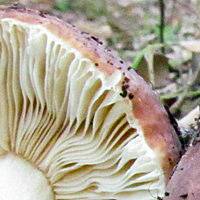 |
GillsCream, turning ochre; adnexed; moderately distant. StemWhite flushed with red, slowly discolouring brown when bruised; cylindrical, occasionally with a slightly clavate base; 4 to 10cm long and 1 to 3cm in diameter. |
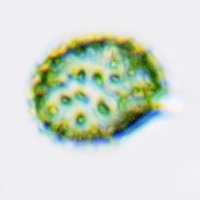 |
SporesEllipsoidal, 8-11 x 6.5-8μm (excluding warts); ornamented with mainly isolated warts up to 0.8μm tall with just a few connecting lines but not forming a closed mesh-like network (reticulum). Spores of Russula xerampelina, Crab Brittlegill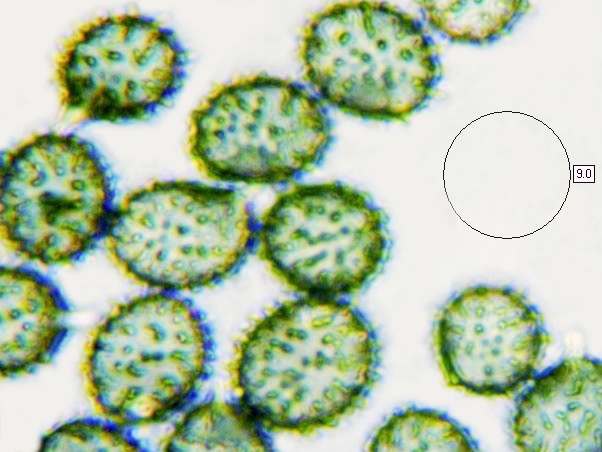 Spore printOchre. |
Odour/taste |
Odour of boiled shellfish (hence the common name) - faint when young but much stronger and eventually rather unpleasant when fully developed. Taste mild. |
Habitat & Ecological role |
The Crab Brittlegill occurs in pine and mixed coniferous forests, but this species (or perhaps more likely other brittlegills in the Russula xerampelina complex) is also reported occasionally from broadleaf woodland. In common with other members of the Russulaceae, Russula xerampelina is an ectomycorrhizal mushroom. |
Season |
August to October in Britain and Ireland. |
Similar species |
Russula sanguinea and several other reddish or purplish brittlegills can look very similar, but they all lack the characteristic shellfish odour of the Crab Brittlegill. |
Culinary Notes
Despite the strong odour when being cooked, the Crab Brittlegill is considered one of the finest of edible fungi, at least in the family Russulaceae (brittlegills and milkcaps). These mushrooms remain firm and crunchy when sauteed, fried or grilled with onions; they also make particularly good mushroom soups.
Reference Sources
Pat O'Reilly (2016). Fascinated by Fungi, First Nature Publishing
Geoffrey Kibby (2011).The Genus Russula in Great Britain, published by G Kibby.
Roberto Galli (1996). Le Russule. Edinatura, Milan.
Paul M. Kirk, Paul F. Cannon, David W. Minter and J. A. Stalpers. (2008). Dictionary of the Fungi; CABI.
Taxonomic history and synonym information on these pages is drawn from many sources but in particular from the British Mycological Society's GB Checklist of Fungi.
Fascinated by Fungi. Back by popular demand, Pat O'Reilly's best-selling 450-page hardback book is available now. The latest second edition was republished with a sparkling new cover design in September 2022 by Coch-y-Bonddu Books. Full details and copies are available from the publisher's online bookshop...