
Sarcodon squamosus (Schaeff.) Quél. - Scaly Tooth
Phylum: Basidiomycota - Class: Agaricomycetes - Order: Thelephorales - Family: Bankeraceae
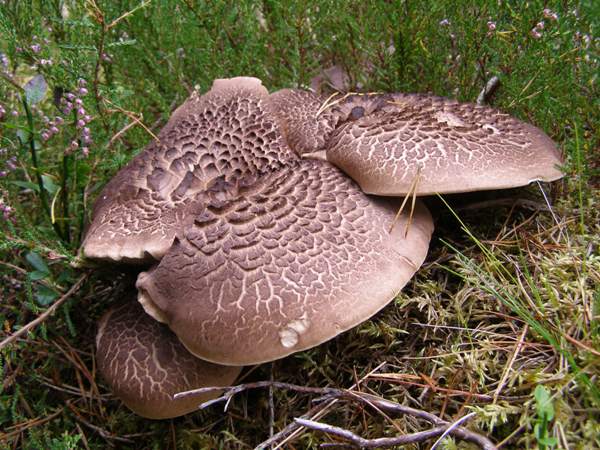
Distinguishing between Sarcodon squamosus and Sarcodon scabrosus (both now known to occur in Britain) has taxed mycologists for years. Although macroscopically similar, molecular analysis supports the view that these fungi, from which dyes of somewhat different colours can be produced, are indeed separate species.
The stem of Scaly Tooth is pale throughout its length, whereas Sarcodon scabrosus has a blue-grey stem base (and the cut flesh inside the stem base is also blue-grey).
Identification guide
 |
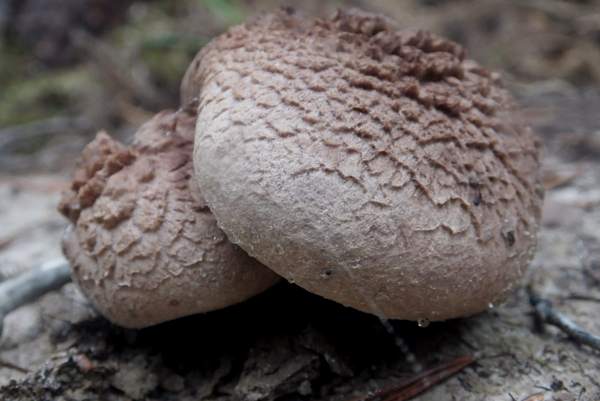
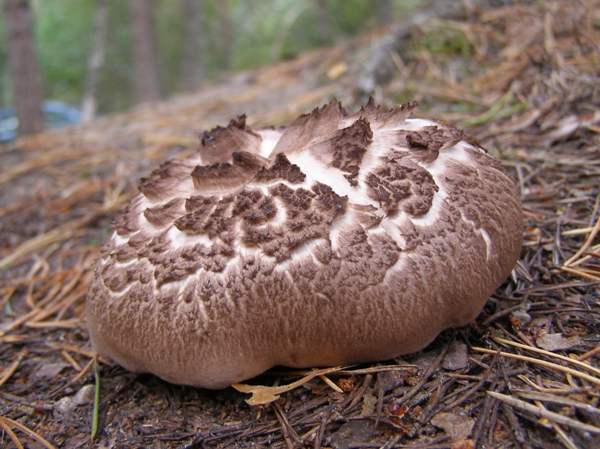
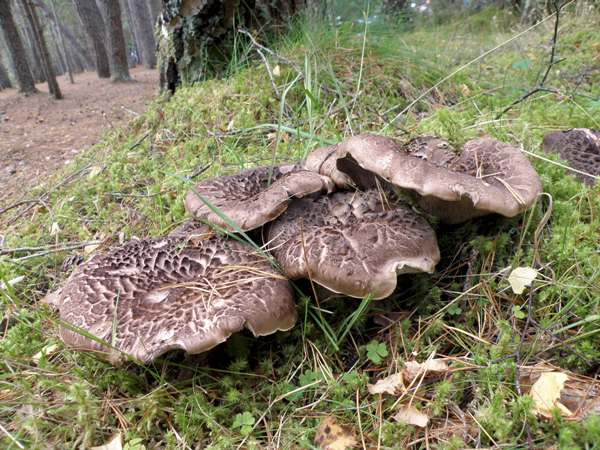
CapA pale brown background covered with dark purple-brown overlapping scales (erect but not recurved), larger near centre; convex then irregularly flattish with an undulating margin, usually developing a shallow central depression; 6 to 18cm across. |
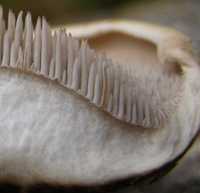 |
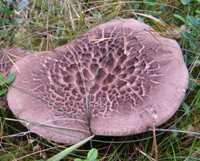
SpinesThe fertile undersurface of the cap of a Sarcodon mushroom is covered with spines 4 to 10mm long, white or pale buff, turning purple-brown with age. Just as with most boletes, the fertile layer of Sarcodon fungi can be separated easily from the rest of the cap flesh, which is said to be edible but rather bitter in taste. StemWhite, becoming brown at maturity; centrally positioned; 4 to 8cm long, 1 to 3cm dia. The stem flesh is white throughout. |
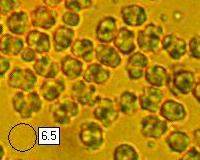 |
SporesIrregularly sperical or sub-globose, 6.5-8 x 5-6µm; ornamented with prominent warts. (The image on the left is of spores from the very closely-related mainland Europe species Sarcodon imbricatus, with which British specimens of Sarcodon squamosus were confused for many years.) Spore printBrown. |
Odour/taste |
Odour not significant; taste slightly bitter. |
Habitat & Ecological role |
Mycorhizal with pines. |
Season |
June to October. |
Occurrence |
Frequent in parts of northern Scotland; rarely seen anywhere else in Britain. |
Similar species |
Sarcodon scabrosus has a steely blue-grey stem base and its cap spines are often noticeably recurved. |
Reference Sources
Fascinated by Fungi, 2nd Edition, Pat O'Reilly 2016, reprinted by Coch-y-bonddu Books in 2022.
Dictionary of the Fungi; Paul M. Kirk, Paul F. Cannon, David W. Minter and J. A. Stalpers; CABI, 2008
Taxonomic history and synonym information on these pages is drawn from many sources but in particular from the British Mycological Society's GB Checklist of Fungi.
Fascinated by Fungi. Back by popular demand, Pat O'Reilly's best-selling 450-page hardback book is available now. The latest second edition was republished with a sparkling new cover design in September 2022 by Coch-y-Bonddu Books. Full details and copies are available from the publisher's online bookshop...