
Strobilomyces strobilaceus (Scop.) Berk. - Old Man of the Woods
Phylum: Basidiomycota - Class: Agaricomycetes - Order: Boletales - Family: Boletaceae
Distribution - Taxonomic History- Etymology - Identification - Culinary Notes - Reference Sources
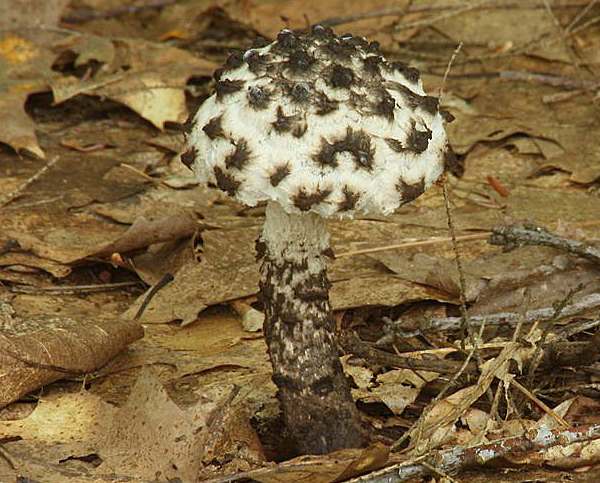
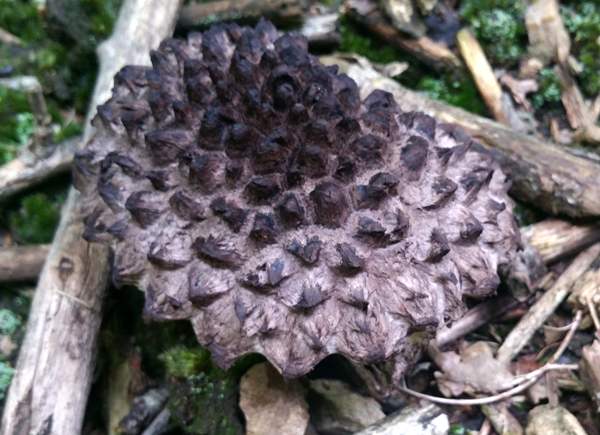
Strobilomyces strobilaceus - Old Man of the Woods - is quite a rare find in the UK, partly no doubt because it is indeed scarce and occurs singly rather than in conspicuous groups and - perhaps more significantly - because this woodland species blends in so well with a background of dead leaves. In fact as the fruitbodies age they sometimes turn very dark and look more like rotting pine cones than fungi.
Distribution
Very rarely seen in the UK, this mushroom is relatively common in many other northern European countries. Strobilomyces strobilaceus also occurs in the USA, Canada and Japan. It is most often found in deciduous woods but does sometimes occur under conifers.
Taxonomic history
This oddball bolete was described in 1770 by Italian mycologist Giovanni Antonio Scopoli, who gave it the binomial scientific name Boletus strobilaceus. It was the British mycologist Miles Joseph Berkeley who in 1851 transferred this species to the genus Strobilomyces (which Berkeley himself had created in that year).
Strobilomyces strobilaceus is the type species of the genus Strobilomyces.
Synonyms of Strobilomyces strobilaceus include Boletus strobilaceus Scop., Boletus strobiliformis Dicks., Boletus floccopus Vahl, Boletus cinereus Pers., Strobilomyces floccopus (Vahl) P. Karst., and Strobilomyces strobiliformis (Vill.) Beck.
Etymology
Strobilomyces comes from an ancient Greek word strobilos, meaning a pine cone, and is a reference to the similarity in appearance between caps boletoid mushrooms in this genus and the cones from pine trees. The specific epithet strobilaceus comes from the same root and is perhaps a rather tautologous reference to the pine-cone-like appearance of this particular species.
Identification guide
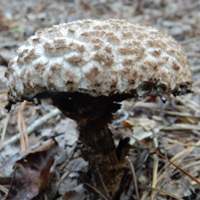 |
CapUsually between 6 and 12cm in diameter but exceptionally approaching 20cm, the convex caps flatten out with age and are covered with upright blackish scales that are woolly when the caps are young, becoming firmer on ageing specimens. The underlying cap colour ranges from almost white through shades of greyish brown to almost entirely black. |
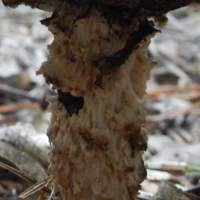 |
Stem1 to 2cm in diameter and typically 8 to 12cm tall, the stem is grey and covered with woolly scales. |
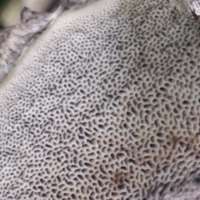
Tubes and poresThe tubes have large pores that are pale grey at first, but when bruised they turn black. |
|
SporesEllipsoidal, 9-15 x 8-12μm; ornamented in a fine mesh pattern. Spore printBlack. |
|
Odour/taste |
Not distinctive. |
Habitat & Ecological role |
In deciduous woodland and occasionally under conifers. |
Season |
July to November in Britain and Ireland. |
Similar species |
None reported from the UK, but similar species from the genus Strobilomyces occur in some tropical regions of Africa. |
Culinary Notes
This distinctive bolete is generally considered edible but of very limited culinary value, and in view of its rarity at least in Britain and Ireland it should not be gathered for food.
Reference Sources
Fascinated by Fungi, 2nd Edition, Pat O'Reilly 2016, reprinted by Coch-y-bonddu Books in 2022.
Dictionary of the Fungi; Paul M. Kirk, Paul F. Cannon, David W. Minter and J. A. Stalpers; CABI, 2008
Taxonomic history and synonym information on these pages is drawn from many sources but in particular from the British Mycological Society's GB Checklist of Fungi.
Acknowledgements
This page includes pictures kindly contributed by Rory Costello, Nigel Kent and Harold Seelig.
Fascinated by Fungi. Back by popular demand, Pat O'Reilly's best-selling 450-page hardback book is available now. The latest second edition was republished with a sparkling new cover design in September 2022 by Coch-y-Bonddu Books. Full details and copies are available from the publisher's online bookshop...