
Stropharia coronilla (Bull.) Quél. - Garland Roundhead
Phylum: Basidiomycota - Class: Agaricomycetes - Order: Agaricales - Family: Strophariaceae
Distribution - Taxonomic History - Etymology - Identification - Culinary Notes - Reference Sources
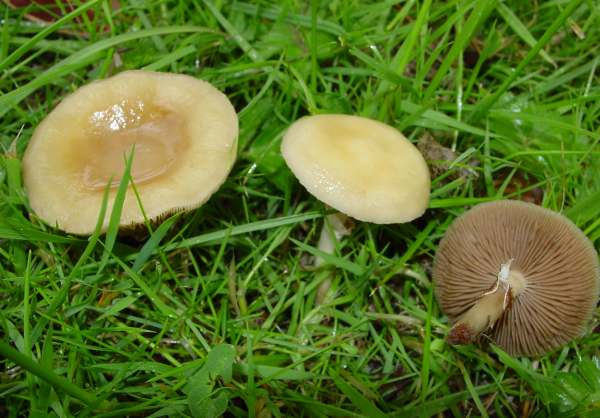
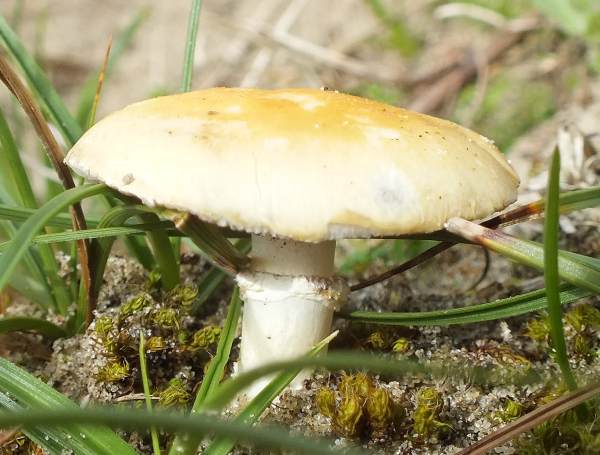
In lowland pastures and on lawns, this occasional roundhead appears sometimes in small groups but more often singly and widely scattered. Bold striations on the upper surface of the stem ring clearly distinguish the Garland Roundhead from other yellow-ochre mushrooms of similar size.
It is not unusual for these chunky mushrooms to be mistaken for small Agaricus species, but they are not reported to be deadly poisonous and so the consequence may not be too bad - see below.
Distribution
In Britain and Ireland the Garland Roundhead is only an occasional find in most areas, but its distribution is far from even and this mushroom can be fairly common in some localities. Found throughout mainland Europe, Stropharia coronilla is also recorded in many other parts of the world including North America.
Taxonomic history
When French botanist Jean Baptiste Francois (Pierre) Bulliard described this mushroom scientifically in 1793, he gave it the binomial name Agaricus coronillus. (Most gilled fungi were initially dumped into a gigantic Agaricus genus, since largely redistributed across several newer genera.) It was another Frenchman, Lucien Quélet, who in 1872 transferred this species into the genus Stropharia, thus establishing the currently accepted scientific name as Stropharia coronilla.
Synonyms of Stropharia coronilla include Agaricus coronillus Bull., Agaricus obturatus Fr., and Stropharia obturata (Fr.) Quél.
Etymology
The genus name Stropharia comes from the Greek word strophos meaning a belt, and it is a reference to the stem rings of fungi in this generic grouping.
Just as it sounds, the specific epithet coronilla means 'with a crown' and refers to the crown-like patterning on the upper surface of the stem ring of the Garland Roundhead.
Identification Guide
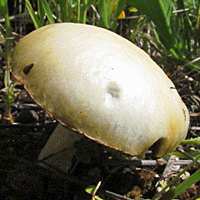 |
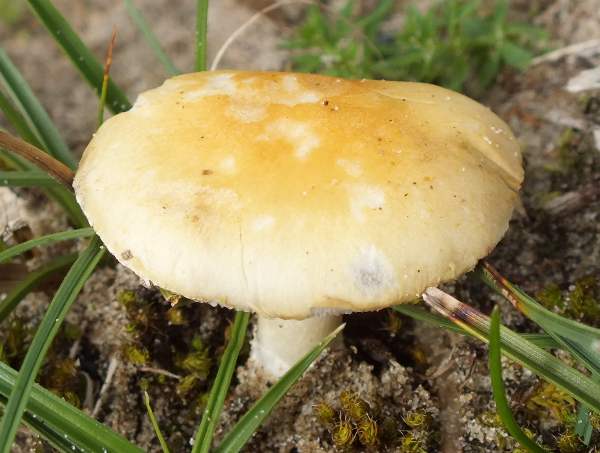
Cap2.5 to 4cm across; initially convex, becoming flat; surface felty or finely scaly; yellow-ochre, often slightly darker towards centre. |
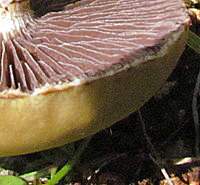 |
GillsAdnate; fairly crowded; pale grey-brown, becoming purple-brown at maturity. |
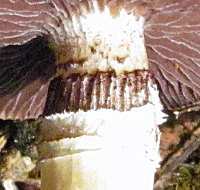 |
Stem2 to 5cm long and 6 to 8mm diameter; white, yellowing with age; smooth at apex, finely fibrillose below ring. A distinguishing feature of the Garland Roundhead is its white persistent ring with a crown-like striate upper surface, from which this species gets its specific epithet. |
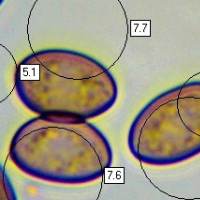 |
SporesEllipsoidal, smooth, 7-9 x 4-6µm. Spores of Stropharia coronilla, enlarged image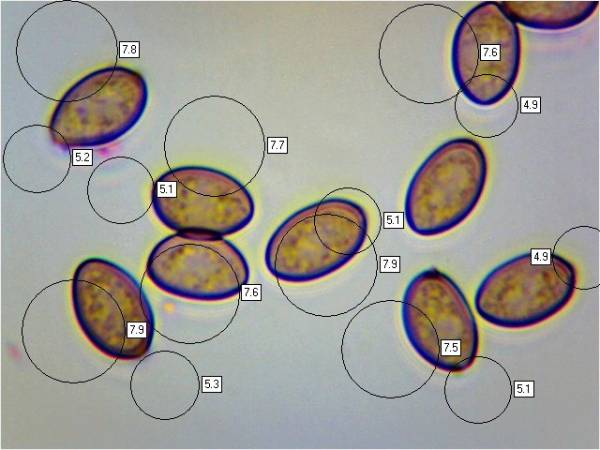 Spore printPurple-brown. |
Odour/taste |
Not distinctive. |
Habitat & Ecological role |
Most Stropharia species occur on rotten wood, well-rotted grass or animal dung, but the Garland Roundhead is one of a select few that grow in grass (albeit usually on nutrient-rich soil) in meadows, parks and gardens. |
Season |
June to November in Britain and Ireland; continuing through to April in Mediterranean countries. |
Similar species |
Panaeolus semiovatus sometimes expands to almost flat; however, it grows on dung and its gills blacken to provide a black spore print. The Garland Roundhead is sometimes misidentified as an Agaricus mushroom; however, it is easily distinguished by the presence of attached (adnate) gills, whereas Agaricus species have free gills. |
Culinary Notes
Stropharia coronilla is widely reported (e.g. in Roger Philips Mushrooms) to be edible but not worthwhile; however, I have also come across reports of poisoning by this species. A report by Michael W. Beug of The Evergreen State College, Olympia WA in the USA reports that '...one to two hours after a meal of Stropharia coronilla, the victim may suffer malaise, headache, vomiting, generalized aching, confusion, loss of coordination, dizziness and hallucinations. The toxic agent is unknown.'
In the light of the above and having found many other sources of conflicting reports, we recommend that Stropharia coronilla should be treated with suspicion and should not be gathered for eating.
Reference Sources
Fascinated by Fungi, 2nd Edition, Pat O'Reilly 2016, reprinted by Coch-y-bonddu Books in 2022.
Noordeloos, M.E. (2011). Strophariaceae s.l. Edizioni Candusso: Alassio, Italy. 648 p.
Thomas, H N; Mitchel, D H; Rumack, B W. Poisoning from the mushroom Stropharia coronilla (Bull. ex Fr.) Quél. J. Arkansas Med. Soc. 73:311-312; 1977.
Dictionary of the Fungi; Paul M. Kirk, Paul F. Cannon, David W. Minter and J. A. Stalpers; CABI, 2008
Taxonomic history and synonym information on these pages is drawn from many sources but in particular from the British Mycological Society's GB Checklist of Fungi.
Acknowledgements
This page includes pictures kindly contributed by Simon Harding.
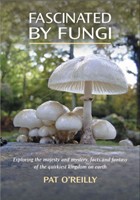
Fascinated by Fungi. Back by popular demand, Pat O'Reilly's best-selling 450-page hardback book is available now. The latest second edition was republished with a sparkling new cover design in September 2022 by Coch-y-Bonddu Books. Full details and copies are available from the publisher's online bookshop...