
Suillus granulatus (L.) Roussel - Weeping Bolete
Phylum: Basidiomycota - Class: Agaricomycetes - Order: Boletales - Family: Suillaceae
Distribution - Taxonomic History - Etymology - Identification - Culinary Notes - Reference Sources
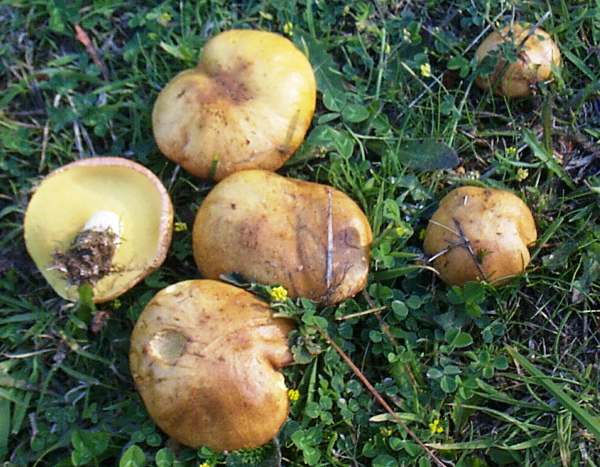
This greasy-capped bolete appears under various kinds of pine trees but most often with two-needle pines, often in quite large and widely scattered groups. The pores of young specimens release milky droplets - hence the common name. Caps of this bolete are sticky, especially in wet weather.
Distribution
Fairly common in Britain and Ireland, the Weeping Bolete is also very common across most of mainland Europe and in parts of North America.
Taxonomic history
When, in 1763, Carl Linnaeus first described this mushroom he named it Boletus granulatus. It was the French physician and naturalist Henri François Anne de Roussel (1748 - 1812) who, in 1796, transferred this mushroom to the Suillus genus. (Suillus is an ancient term for a fungus, and it comes from the same origin as 'swine' - a reference to the greasy nature of pigs and of this group of boletes, perhaps.)
Suillus granulatus has several synonyms including Boletus lactifluus Sowerby, Leccinum lactifluum (Sowerby) Gray, Ixocomus granulatus (L.) Quél., and Suillus lactifluus (Sowerby) A.H. Sm. & Thiers. Among its many common names are Granulated Bolete, Ringless Slippery Jack (an ambiguous term that has also been applied to other Suillus species) and, again ambiguously, Dotted-stem Bolete.
Etymology
The generic name Suillus means of pigs (swine) and is a reference to the greasy nature of the caps of fungi in this genus. The specific epithet granulatus means, as it suggests, granulated. This is a reference to the granular surface of the upper part of the stems of these boletes.
Identification Guide
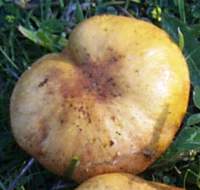 |
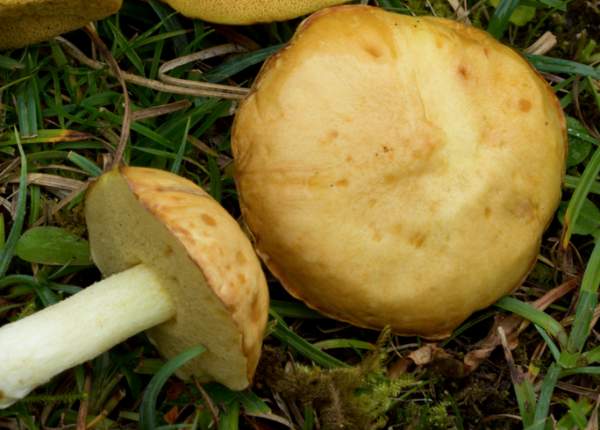
CapCinnamon brown to orange brown the sticky caps of thye Weeping Bolete grow to between 4 and 10cm in diameter and remain convex. The cap flesh is pale yellow and soft; it does not change colour when the cap is cut. |
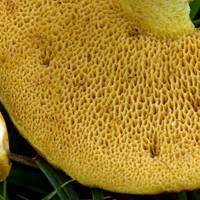 |
Tubes and PoresA characteristic feature of this species is the presence of milky droplets that are exuded by the tiny circular pores. These droplets eventually darken as they dry. The tubes are shallow and lemon yellow, and they terminate in pores of the same colour. |
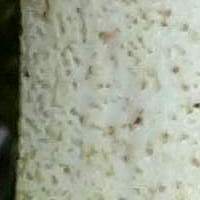 |
Stem surfaceThe stem of this bolete is very pale straw yellow and has no ring or ring zone. Towards the apex of the stem, the surface is granular (from which feature this species gets its common name); the granules, which are formed as milky droplets exuded from the stem flesh, harden as they dry. |
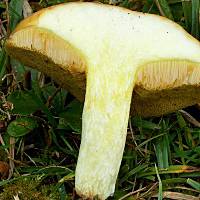 |
Stem fleshLike the cap, when cut the pale yellow stem flesh does no change colour. |
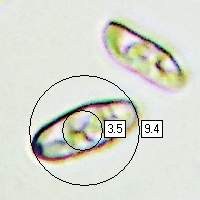 |
SporesSubfusiform, smooth, 8–10 x 2.5–3.5μm Spores of Suillus granulatus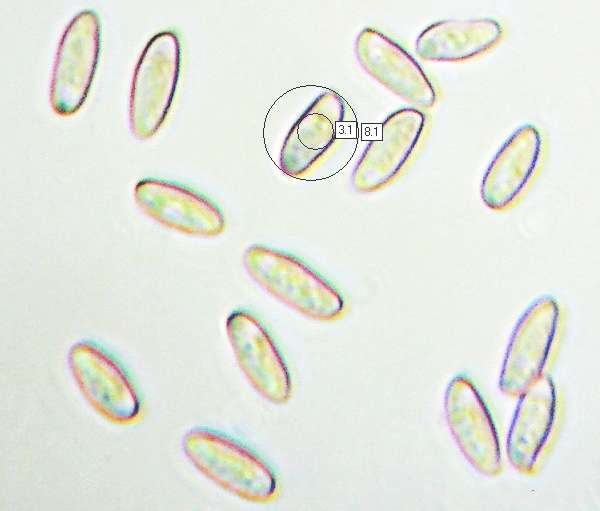 Spore printOchre or sienna-brown. |
Odour/taste |
Not distinctive. |
Habitat & Ecological role |
Suillus granulatus is a mycorrhizal mushroom that appears beneath coniferous trees, and in particular Scots Pine. |
Season |
July to November in Britain and Ireland; rather later in southern Europe.. |
Similar species |
Suillus grevillei has a similar cap, but there is a very distinct ring zone on its stem and its pores are much larger and angular. |
Culinary Notes
Although considered edible, this is not one of the finest of boletes, which is a shame because often it fruits in great numbers. The cap skin and tube layer are usually removed and only the firm cap flesh used for culinary purposes.
Some people find that Suillus fungi cause them stomach upsets, and so if you do decide to gather Weeping Boletes, Larch Boletes, Slippery Jacks or any other kind of Suillus mushrooms it is advisable to peel the caps, remove the tube layer, cook them thoroughly, and even then, as with any kind of edible mushroom that you are trying for the first time, have only very small portions until you are sure that you do not have an adverse reaction. (Personally, I don't collect any Suillus species because so many other superior mushrooms fruit over much the same period.)
Reference Sources
Fascinated by Fungi, 2nd Edition, Pat O'Reilly 2016, reprinted by Coch-y-bonddu Books in 2022.
British Boletes, with keys to species, Geoffrey Kibby (self published) 3rd Edition 2012
Roy Watling & Hills, A.E. 2005. Boletes and their allies (revised and enlarged edition), – in: Henderson, D.M., Orton, P.D. & Watling, R. [eds]. British Fungus Flora. Agarics and boleti. Vol. 1. Royal Botanic Garden, Edinburgh.
BMS List of English Names for Fungi
Dictionary of the Fungi; Paul M. Kirk, Paul F. Cannon, David W. Minter and J. A. Stalpers; CABI, 2008
Taxonomic history and synonym information on these pages is drawn from many sources but in particular from the British Mycological Society's GB Checklist of Fungi.
Acknowledgement
This page includes pictures kindly contributed by David Kelly.
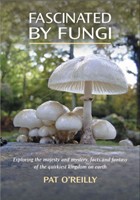
Fascinated by Fungi. Back by popular demand, Pat O'Reilly's best-selling 450-page hardback book is available now. The latest second edition was republished with a sparkling new cover design in September 2022 by Coch-y-Bonddu Books. Full details and copies are available from the publisher's online bookshop...