
Tricholomopsis rutilans (Schaeff.) Singer - Plums and Custard
Phylum: Basidiomycota - Class: Agaricomycetes - Order: Agaricales - Family: Tricholomataceae
Distribution - Taxonomic History - Etymology - Identification - Culinary Notes - Reference Sources
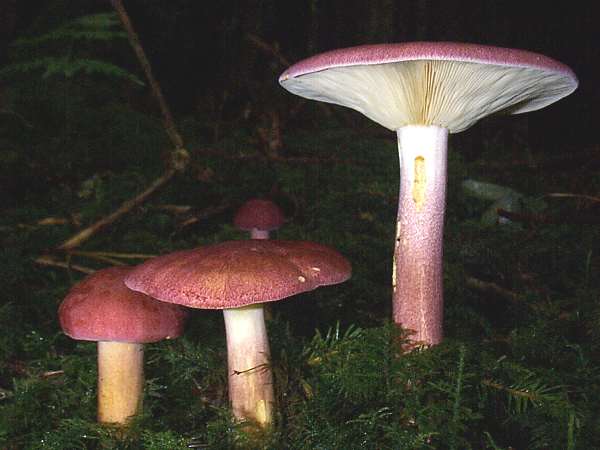
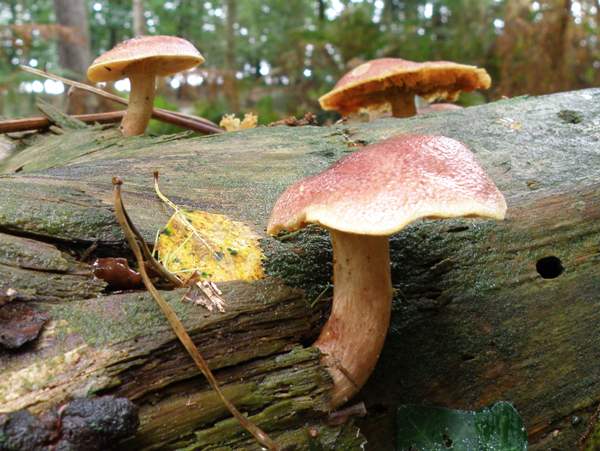
Commonly referred to as Plums and Custard or occasionally as the Strawberry Mushroom, Tricholomopsis rutilans is, nevertheless, a very bitter and inedible fungus. It is always a joy to come across these stately mushrooms, not least because of their habit of colonising buried decaying conifer roots and forming wonderfully photogenic groups.
The bright yellow gills of this mushroom serve as a reminder that gill colour is not a good guide to spore colour; the spores of this species are white.
Distribution
This very beautiful wood-rotting mushroom is found throughout Britain and Ireland as well as in other European countries. Tricholomopsis rutilans is also native to North America, but its occurrence in Australia is thought to be due to its being introduced there.
Taxonomic history
Originally described in 1770 by Jacob Christian Schaeffer and called Agaricus rutilans - most gilled fungi were initially placed in a giant Agaricus genus, now redistributed to many other genera - this species was moved into the new genus Tricholoma by Paul Kummer in 1871. There it remained until 1939, when the famous German-born mycologist Rolf Singer assigned it to its present genus Tricholomopsis (implying that it was very much like a Tricholoma, but not quite close enough!).
Synonyms of Tricholomopsis rutilans include Agaricus rutilans Schaeff., Agaricus xerampelinus Scop., Gymnopus rutilans (Schaeff.) Gray, Tricholoma rutilans (Schaeff.) P. Kumm., and Tricholoma variegatum (Scop.) Sacc.
Etymology
The genus Tricholomopsis, established by Rolf Singer in 1939, lies somewhere between the genera Clitocybe (many of the fungi within which were formerly - Classed as Tricholoma species) and Tricholoma, and the term Tricholomopsis means 'similar to a Tricholoma'. (Tricho- as a prefix refers to hair.) The specific epithet rutilans means becoming red, as indeed the caps of Plums and Custard usually do (although generally with a purplish tinge).
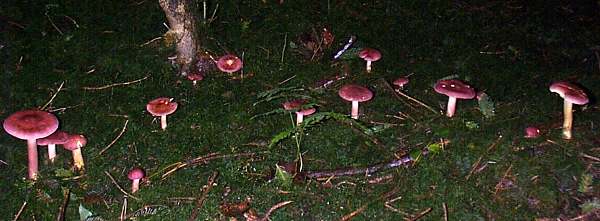
The splendid line of Plums and Custard mushrooms shown above was part of a large fairy ring growing on the floor of a spruce forest where old stumps and trunks had rotted to produce a soft wood-rich humus with a mossy covering to hold in the moisture - ideal habitat for all sorts of saprobic mushrooms!
Identification guide
 |
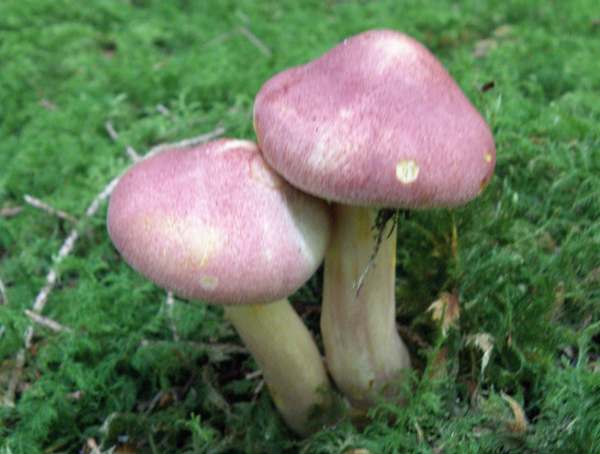
Against a background of moss covering old pine stumps or fallen trunks, these large, colourful mushrooms make a spectacular sight, especially when, as is often the case, they occur in large numbers. In very dry weather the caps sometimes craze into a network of scales, revealing the bright yellow flesh beneath the cuticle. |
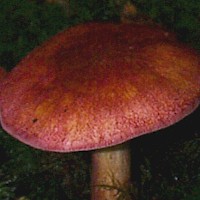 |
Cap4 to 12cm in diameter, the surface of the caps of Tricholomopsis rutilans is bright egg-yolk yellow and covered with radial streaks made up of tiny purple scales. Beneath the cap cuticle, the thin flesh is pale yellow. Convex, sometimes with a shallow central depression, the caps expand and become broadly umbonate or occasionally almost completely flat at maturity. |
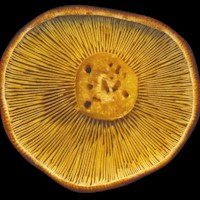 |
GillsAdnate or weakly sinuate, the egg-yolk-yellow gills are broad and crowded. Despite the brightly coloured gills, this mushroom deposits the white spores that are typical of Tricholomas. |
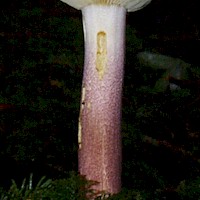 |
Stem1 to 2cm in diameter, the stems range from 4 to 10cm tall and are often curved away from the stump or trunk from which the fruiting body emerges. Pale near the apex, the stems are covered in purple-red scales on a white background. Beneath the stem surface the flesh is pale yellow. |
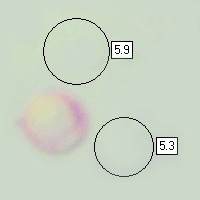 |
SporesEllipsoidal to subglobose, smooth, 5-7 x 3.5-5.5µm. Spores of Tricholomopsis rutilans, Plums and Custard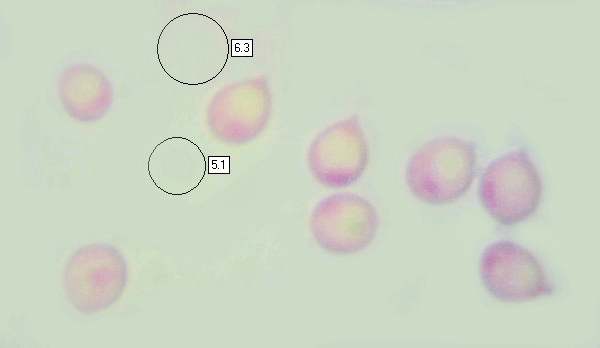 Spore printWhite. |
Odour/taste |
Odour of rotten pinewood; taste not distinctive. |
Habitat & Ecological role |
Saprobic, on conifer stumps, particularly spruce and pine; far less frequently on broad-leaf stumps. |
Season |
July to October in Britain and Ireland. |
Similar species |
The close relative Tricholomopsis decora is yellow or yellow-ochre; it is much less common and in Britain it is largely confined to mountain regions of Scotland, only very occasionally turning up on dead pine wood in the lowlands of England and Wales. |
Culinary Notes
Despite its tempting common name and very attractive appearance, Tricholomopsis rutilans is bitter and inedible.
Reference Sources
Fascinated by Fungi, 2nd Edition, Pat O'Reilly 2016, reprinted by Coch-y-bonddu Books in 2022.
Funga Nordica: 2nd edition 2012. Edited by Knudsen, H. & Vesterholt, J. ISBN 9788798396130
Dictionary of the Fungi; Paul M. Kirk, Paul F. Cannon, David W. Minter and J. A. Stalpers; CABI, 2008
Taxonomic history and synonym information on these pages is drawn from many sources but in particular from the British Mycological Society's GB Checklist of Fungi.
Fascinated by Fungi. Back by popular demand, Pat O'Reilly's best-selling 450-page hardback book is available now. The latest second edition was republished with a sparkling new cover design in September 2022 by Coch-y-Bonddu Books. Full details and copies are available from the publisher's online bookshop...